Around 500 BC Greece was not a country. It was a patchwork of more than a thousand small, independent city-states that shared a language and gods but rarely a government. In the next hundred and sixty years these quarrelsome cities held off the largest empire on earth, tried out democracy in Athens, kept up a strict army state in Sparta, built the Parthenon, staged the first tragedies and comedies, wrote the first histories and asked questions that philosophers still ask. Then they wore each other out in war, and in 338 BC a king from the north, Philip II of Macedon, made himself their master.
Where this chapter fits
The previous chapter looked at Europe around 500 BC: the Greeks in the south-east, the Etruscans and Carthage in the west, Celts and Scythians to the north, and the Persian Empire pressing against the Aegean. This chapter stays with the Greeks, because the century and a half after 500 BC, which historians call the Classical period, left Europe more ideas and words than any other time of the same length: politics, democracy, tyranny, history, theatre, philosophy. Most of what we know about it comes from Athens, the city that wrote the most and whose books survived. That is worth keeping in mind. Athens was one city among many, and an unusual one.
A land of city-states
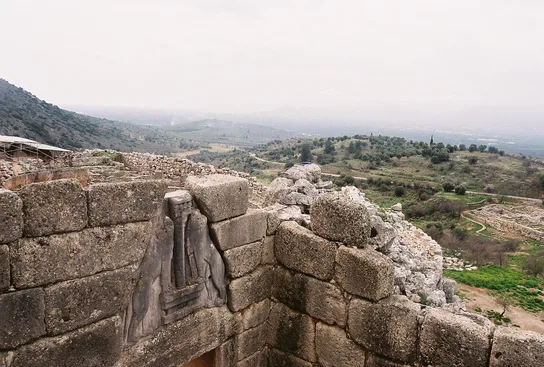
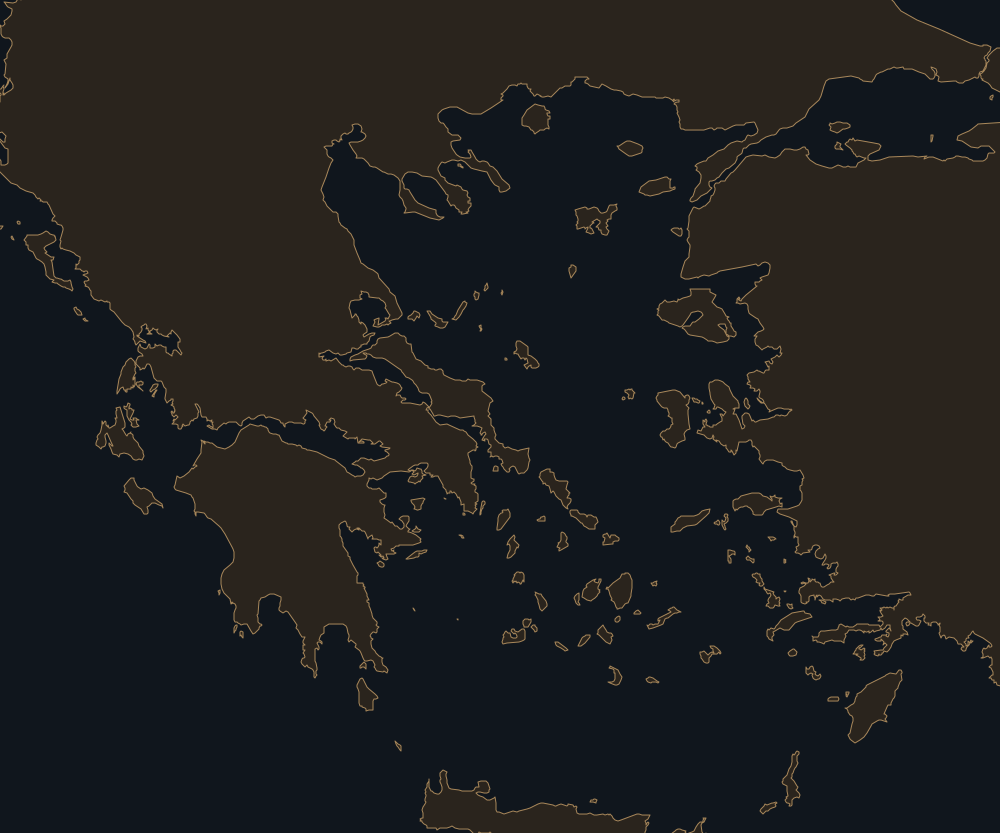
Look at a relief map of Greece and the reason for its politics jumps out. The country is mostly mountains, cut into small plains and valleys, with the sea never more than a day’s walk away. Each plain held its own community, and each community wanted to run itself. The Greek word for such a community was polis, usually translated “city-state”. A polis was a town, often built around a fortified hill (the acropolis, “high city”) and a market square (the agora), together with the farmland and villages around it. It had its own laws, its own officials, its own army of citizen soldiers, its own calendar and festivals, a patron god or goddess and, from the 6th century BC, often its own coins.
There were a great many of them. Modern scholars at the Copenhagen Polis Centre, working through every ancient text and inscription, listed 1,035 city-states of the Archaic and Classical periods, from Spain to the Black Sea.1M. H. Hansen and T. H. Nielsen (eds), An Inventory of Archaic and Classical Poleis (Oxford, 2004)Modern catalogue of the Copenhagen Polis Centre: 1,035 Greek city-states listed one by oneView on Google Books ↗ Most were tiny, with a few thousand inhabitants and a territory a farmer could cross in a morning. Athens, which controlled the whole of Attica (about 2,500 square kilometres), and Sparta, which ruled more than 8,000, were giants by comparison.
The Greeks did not call themselves Greeks; that is the Roman name. They called themselves Hellenes, and they knew what joined them. In 479 BC, Herodotus says, the Athenians told a Spartan embassy that they would never side with Persia, because of “the kinship of all Greeks in blood and speech, and the shrines of gods and the sacrifices that we have in common, and the likeness of our way of life”.2Herodotus, Histories 8.144.2Written c. 430 BC, one to three generations after the Persian Wars, from informants. Translation by A. D. GodleyRead on Perseus ↗ Everyone else was a barbaros, a “barbarian”: at first simply someone whose speech sounded like “bar-bar”, a foreigner, including the Persians and the Egyptians, whom the Greeks admired. Only later did the word take on the meaning of “uncivilised”.
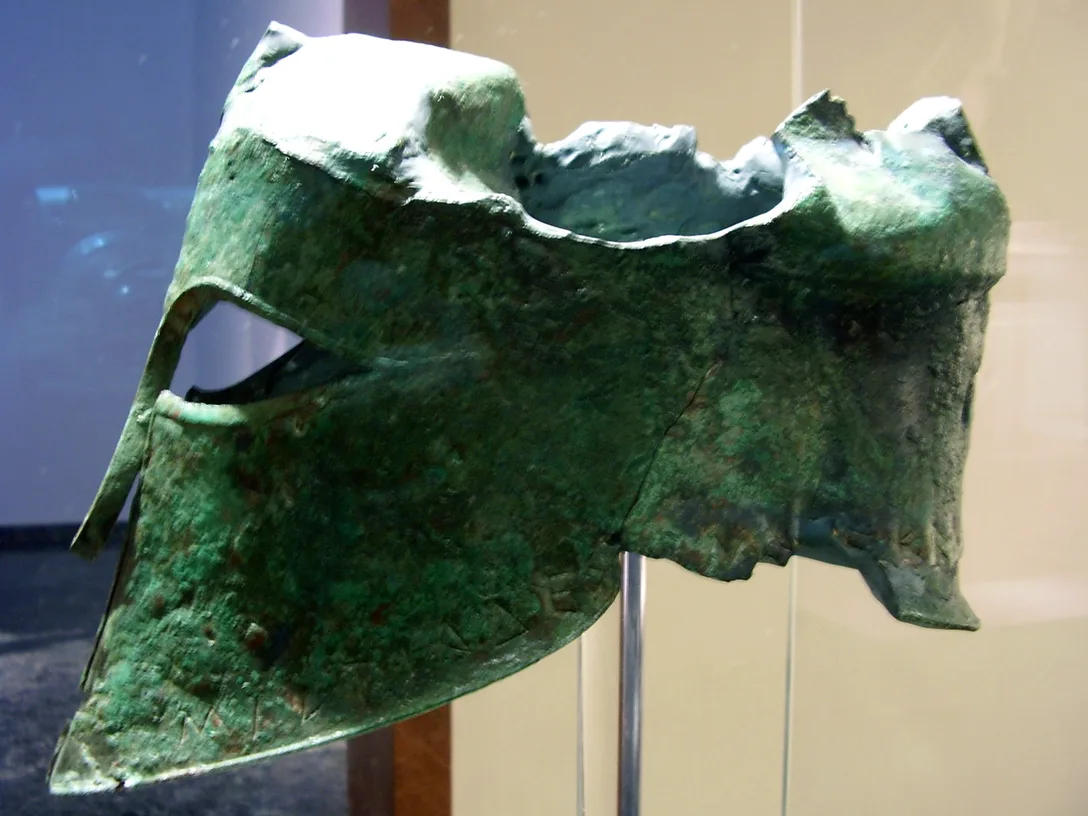
Shared language and gods did not make the Greeks one people politically. City-states fought their neighbours over border land almost every generation, and inside many cities rich and poor fought each other. The men who fought were the citizens themselves. From the 7th century BC the main fighting force was the hoplite phalanx: a block of heavy infantrymen, each with a bronze helmet, a large round shield and a spear, standing shoulder to shoulder, eight or more ranks deep. A hoplite paid for his own armour, so the hoplites were the farmers and craftsmen of middling wealth, and a city that relied on them had to give them a say in its affairs. That link between fighting for the city and having a voice in it runs through the whole of this chapter.
Colonies, trade and the first coins
Small plains feed only so many people. From about 750 to 550 BC many Greek cities sent groups of settlers overseas to found new cities, usually on the coast. The Greek word for such a settlement was apoikia, “a home away”; we call it a colony, though it was not ruled from the mother city. It was a new, independent polis that kept its founders’ gods, dialect and customs. Thucydides, writing in the late 5th century from local traditions, says that Syracuse in Sicily “was founded the year afterwards by Archias, one of the Heraclids from Corinth”, a year after the first Greek colony on the island; the traditional date is 733 BC.3Thucydides, History of the Peloponnesian War 6.3.2Written c. 431–400 BC by an Athenian general who lived through the war. Translation by R. CrawleyRead on Project Gutenberg ↗ Greeks from Phocaea in Ionia, whom Herodotus calls “the earliest of the Greeks to make long sea-voyages”, founded Massalia, today’s Marseille, around 600 BC.4Herodotus, Histories 1.163.1Written c. 430 BC, one to three generations after the Persian Wars, from informants. Translation by A. D. GodleyRead on Perseus ↗ Megara founded Byzantium on the Bosporus, the future Constantinople and Istanbul; Miletus planted a ring of cities around the Black Sea; settlers from the island of Thera founded Cyrene in Libya.
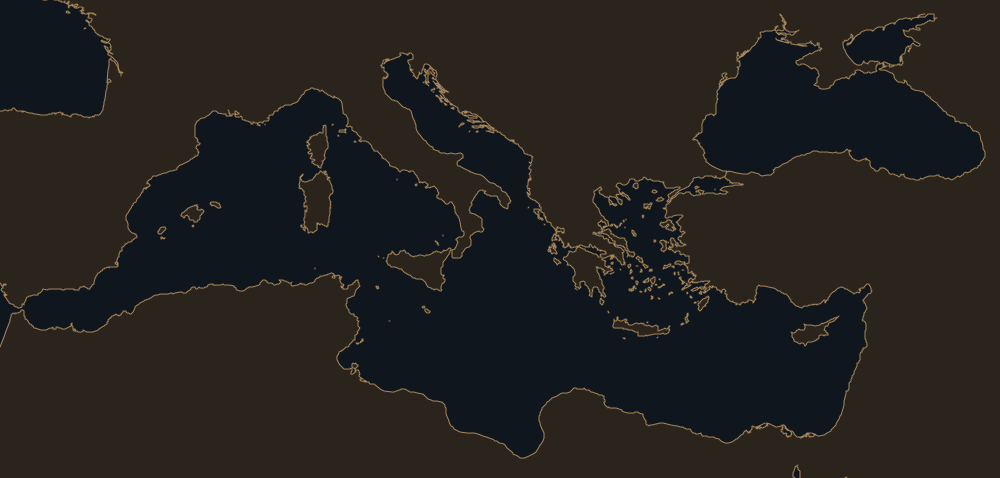
Ships carried olive oil, wine and the painted pottery of Corinth and Athens outward, and brought back what the rocky homeland lacked: grain from Sicily, Egypt and the Black Sea, timber for ships, metals, and slaves. Some cities, Athens above all, came to depend on imported grain. By 500 BC there were Greek cities along the coasts of Sicily and southern Italy (the Romans later called that region Magna Graecia, Great Greece), the south of France and Spain, Libya and the Black Sea. In the 4th century Plato has Socrates say that the Greeks lived around the sea like ants or frogs around a pond. They had spread the polis, its gods and its alphabet across the Mediterranean.
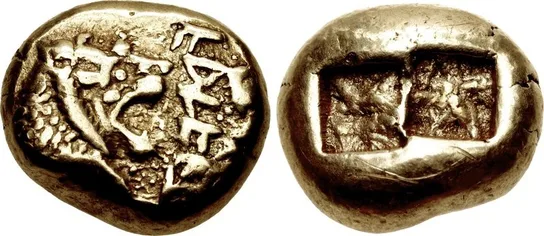
Trade was helped by a new invention. Herodotus says of the Lydians, the kingdom in western Asia Minor next to the Ionian Greeks, that “they were the first men whom we know who coined and used gold and silver currency”.5Herodotus, Histories 1.94.1Written c. 430 BC, one to three generations after the Persian Wars, from informants. Translation by A. D. GodleyRead on Perseus ↗ Archaeology agrees: the oldest known coins, small lumps of electrum (a natural mix of gold and silver) stamped with a lion’s head, come from Lydia and Ionia in the late 7th century BC. Greek cities soon struck their own silver coins: Aegina with a turtle, Corinth with the winged horse Pegasus, Athens, from the late 6th century, with the head of Athena and her owl. A coin was a piece of metal of guaranteed weight and purity, stamped by a city that stood behind it. It made paying soldiers, taxes and traders much easier.
Sparta and the helots
The two strongest Greek cities went in opposite directions. Sparta, in the valley of the river Eurotas in the south of the Peloponnese, had conquered its neighbours in Laconia and then, in the 8th and 7th centuries BC, the fertile land of Messenia on the other side of the Taygetus mountains. The poet Tyrtaeus, who lived through the second Messenian war in the 7th century, describes the defeated Messenians as working the land and bringing their masters half of every harvest. They became helots: unfree farmers who belonged to the Spartan state, tied to the land and handed over to Spartan families to work their estates. Thucydides explains that “most of the Helots were the descendants of the old Messenians that were enslaved in the famous war”.6Thucydides, History of the Peloponnesian War 1.101.2Written c. 431–400 BC by an Athenian general who lived through the war. Translation by R. CrawleyRead on Project Gutenberg ↗ Between the Spartans and the helots lived the perioikoi, “dwellers around”: free men in their own towns who fought in Sparta’s army but had no say in its government.
The helots far outnumbered their masters. Herodotus says that when Sparta sent five thousand Spartans to Plataea in 479 BC, “seven helots were appointed to attend each of them”.7Herodotus, Histories 9.10.1Written c. 430 BC, one to three generations after the Persian Wars, from informants. Translation by A. D. GodleyRead on Perseus ↗ Modern historians think that ratio is exaggerated, or at least special to that campaign, but agree that the helots were several times as many as the Spartan citizens, whose number kept falling: about eight thousand men in 480 BC according to Herodotus, and perhaps a thousand or so by the 4th century.8P. Cartledge, Sparta and Lakonia: A Regional History 1300–362 BC (2nd ed., London, 2002)Modern history of Sparta and its helotsView on Google Books ↗ Sparta lived in permanent fear of a helot rising. In about 464 BC, after a great earthquake, the Messenian helots did rise, and held out on Mount Ithome for years.
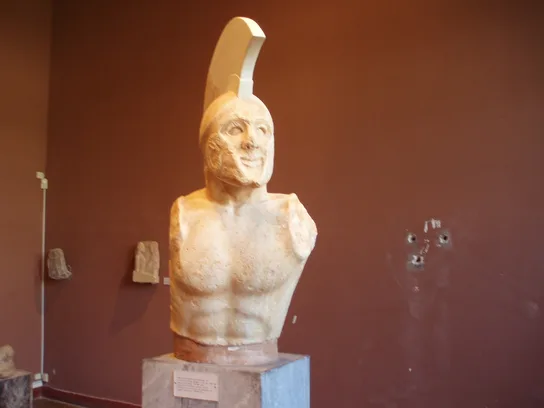
To hold down the helots, Sparta turned itself into an army camp. A citizen, a Spartiate, did no farming or trade; the helots fed him, and his whole life was training for war. Plutarch, writing around AD 100 from older books, says that “as soon as they were seven years old” boys were taken from their families and “enrolled in certain companies and classes, where they all lived under the same order and discipline”.9Plutarch, Lycurgus 16Written c. AD 100, five to six centuries after the events, from older books. Translation by J. Dryden, revised by A. H. CloughRead on Project Gutenberg ↗ Grown men ate together in common messes and lived in barracks until they were thirty. Plutarch also reports, on the authority of Aristotle, that the ephors, Sparta’s five annual officials, “so soon as they were entered into their office, used to declare war against” the helots, so that killing one was not murder.10Plutarch, Lycurgus 28Written c. AD 100, five to six centuries after the events, from older books. Translation by J. Dryden, revised by A. H. CloughRead on Project Gutenberg ↗ Much of this picture comes from writers who lived long after the 5th century, and modern historians think some of the details belong to the later, partly revived “ancient” Sparta that Roman tourists came to see.
Sparta’s government was a mixture that impressed many Greek thinkers. It had two kings at the same time, from two royal families, who led the army in war. A council of twenty-eight elders over sixty years old, with the kings, prepared business and judged the most serious cases. The five ephors, elected every year, watched over the kings and ran daily affairs, and an assembly of all Spartiates voted by shouting. Spartan women were also unusual by Greek standards: they exercised outdoors, could inherit and own land, and in the 4th century, Aristotle claimed, they owned about two fifths of Spartan land. With the strongest army in Greece and an alliance of most Peloponnesian cities behind it, the Peloponnesian League, Sparta was the leading power in Greece around 500 BC.
Politics and warAthens from Solon to Cleisthenes
Athens took the other road, but slowly and through crises. Around 600 BC it was ruled by a few noble families. The Athenian Constitution, a history of Athenian government written in Aristotle’s school around 330 BC, describes a city in which “the poorer classes, men, women, and children, were the serfs of the rich”; if they failed to pay their rent “they were liable to be haled into slavery, and their children with them”.12Aristotle (or a pupil), The Athenian Constitution 2Written c. 330 BC: first-hand for the 4th-century democracy, 170–260 years after Solon and Cleisthenes. Translation by F. G. KenyonRead on Project Gutenberg ↗ A farmer who borrowed against his own body and could not pay became the slave of his creditor, or was sold abroad.
In 594 BC, by the traditional date (some historians put his laws twenty years later), the Athenians gave a respected nobleman and poet, Solon, the power to rewrite their laws. His first act became famous as the seisachtheia, the “shaking off of burdens”: Solon “liberated the people once and for all, by prohibiting all loans on the security of the debtor’s person”, and cancelled debts.13Aristotle (or a pupil), The Athenian Constitution 6Written c. 330 BC: first-hand for the 4th-century democracy, 170–260 years after Solon and Cleisthenes. Translation by F. G. KenyonRead on Project Gutenberg ↗ Already in antiquity people disagreed about how far he went; Plutarch notes that the historian Androtion thought “the debts were not canceled, but the interest only lessened”.14Plutarch, Solon 15Written c. AD 100, five to six centuries after the events, from older books. Translation by J. Dryden, revised by A. H. CloughRead on Project Gutenberg ↗ Solon’s own poems, quoted in the Athenian Constitution, boast that he brought home Athenians sold as slaves abroad, exiles “speaking no more the dear Athenian tongue”, and set free those who “crouched ’neath a master’s frown”.15Aristotle (or a pupil), The Athenian Constitution 12Written c. 330 BC: first-hand for the 4th-century democracy, 170–260 years after Solon and Cleisthenes. Translation by F. G. KenyonRead on Project Gutenberg ↗ These poems are the oldest words of an Athenian politician that survive.
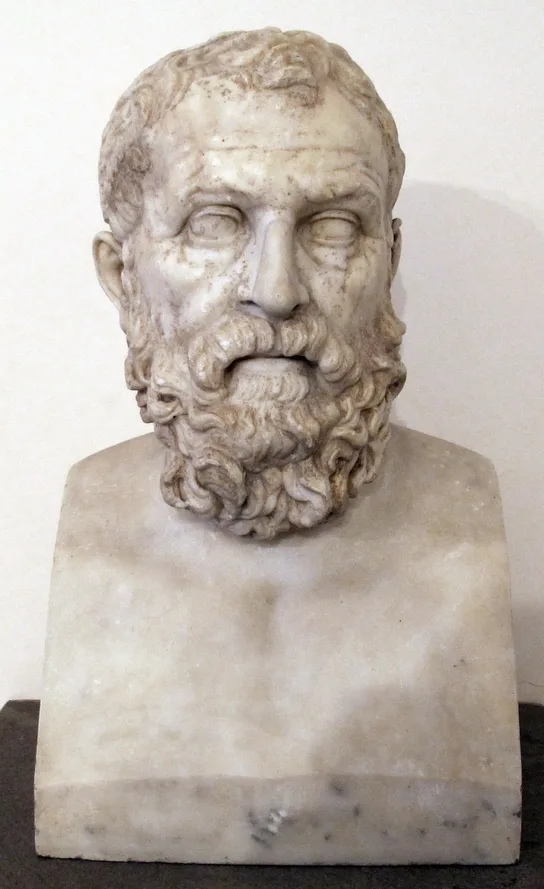
Solon also divided the citizens into four classes by the size of their harvest. The top offices stayed with the two richest classes, but even the poorest, the thetes, could sit in the assembly and in the new law courts. That was not democracy, but it made being an Athenian citizen something a poor man could not lose to debt. Solon’s compromise satisfied nobody for long. Around 561 BC a nobleman, Peisistratus, seized power as tyrannos, a ruler who had taken power outside the normal rules. The Greek word did not yet mean a cruel ruler: Herodotus says that Peisistratus governed “according to its established constitution and arranging all things fairly and well”.16Herodotus, Histories 1.59.6Written c. 430 BC, one to three generations after the Persian Wars, from informants. Translation by A. D. GodleyRead on Perseus ↗ After two false starts he ruled until his death in 527 BC, and his sons Hippias and Hipparchus after him. Hipparchus was murdered in 514, Hippias became harsher, and in 510 BC he was driven out with the help of a Spartan army under King Cleomenes. The family had ruled Athens, Herodotus says, for thirty-six years.
In the struggle that followed, a nobleman of the Alcmaeonid family, Cleisthenes, “was getting the worst of it in this dispute and took the commons into his party”, Herodotus writes.17Herodotus, Histories 5.66.2Written c. 430 BC, one to three generations after the Persian Wars, from informants. Translation by A. D. GodleyRead on Perseus ↗ When his rival Isagoras called in the Spartans again, the people of Athens rose, besieged the Spartans on the Acropolis and sent them home. In 508/507 BC Cleisthenes carried his reforms. He took the villages and town quarters of Attica, the demes, and grouped them into thirty districts: “ten from the districts about the city, ten from the coast, and ten from the interior”. Each of ten new tribes received one district from each region.18Aristotle (or a pupil), The Athenian Constitution 21Written c. 330 BC: first-hand for the 4th-century democracy, 170–260 years after Solon and Cleisthenes. Translation by F. G. KenyonRead on Project Gutenberg ↗ A tribe now mixed townsmen, fishermen and hill farmers, and the old networks of noble families that had controlled each region lost their grip. Every citizen was registered in his deme, and Athenians began to name themselves by it: Pericles of Cholargos, Socrates of Alopeke.
How Athenian democracy worked
Cleisthenes’ system grew over the next century into what the Greeks called dēmokratia: rule (kratos) by the people (dēmos). Pericles, as Thucydides reports his speech in 431 BC, put it simply: “Its administration favours the many instead of the few; this is why it is called a democracy.”19Thucydides, History of the Peloponnesian War 2.37.1Written c. 431–400 BC by an Athenian general who lived through the war. Translation by R. CrawleyRead on Project Gutenberg ↗ It was a direct democracy, not a representative one. Citizens did not elect a parliament; they came and voted themselves. Most of the details we know come from the Athenian Constitution, which describes the system as it worked around 330 BC.
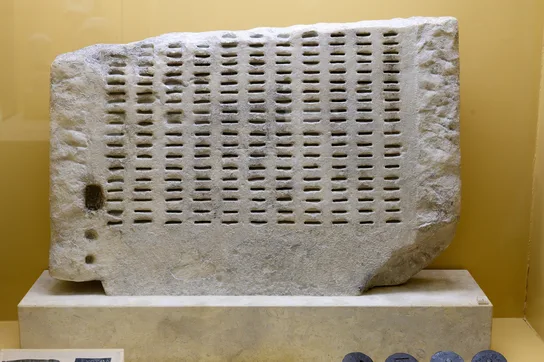
Two features stand out. The first is the lot. Athenians thought elections favoured the rich and famous, so most offices were filled by drawing names, and a farmer could find himself running the city’s finances for a year. The juries were picked with an allotment machine, the kleroterion: each juror slotted his bronze name ticket into a column of the stone, and black and white markers let down a tube decided which rows served that day. The process is described step by step in the Athenian Constitution, which explains that “the juries for the law-courts are chosen by lot by the nine Archons, each for their own tribe”.20Aristotle (or a pupil), The Athenian Constitution 63Written c. 330 BC: first-hand for the 4th-century democracy, 170–260 years after Solon and Cleisthenes. Translation by F. G. KenyonRead on Project Gutenberg ↗ Only offices that needed skill, above all command of the army and fleet, were elected.
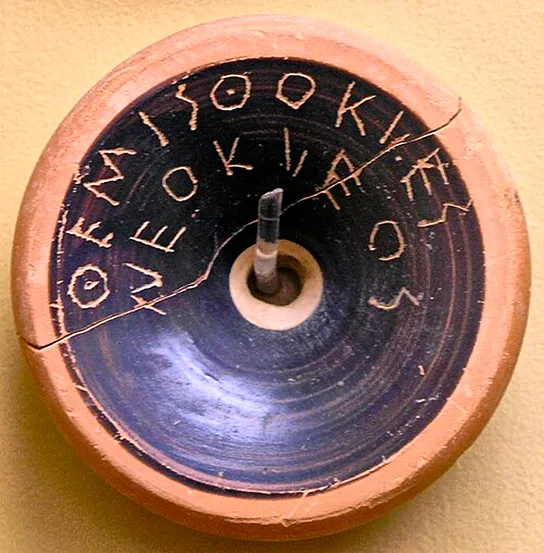
The second is ostracism, the strangest of Cleisthenes’ laws. Every year the assembly decided whether to hold one. If it did, each citizen scratched a name on an ostrakon, a broken piece of pottery, and the man with the most votes, provided at least six thousand were cast, went into exile for ten years. It was not a punishment for a crime but a safety valve against anyone who seemed to be growing too powerful, and it was first used in 487 BC. Plutarch tells a story about Aristides, nicknamed “the Just”: an illiterate farmer who did not recognise him asked him to write “Aristides” on his sherd, because he was “tired of hearing him everywhere called the Just”. Aristides wrote his own name.21Plutarch, Aristides 7Written c. AD 100, five to six centuries after the events, from older books. Translation by J. Dryden, revised by A. H. CloughRead on Project Gutenberg ↗ Thousands of ostraka have been found in Athens, some written by the same hand, which suggests that groups prepared them in advance.
Who was “the people”? Only adult men whose fathers were Athenian citizens, and after a law proposed by Pericles in 451 BC, men whose mother and father were both of citizen birth. Herodotus speaks of “thirty thousand Athenians” around 499 BC.22Herodotus, Histories 5.97.2Written c. 430 BC, one to three generations after the Persian Wars, from informants. Translation by A. D. GodleyRead on Perseus ↗ Modern historians estimate that the citizen body grew fast in the following decades, to somewhere between 40,000 and 60,000 men by 431 BC, out of a total population of Attica of perhaps 250,000 or more.23M. H. Hansen, The Athenian Democracy in the Age of Demosthenes (Oxford, 1991)Modern study of how the democracy worked; estimates about 60,000 adult male citizens in 431 BCFind in a library (WorldCat) ↗24B. Akrigg, Population and Economy in Classical Athens (Cambridge, 2019)Modern study of how many people lived in Attica; argues the citizen body roughly doubled between the 470s and 431 BCView on Google Books ↗ Herodotus himself thought the new system had made Athens strong: “So the Athenians grew in power and proved, not in one respect only but in all, that equality is a good thing.”25Herodotus, Histories 5.78.1Written c. 430 BC, one to three generations after the Persian Wars, from informants. Translation by A. D. GodleyRead on Perseus ↗ Under tyrants, he explains, they had been no better soldiers than their neighbours; once free, they were the best of all.
The Persian Wars in brief, 499–479 BC
The young democracy was soon tested. The Greek cities of Ionia, on the west coast of today’s Turkey, had been ruled by the Persian Empire since the 540s BC. In 499 BC they rebelled, and Athens sent twenty ships to help. The rebels burned Sardis, the Persian regional capital, before the revolt was crushed at the sea battle of Lade in 494 and Miletus was sacked (chapter 1 and chapter 2 of our Persian Wars story). Herodotus says that King Darius ordered a servant to say to him three times at every dinner, “Master, remember the Athenians.”26Herodotus, Histories 5.105.2Written c. 430 BC, one to three generations after the Persian Wars, from informants. Translation by A. D. GodleyRead on Perseus ↗
In 490 BC a Persian fleet crossed the Aegean, burned Eretria and landed at Marathon, a day’s march from Athens. The Athenians and a small force from Plataea, perhaps ten thousand men in all, charged the Persian army at a run and drove it back to its ships. Herodotus counted about 6,400 Persian dead “and one hundred and ninety-two Athenians”, a figure probably taken from the casualty list (Marathon).27Herodotus, Histories 6.117.1Written c. 430 BC, one to three generations after the Persian Wars, from informants. Translation by A. D. GodleyRead on Perseus ↗ Ten years later Darius’ son Xerxes came himself, with the largest army the Greeks had ever seen. Herodotus gives it more than five million men; modern historians reject that figure and estimate the army at somewhere between about 100,000 and 300,000 soldiers, with a fleet of perhaps 600 to 1,200 ships.28J. F. Lazenby, The Defence of Greece 490–479 BC (1993)Modern military history of the Persian WarsView on Google Books ↗29P. Green, The Greco-Persian Wars (1996)Modern history of the Persian WarsView on Google Books ↗ About thirty Greek cities, led by Sparta, swore to fight together (Seventy out of seven hundred); many others, including Thebes, submitted.
In August 480 BC King Leonidas of Sparta, with about seven thousand men among them three hundred Spartans, held the pass of Thermopylae for two days until the Persians found a mountain path around it; Leonidas and most of those who stayed with him were killed. The Persians burned Athens, which its people had abandoned. In September the Greek fleet, more than half of it Athenian, trapped and rammed the Persian ships in the narrow strait of Salamis, while Xerxes watched from the shore. In 479 the Greek army under the Spartan regent Pausanias destroyed the remaining Persian army at Plataea, and the Greek fleet burned the Persian camp at Mycale in Ionia (Plataea and Mycale).
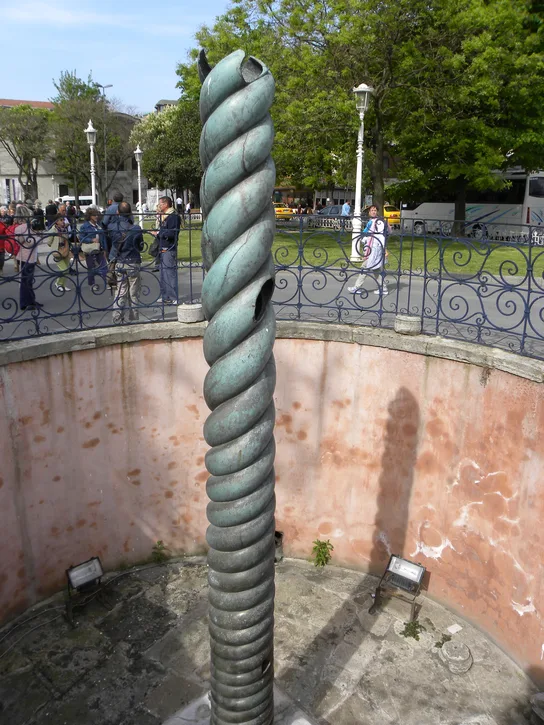
The victory changed how the Greeks saw themselves. They gave thanks at Delphi with a bronze column of three twisted snakes carrying the names of the thirty-one cities that had fought; the column still stands, damaged, in Istanbul. Aeschylus, who had fought at Marathon, staged his play The Persians in 472 BC, and the war of free Greeks against an Asian king became a founding story. For Persia the defeat was serious but not fatal. Its kings never mentioned it in their inscriptions, it kept its empire from Egypt to India, and within a century Persian gold would be deciding wars between Greek cities. How the Persians saw these wars is told in the Persian perspective sections of our Persian Wars story.
Silver, slaves and the fleet
Athens could fight at Salamis because of a lucky strike underground. Around 483 BC a rich new seam of silver was found at the mines of Laurion, in the hills of southern Attica. The Athenians planned to share out the money, ten drachmas for every citizen. Themistocles, the leading politician of the day, persuaded them instead “to use the money to build two hundred ships for the war, that is, for the war with Aegina”, the island rival a few miles off the coast.30Herodotus, Histories 7.144.1Written c. 430 BC, one to three generations after the Persian Wars, from informants. Translation by A. D. GodleyRead on Perseus ↗ The Athenian Constitution gives a smaller figure, a hundred talents and a hundred ships; whichever is right, when Xerxes came, Athens had the largest fleet in Greece.
The silver was dug by slaves. Underground galleries at Laurion run for kilometres, some less than a metre high, and the miners worked by oil lamp. In the 5th century the Athenian general Nicias owned a thousand slaves whom he hired out to mine contractors, according to Xenophon. The mines paid for Athens’ fleet, and later for its coins, the “owls”, which became the most trusted money in the eastern Mediterranean.

The ships were triremes: long, narrow galleys with a bronze ram at the bow, rowed by about 170 men sitting in three levels. A trireme was a weapon, not a cargo ship; it won by speed and by ramming. The rowers did not need armour, only strong arms and training, so they came from the poorest citizens, the thetes, with metics and hired foreigners. Ancient writers saw a direct link between the fleet and the democracy. The Athenian Constitution says that after the Persian Wars the city “turned the policy of the state in the direction of sea power, which caused the masses to acquire confidence in themselves and consequently to take the conduct of affairs more and more into their own hands”.31Aristotle (or a pupil), The Athenian Constitution 27Written c. 330 BC: first-hand for the 4th-century democracy, 170–260 years after Solon and Cleisthenes. Translation by F. G. KenyonRead on Project Gutenberg ↗ The hoplite farmer had earned his vote with his shield; the poor man now earned his with his oar.
Politics and warFrom alliance to empire
After 479 BC the war against Persia went on at sea, to free the Greek cities of the islands and Asia Minor. The allies soon tired of the arrogant Spartan commander Pausanias, and Sparta, never keen on campaigns far from home, pulled out. In the winter of 478/477 BC Athens and many island and coastal cities swore an alliance with its meeting place and treasury on the sacred island of Delos, the birthplace of Apollo; modern historians call it the Delian League. Each member gave ships or money. Thucydides writes: “The tribute was first fixed at four hundred and sixty talents. The common treasury was at Delos, and the congresses were held in the temple.”32Thucydides, History of the Peloponnesian War 1.96.2Written c. 431–400 BC by an Athenian general who lived through the war. Translation by R. CrawleyRead on Project Gutenberg ↗ A talent was 6,000 drachmas, and a drachma about a day’s wage for a skilled worker, so this was an enormous sum.
Membership turned out to be for ever. Around 470 BC the island of Naxos tried to leave and was forced back after a siege: “this was the first instance of the engagement being broken by the subjugation of an allied city”, Thucydides says, and others followed.33Thucydides, History of the Peloponnesian War 1.98.4Written c. 431–400 BC by an Athenian general who lived through the war. Translation by R. CrawleyRead on Project Gutenberg ↗ More and more members paid money instead of building ships, which made Athens’ fleet stronger and theirs weaker. In 454 BC the treasury was moved from Delos to Athens, and from that year the Athenians carved on stone the sixtieth part of each city’s tribute that went to Athena. Those inscriptions, the Athenian Tribute Lists, survive in fragments and show well over a hundred and fifty cities paying in a typical year. By the 440s Athenians themselves spoke of their archē, their rule. The Delian League had become an Athenian empire (The Delian League).

The empire paid for the democracy. The Athenian Constitution claims that out of the tribute, taxes and allied contributions “more than twenty thousand persons were maintained”: six thousand jurors, the archers and cavalry, the Council, guards and some seven hundred officials at home and as many abroad.34Aristotle (or a pupil), The Athenian Constitution 24Written c. 330 BC: first-hand for the 4th-century democracy, 170–260 years after Solon and Cleisthenes. Translation by F. G. KenyonRead on Project Gutenberg ↗ Athenian democracy at home and Athenian power over other Greeks were two sides of the same coin, a point that critics of Athens made at the time.
Pericles and the Parthenon
The leading man of this Athens was Pericles (c. 495–429 BC), from one of the oldest noble families; his mother was a niece of Cleisthenes. He was a cool, gifted speaker and was elected general every year from 443 BC until his death. The Athenian Constitution says he was “the first to institute pay for service in the law-courts, as a bid for popular favour”, and he proposed the citizenship law of 451.35Aristotle (or a pupil), The Athenian Constitution 27Written c. 330 BC: first-hand for the 4th-century democracy, 170–260 years after Solon and Cleisthenes. Translation by F. G. KenyonRead on Project Gutenberg ↗ Thucydides, who knew him, judged that Athens under Pericles was a democracy only on the surface: “what was nominally a democracy became in his hands government by the first citizen.”36Thucydides, History of the Peloponnesian War 2.65.9Written c. 431–400 BC by an Athenian general who lived through the war. Translation by R. CrawleyRead on Project Gutenberg ↗


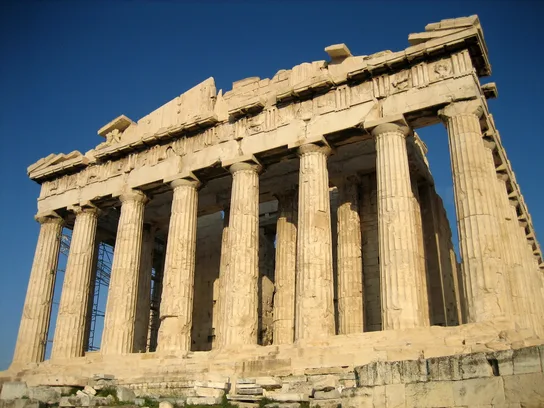
Pericles used the league’s money to rebuild the temples the Persians had burned in 480, which had been left in ruins for a generation. The Parthenon, the temple of Athena the Maiden (Parthenos), was built between 447 and 432 BC; Plutarch says that “Callicrates and Ictinus built the Parthenon” and that the sculptor Phidias “had the oversight of all the works”.37Plutarch, Pericles 13Written c. AD 100, five to six centuries after the events, from older books. Translation by J. Dryden, revised by A. H. CloughRead on Project Gutenberg ↗ Inside stood Phidias’ statue of Athena in gold and ivory; Thucydides reports that its gold alone weighed forty talents and could be removed in an emergency. Not everyone approved. Plutarch, five centuries later, tells of opponents who said that Athens was gilding and adorning herself “as it were some vain woman, hung round with precious stones and figures and temples” with money the allies had paid for defence. Pericles answered that the allies were owed protection, not accounts.38Plutarch, Pericles 12Written c. AD 100, five to six centuries after the events, from older books. Translation by J. Dryden, revised by A. H. CloughRead on Project Gutenberg ↗
In the speech Thucydides gives him over the first war dead of 431 BC, the Funeral Oration, Pericles praised Athens as an open, free and confident city, and summed it up: “as a city we are the school of Hellas”.39Thucydides, History of the Peloponnesian War 2.41.1Written c. 431–400 BC by an Athenian general who lived through the war. Translation by R. CrawleyRead on Project Gutenberg ↗ The words are Thucydides’ version, not a recording, but they express how Athenians liked to see their city, and the speech has been quoted by politicians ever since.
Society and cultureWho belonged? Women, metics and slaves
Most people in Attica had no vote. Citizen women were citizens in the sense that their sons could be citizens, but they could not vote, hold office or own much property in their own name. Every woman had a kyrios, a male guardian: her father, then her husband. Respectable women of well-off families were expected to stay largely at home, and the ideal was silence. In the Funeral Oration, Pericles has only one sentence for the war widows: “greatest will be hers who is least talked of among the men, whether for good or for bad.”40Thucydides, History of the Peloponnesian War 2.45.2Written c. 431–400 BC by an Athenian general who lived through the war. Translation by R. CrawleyRead on Project Gutenberg ↗ Real life was more varied. Poorer women sold goods in the market, worked as wool-workers and nurses, and helped in the fields. Women had their own festivals, and the priestess of Athena Polias was one of the most respected people in the city.
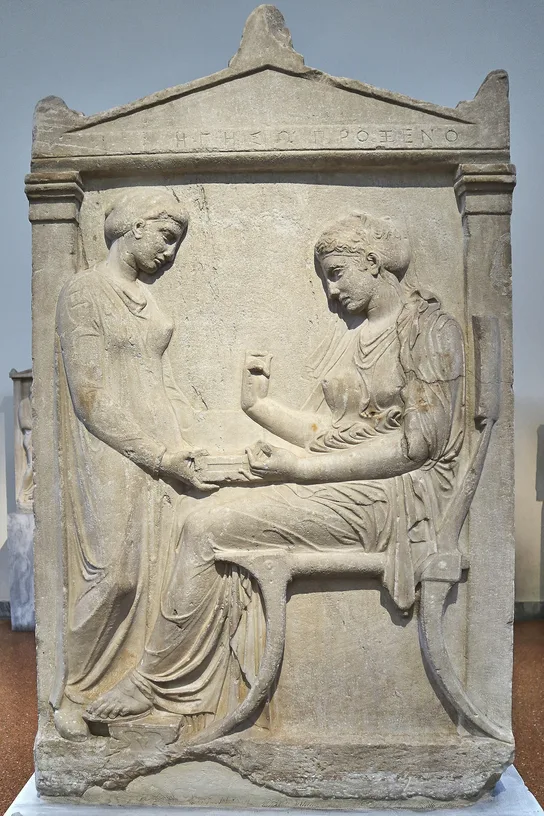
Free foreigners who settled in Athens were called metics, “those who live with”. Many were Greeks from other cities, others Phoenicians, Thracians or Lydians. They paid a special tax, served in the army and fleet and paid for festivals, but they could not vote or own land or a house in Attica, and after 451 BC their children with a citizen could not be citizens. Many metics grew rich as traders, bankers and craftsmen. Some of the most famous “Athenians” were metics: the philosopher Aristotle, the speechwriter Lysias, the shield-factory owner Cephalus, at whose family home in the Piraeus Plato set his Republic.
And there were slaves, bought and sold as property, often prisoners of war or people from Thrace, the Black Sea or Asia Minor. They worked in households, in workshops, on farms, as public servants (Athens’ police were Scythian archers owned by the city) and, in the worst conditions, in the silver mines. When the Spartans fortified Decelea in Attica in 413 BC, Thucydides says, “more than twenty thousand slaves had deserted, a great part of them artisans”.41Thucydides, History of the Peloponnesian War 7.27.5Written c. 431–400 BC by an Athenian general who lived through the war. Translation by R. CrawleyRead on Project Gutenberg ↗ How many slaves there were in total is one of the most disputed numbers in ancient history. No census survives; modern estimates run from about 20,000 to more than 100,000. Hardly any Greek writer questioned slavery itself. Aristotle, in his Politics, even argued that some people were slaves by nature.
The Peloponnesian War, 431–404 BC
Two great powers now faced each other: Athens with its empire and fleet, and Sparta with its alliance and army. After a first war in the 450s and a thirty-year peace made in 446, quarrels over Corinth’s colony Corcyra (Corfu), the city of Potidaea in the north and an Athenian trade ban on Megara brought them to war again in 431 BC. Thucydides, an Athenian who began writing as soon as the war broke out, looked behind these quarrels: “The growth of the power of Athens, and the alarm which this inspired in Lacedaemon, made war inevitable.”42Thucydides, History of the Peloponnesian War 1.23.6Written c. 431–400 BC by an Athenian general who lived through the war. Translation by R. CrawleyRead on Project Gutenberg ↗ His explanation is still the starting point of every discussion of the war’s causes, although modern historians give more weight to the immediate quarrels than he did.
Pericles had a plan. Sparta’s army was unbeatable on land, so the Athenians would not fight it. When the Spartans invaded Attica each summer to burn the crops, the country people would move inside the walls of Athens and the Long Walls that joined the city to its port, the Piraeus, six kilometres away. Food would come in by sea, paid for by the empire, while the fleet raided the coasts of the Peloponnese. Thucydides lists the city’s resources in 431: a reserve of silver on the Acropolis, a fleet of three hundred triremes, “an army of thirteen thousand heavy infantry, besides sixteen thousand more in the garrisons and on home duty at Athens”.43Thucydides, History of the Peloponnesian War 2.13.6Written c. 431–400 BC by an Athenian general who lived through the war. Translation by R. CrawleyRead on Project Gutenberg ↗
The plan did not allow for disease. In 430 BC, in the overcrowded city, a plague broke out. Thucydides describes the fever, the sores and the thirst in detail, “as I had the disease myself, and watched its operation in the case of others”.44Thucydides, History of the Peloponnesian War 2.48.3Written c. 431–400 BC by an Athenian general who lived through the war. Translation by R. CrawleyRead on Project Gutenberg ↗ People died untended in the temples and streets, and the fear of death broke down law and custom; this was not, he writes, “the only form of lawless extravagance which owed its origin to the plague”.45Thucydides, History of the Peloponnesian War 2.53.1Written c. 431–400 BC by an Athenian general who lived through the war. Translation by R. CrawleyRead on Project Gutenberg ↗ Over its two outbreaks, by his count, it killed 4,400 hoplites and 300 cavalry, “besides a number of the multitude that was never ascertained”.46Thucydides, History of the Peloponnesian War 3.87.3Written c. 431–400 BC by an Athenian general who lived through the war. Translation by R. CrawleyRead on Project Gutenberg ↗ Modern historians estimate that a quarter to a third of the population died. Pericles was among them, in 429 BC. What the disease was is still unknown. In 2006 Greek researchers reported DNA of the typhoid bacterium in teeth from a mass grave of the 430s in Athens, but other scientists argued that the result did not prove typhoid; typhus, smallpox and measles have also been proposed.47M. J. Papagrigorakis and others, “DNA examination of ancient dental pulp incriminates typhoid fever as a probable cause of the Plague of Athens”, International Journal of Infectious Diseases 10 (2006), pp. 206–214Modern DNA study of teeth from a mass grave in the Kerameikos cemetery, AthensRead on the publisher’s site ↗48B. Shapiro, A. Rambaut and M. T. P. Gilbert, “No proof that typhoid caused the Plague of Athens (a reply to Papagrigorakis et al.)”, International Journal of Infectious Diseases 10 (2006)Modern reply arguing that the DNA result does not show typhoidRead on PubMed ↗

Sicily, Aegospotami and the fall of Athens
After ten years of war and a peace named after the Athenian general Nicias in 421 BC, the struggle flared up again. In 415 BC a brilliant and reckless young politician, Alcibiades, who had grown up in Pericles’ house as his ward, persuaded the assembly to send a great fleet to conquer Syracuse, the richest Greek city of Sicily. Nicias, who had argued against it, was made one of the commanders. Just before the fleet left, the stone busts of the god Hermes that stood at Athenian doorways were mutilated in one night, and Alcibiades was accused of mocking the sacred Mysteries. Soon after the fleet reached Sicily he was called home for trial, escaped, and went over to Sparta, where he advised the Spartans how to hurt Athens.
The Sicilian expedition ended in 413 BC in complete disaster: the fleet was trapped in the harbour of Syracuse, the army was hunted down as it retreated, and the survivors died in the stone quarries. Thucydides closes his account: “they were destroyed, as the saying is, with a total destruction, their fleet, their army, everything was destroyed, and few out of many returned home.”49Thucydides, History of the Peloponnesian War 7.87.6Written c. 431–400 BC by an Athenian general who lived through the war. Translation by R. CrawleyRead on Project Gutenberg ↗ That same year a Spartan army fortified Decelea, a few hours’ march from Athens, and stayed all year round.
Athens fought on for nine more years, and almost recovered. What decided the war was Persia. The Persian king’s son Cyrus, governor in western Asia Minor, gave the Spartan admiral Lysander money to pay rowers, so that Sparta could at last build a fleet as good as Athens’. In 405 BC Lysander caught the Athenian fleet drawn up on the beach at Aegospotami, on the Hellespont. Only the general Conon escaped with nine ships; “every one of the remaining one hundred and seventy-one vessels were captured by Lysander on the beach”, Xenophon writes.50Xenophon, Hellenica 2.1.28Written c. 380s–350s BC by an Athenian who lived through these years and admired Sparta. Translation by H. G. DakynsRead on Project Gutenberg ↗ Without its fleet Athens could not bring in grain. Besieged by land and sea, it surrendered in spring 404 BC. Its Long Walls were pulled down, and Xenophon, who lived through it, says the victors did it “to the accompaniment of female flute-players, deeming that day the beginning of liberty to Greece”.51Xenophon, Hellenica 2.2.23Written c. 380s–350s BC by an Athenian who lived through these years and admired Sparta. Translation by H. G. DakynsRead on Project Gutenberg ↗
Sparta put Athens under thirty men from the anti-democratic party, the Thirty Tyrants, who executed some 1,500 people in a few months. Within a year democrats in exile fought their way back, and in 403 BC democracy was restored, with an amnesty that forbade prosecutions for what had happened under the Thirty. Athens survived as a democracy for another eighty years, but its empire was gone.
Society and culture · ReligionTragedy and comedy
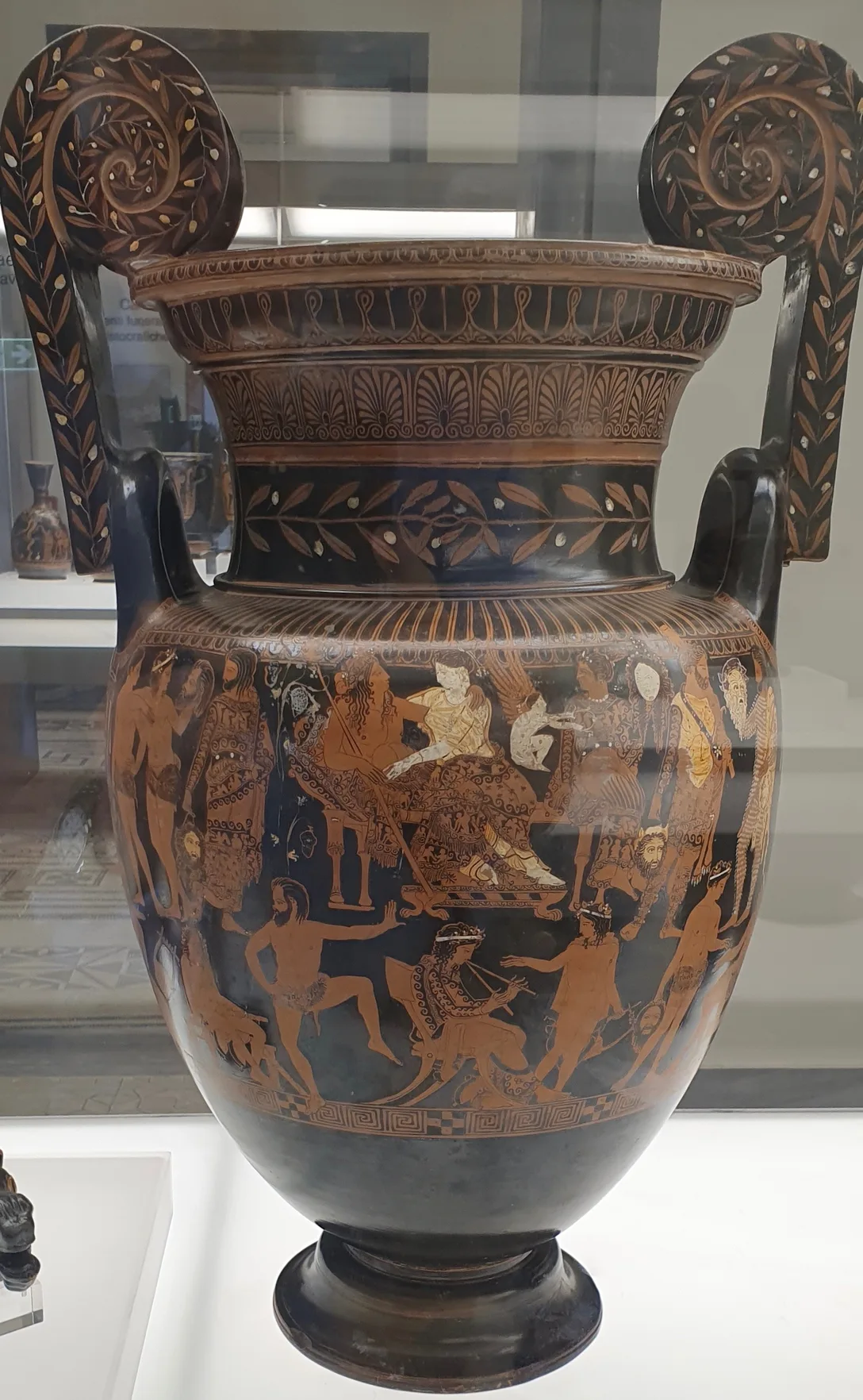
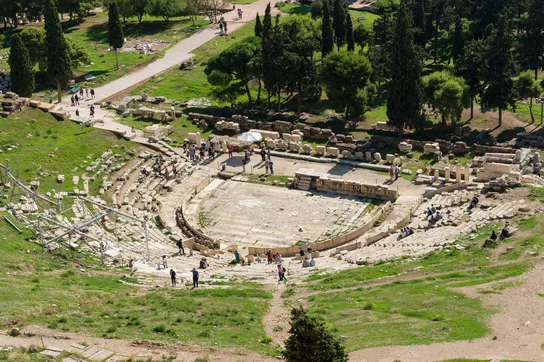
Theatre was born in Athens as part of religion. Every spring the city held the Great Dionysia, a festival for Dionysus, god of wine and of transformation. Over several days, in the open-air theatre on the south slope of the Acropolis, citizens watched choruses dance and sing and three playwrights compete, each with three tragedies and a comic “satyr play”; comedies were added in 486 BC. A wealthy citizen, the choregos, paid for each chorus as a public duty. The actors, all men, wore masks and could play several parts each. Ten judges chosen by lot picked the winners.
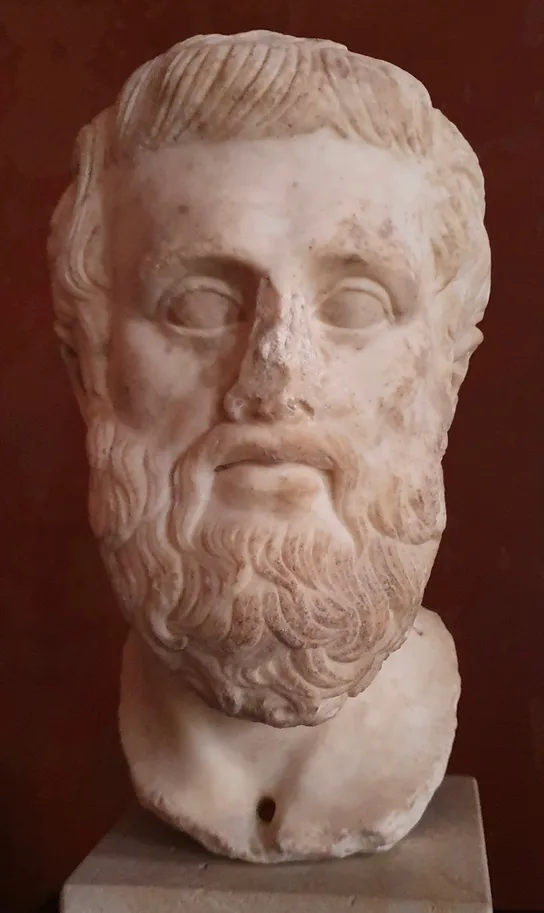
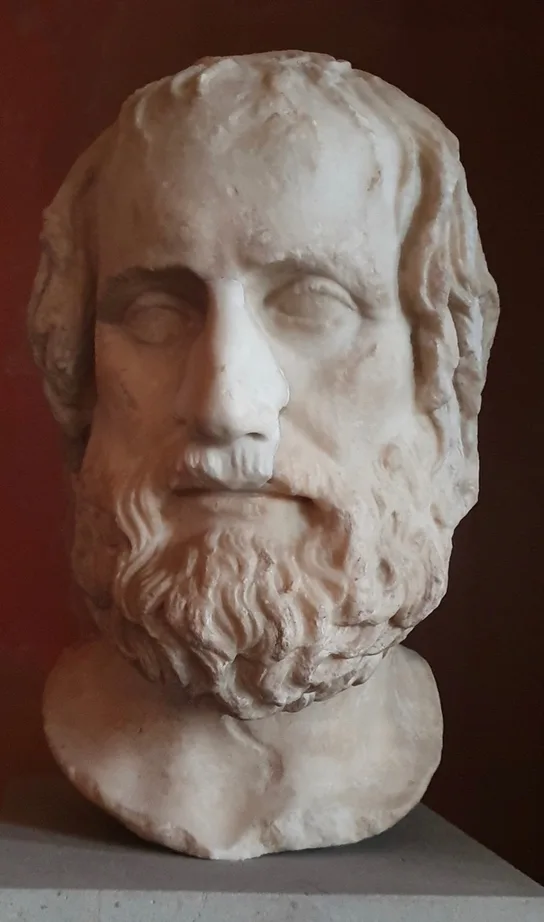
Three tragedians’ plays survive. Aeschylus (c. 525–456 BC) had fought at Marathon, and that, not his plays, is what he chose to record on his tomb, Pausanias says: “he had as witnesses of his prowess the grove at Marathon and the Persians who landed there”.52Pausanias, Description of Greece 1.14.5Written c. AD 160; Pausanias visited the sites. Translation by A. R. Shilleto (1886)Read on Project Gutenberg ↗ His Persians of 472 BC, the only surviving tragedy about recent history, was paid for by the young Pericles. Sophocles (c. 496–406) wrote Oedipus the King and Antigone, and served as a general; Euripides (c. 480–406) gave a voice to women, slaves and the victims of war, in plays such as Medea and The Trojan Women, staged in 415 BC just after Athens had massacred the men of the island of Melos. Their tragedies took old myths and used them to ask hard questions about fate, justice, the gods and the state.
Comedy did the opposite: it mocked the living. Aristophanes (c. 446–386 BC) put real politicians on stage as clowns, made fun of the war in Lysistrata (411 BC), in which the women of Greece go on strike to force their husbands to make peace, and in The Clouds (423 BC) turned Socrates into a fraud who teaches young men to win arguments by cheating. That such plays were staged at a state festival, during a war, says something about Athenian freedom of speech. It also mattered later: at his trial Socrates complained that the jury had seen him mocked “in the comedy of Aristophanes”.

The first historians
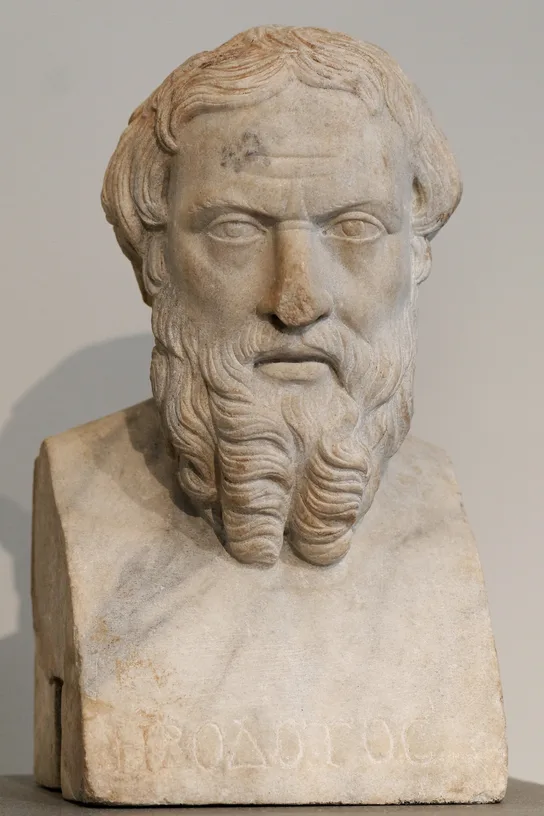
The Greeks also invented the writing of history as we know it: not a list of kings or a royal boast, but an inquiry into what happened and why. The Greek word historia means “inquiry”. Herodotus of Halicarnassus, a Greek from a city under Persian rule in south-west Asia Minor, wrote the first such book around 430 BC. It opens by stating its purpose: to record “great and marvelous deeds, some displayed by the Hellenes, some by the barbarians”, “including among others what was the cause of their waging war on each other”.53Herodotus, Histories 1.1Written c. 430 BC, one to three generations after the Persian Wars, from informants. Translation by A. D. GodleyRead on Perseus ↗ Herodotus travelled to Egypt, Babylon and the Black Sea, asked questions, and wrote down what people told him, often adding that he did not believe it. Without him we would know very little about the Persian Wars.
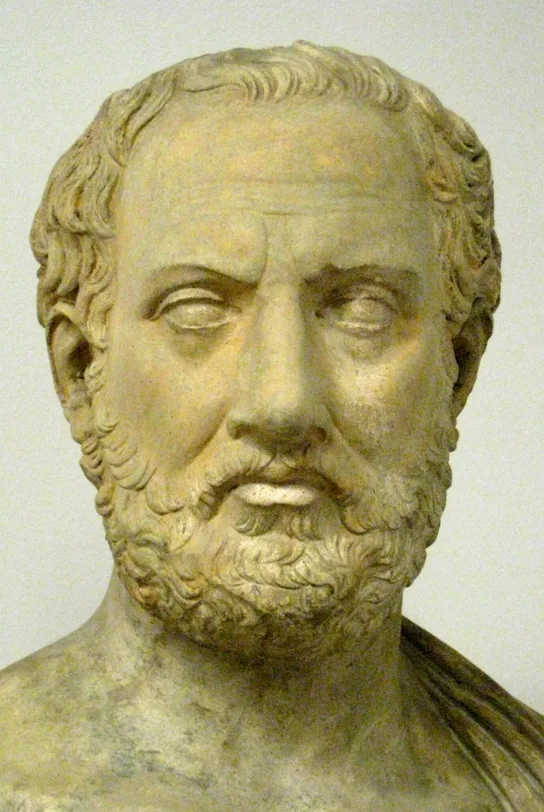
Thucydides (c. 460–c. 400 BC) was an Athenian general who failed to save the city of Amphipolis in 424 BC and was exiled. “It was also my fate to be an exile from my country for twenty years after my command at Amphipolis”, he writes, and he used his exile to talk to both sides.54Thucydides, History of the Peloponnesian War 5.26.5Written c. 431–400 BC by an Athenian general who lived through the war. Translation by R. CrawleyRead on Project Gutenberg ↗ He was stricter than Herodotus. He left out the gods as causes, compared eyewitness accounts, and wrote, as he said, “not as an essay which is to win the applause of the moment, but as a possession for all time”.55Thucydides, History of the Peloponnesian War 1.22.4Written c. 431–400 BC by an Athenian general who lived through the war. Translation by R. CrawleyRead on Project Gutenberg ↗ He also put long speeches in the mouths of his characters, which give what he thought the speakers would have needed to say, not always their words. His book breaks off in 411 BC, in mid-sentence; Xenophon carried the story on in his Hellenica.
Gods, Delphi and the Olympic Games
Greek religion had no holy book, no creed and no church. The Greeks honoured many gods: the twelve Olympians led by Zeus, who were thought to live on Mount Olympus, and countless local heroes, nymphs and spirits. Religion was something you did, not something you believed: you prayed, made vows, poured offerings of wine, and above all sacrificed animals at the altar in front of a temple, after which the meat was shared out at a feast. Priests and priestesses were usually ordinary citizens serving for a time, and the city itself, through its assembly, ran its festivals. The great festival of Athens, the Panathenaia, honoured Athena with a procession to the Acropolis and games whose winners received jars of olive oil.
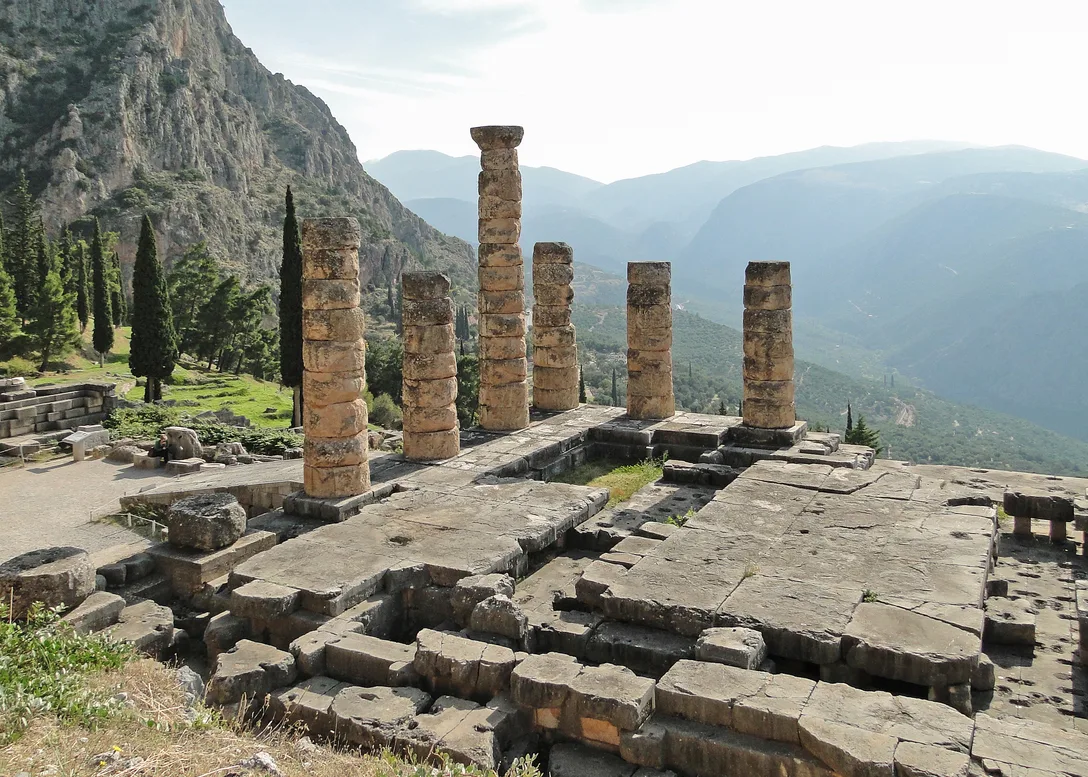
Some sanctuaries belonged to all Greeks. At Delphi, on the slopes of Mount Parnassus, a priestess of Apollo, the Pythia, gave the god’s answers to questions from cities and individuals. Her answers were famous for being ambiguous. When King Croesus of Lydia asked whether he should attack Persia, Herodotus says, he was told “that if he should send an army against the Persians he would destroy a great empire”; he did, and the empire he destroyed was his own.56Herodotus, Histories 1.53.3Written c. 430 BC, one to three generations after the Persian Wars, from informants. Translation by A. D. GodleyRead on Perseus ↗ In 480 BC the Athenians were told to trust in a “wooden wall”, which Themistocles explained as their ships. Cities consulted Delphi before founding colonies, and filled the sanctuary with treasuries and monuments to their victories, often over other Greeks.

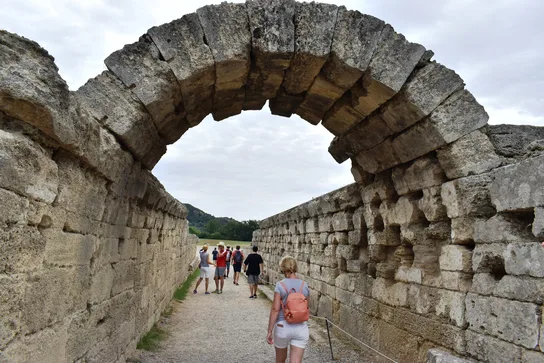
At Olympia in the western Peloponnese, Greeks from every city met every four years for the Olympic Games, held in honour of Zeus. The Greeks counted years by Olympiads, and later dated the first games to 776 BC; that date comes from a list of victors drawn up around 400 BC by Hippias of Elis, and modern historians treat it as tradition, not fact.57P. Christesen, Olympic Victor Lists and Ancient Greek History (Cambridge, 2007), ch. “Whence 776?”Modern study of how the first Olympic victor list was put together, c. 400 BCView on Google Books ↗ A sacred truce let athletes and visitors travel safely; Pausanias, writing in the 2nd century AD, says that its founder “established a truce as long as the games lasted”.58Pausanias, Description of Greece 5.4.5Written c. AD 160; Pausanias visited the sites. Translation by A. R. Shilleto (1886)Read on Project Gutenberg ↗ The events were running, wrestling, boxing, the pankration (a fight with almost no rules), the pentathlon and chariot and horse races. Athletes competed naked, and the only prize was a wreath of wild olive, though home cities rewarded their winners richly. The truce did not stop wars between Greek cities: it only protected the festival.
The trial of Socrates
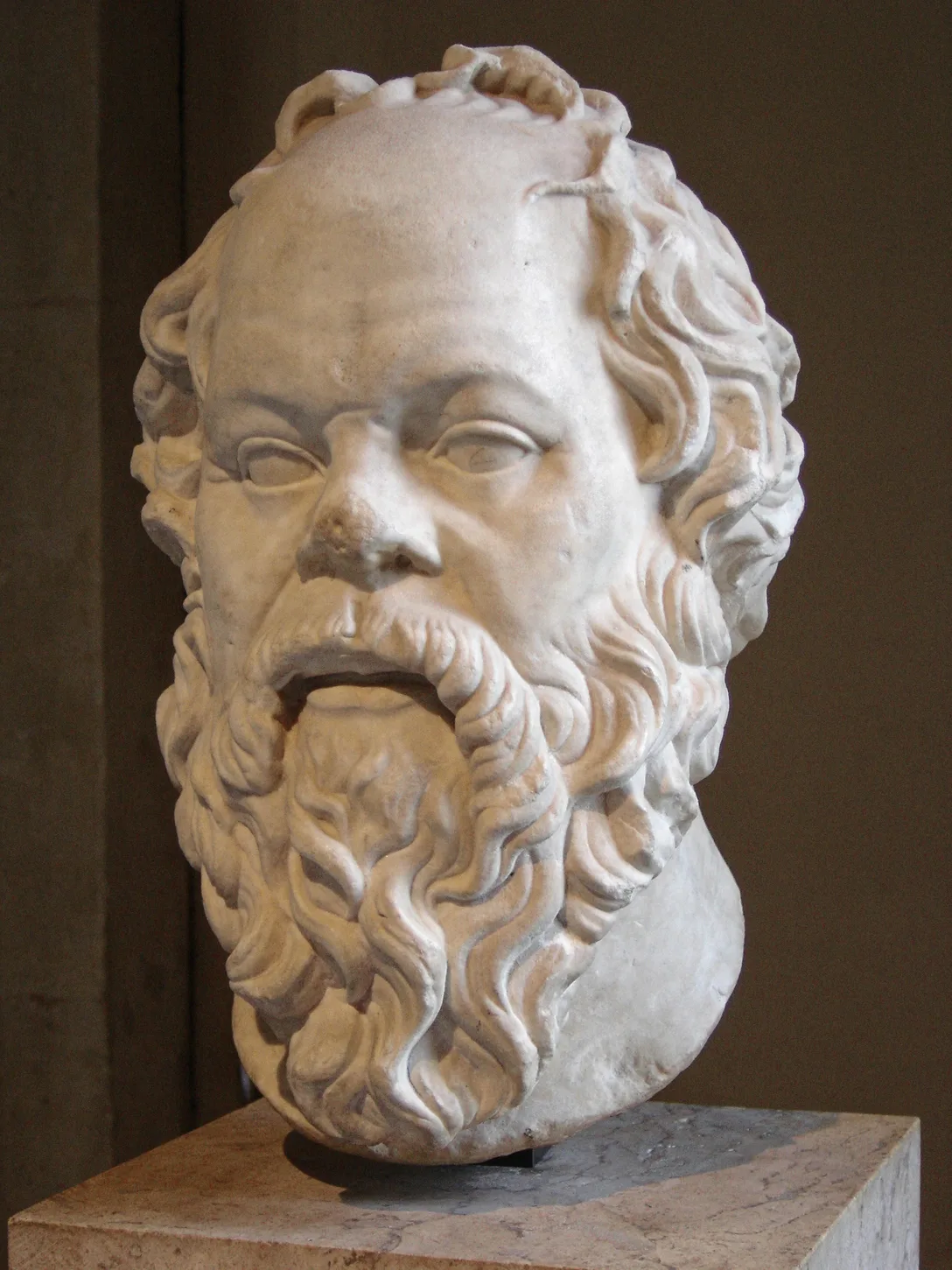
In the bitter, defeated Athens of the 390s lived Socrates (c. 470–399 BC), by tradition a stonemason’s son, an ugly man who walked barefoot and had fought as a hoplite “at Potidaea and Amphipolis and Delium”, as he reminded his jury.60Plato, Apology 28eSocrates’ defence speech as written by Plato, who was at the trial in 399 BC. Translation by B. JowettRead on Project Gutenberg ↗ He wrote nothing. He spent his days in the agora and the gymnasia asking people what courage, justice or goodness were, and showing them that they did not know. He told the story that a friend had asked the oracle at Delphi whether anyone was wiser than Socrates, and “the Pythian prophetess answered, that there was no man wiser”. Socrates concluded that he was wise only in knowing that he knew nothing.61Plato, Apology 21aSocrates’ defence speech as written by Plato, who was at the trial in 399 BC. Translation by B. JowettRead on Project Gutenberg ↗ Everything we know about him comes from others: his pupils Plato and Xenophon, who admired him, and Aristophanes, who laughed at him.
In 399 BC three citizens prosecuted him. As Plato gives the charge, “Socrates is a doer of evil, who corrupts the youth; and who does not believe in the gods of the state, but has other new divinities of his own”.62Plato, Apology 24bSocrates’ defence speech as written by Plato, who was at the trial in 399 BC. Translation by B. JowettRead on Project Gutenberg ↗ Behind the religious charge lay politics. Two of the men who had spent time with Socrates had done Athens great harm: Alcibiades, who had gone over to Sparta, and Critias, the leader of the Thirty Tyrants. The amnesty of 403 forbade prosecutions for that, but it probably counted against him with the jury.
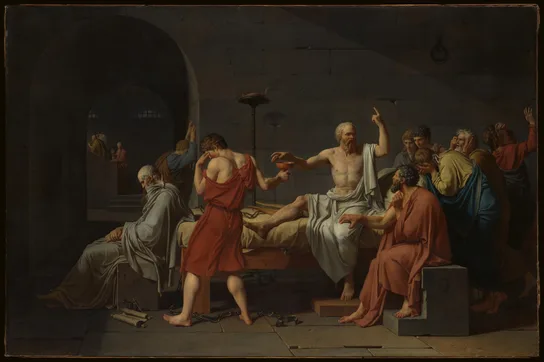
The jury was large, probably 501 citizens. In the defence speech that Plato wrote, Socrates refused to beg. He called himself the city’s gadfly, stinging a large and lazy horse into life, and said that “the unexamined life is not worth living”.63Plato, Apology 38aSocrates’ defence speech as written by Plato, who was at the trial in 399 BC. Translation by B. JowettRead on Project Gutenberg ↗ The vote was close: “had thirty votes gone over to the other side, I should have been acquitted”, he says.64Plato, Apology 36aSocrates’ defence speech as written by Plato, who was at the trial in 399 BC. Translation by B. JowettRead on Project Gutenberg ↗ When the prosecution proposed death, he suggested at first that he should be rewarded with free meals for life. He was condemned, refused a chance to escape, and some weeks later drank the poison, usually identified as hemlock, in prison, surrounded by his friends. Plato’s dialogue Phaedo describes his last day.
Plato and Aristotle
Plato (c. 427–347 BC), an Athenian aristocrat related to Critias, turned his teacher’s conversations into written dialogues, in which Socrates questions friends and opponents. Around 387 BC he founded a school in a grove outside Athens sacred to the hero Akademos: the Academy, which gave its name to academies everywhere. Plato never forgave democracy for killing Socrates. In the Republic he described an ideal state run by a class of trained guardians, and argued that “until philosophers are kings, or the kings and princes of this world have the spirit and power of philosophy”, “cities will never have rest from their evils”.65Plato, Republic 5, 473dWritten c. 375 BC. Translation by B. JowettRead on Project Gutenberg ↗

Plato’s greatest pupil, Aristotle (384–322 BC), came from Stagira, a small Greek city in the north near Macedon. He studied at the Academy for twenty years, and in Athens he was always a metic, without a vote. Aristotle wanted to understand everything by collecting facts and sorting them: animals and plants, the stars, logic, poetry, ethics and politics. He and his students gathered the constitutions of 158 Greek states; the only one to survive is the Athenian Constitution quoted in this chapter, found on a papyrus in Egypt and published in 1891. In 343 BC King Philip of Macedon, Plutarch writes, “sent for Aristotle” to teach his son Alexander, and as his fee rebuilt Aristotle’s home town, which Philip himself had destroyed.66Plutarch, Alexander 7Written c. AD 100, five to six centuries after the events, from older books. Translation by J. Dryden, revised by A. H. CloughRead on Project Gutenberg ↗
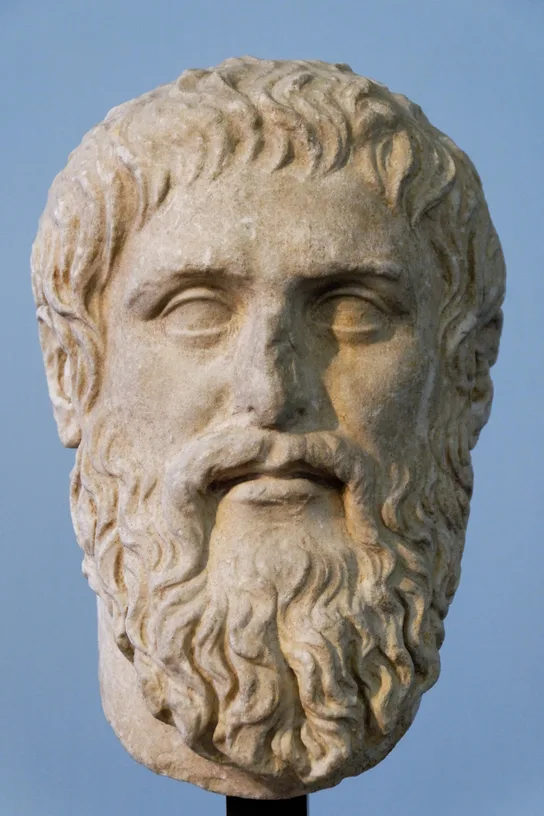

Diodorus, writing in the 1st century BC, looked back on these generations as a golden age in which “philosophy and oratory had a high place of honour among all Greeks, and especially the Athenians”, naming “Socrates and Plato and Aristotle” as its philosophers.67Diodorus Siculus, Library of History 12.1.4Written c. 30 BC, from older histories that are now lost. Translation by C. H. Oldfather (1946)Read on LacusCurtius ↗ Through the Romans, the Arabs and the universities of medieval Europe, Plato and Aristotle remained the foundation of Western philosophy and science for two thousand years.
Politics and warSparta falls, Thebes rises, 404–362 BC
Sparta had promised the Greeks freedom from Athens, but after 404 BC it ruled the former Athenian cities with Spartan governors and garrisons, and many Greeks found it harsher than Athens had been. Thebes, Corinth, Argos and a recovering Athens fought it in the Corinthian War (395–387 BC). The war was ended by Persia. In 387/386 BC the Persian king dictated the terms, and Xenophon quotes them: “The king, Artaxerxes, deems it just that the cities in Asia, with the islands of Clazomenae and Cyprus, should belong to himself; the rest of the Hellenic cities he thinks it just to leave independent, both small and great.”68Xenophon, Hellenica 5.1.31Written c. 380s–350s BC by an Athenian who lived through these years and admired Sparta. Translation by H. G. DakynsRead on Project Gutenberg ↗ The Ionian Greeks, for whose freedom Athens and Sparta had fought a century earlier, were handed back to Persia, and Sparta enforced the peace in Greece as the king’s partner.
Sparta’s end as a great power came from Thebes. Under two remarkable leaders, Pelopidas and Epaminondas, the Thebans built up a new army, with an elite unit of three hundred men, the Sacred Band, made up, Plutarch says, of pairs of lovers who would never shame each other. In 371 BC, at Leuctra in Boeotia, Epaminondas massed his best troops fifty ranks deep on his left wing, against the Spartans, and smashed them. Xenophon, a friend of Sparta, reports the shock: “nearly a thousand men of the total Lacedaemonian troops were slain”, and “of the seven hundred Spartans themselves who were on the field something like four hundred lay dead”.69Xenophon, Hellenica 6.4.15Written c. 380s–350s BC by an Athenian who lived through these years and admired Sparta. Translation by H. G. DakynsRead on Project Gutenberg ↗ A Spartan army had been beaten in open battle by an equal force, and Sparta, short of citizens, could not replace the dead.
In the winter of 370/369 BC Epaminondas marched into the Peloponnese, invaded Laconia, and freed Messenia. The Messenians, Pausanias says, came back to their land from all over the Greek world, “from yearning affection to their fatherland, and from their abiding hate to the Lacedæmonians”, and founded the new city of Messene below Mount Ithome.70Pausanias, Description of Greece 4.26Written c. AD 160; Pausanias visited the sites. Translation by A. R. Shilleto (1886)Read on Project Gutenberg ↗ Without Messenia’s helots, Sparta lost the economic base of its army state. But Thebes could not hold the leadership either. Epaminondas was killed in battle at Mantinea in 362 BC, and Greece was left with three exhausted powers, Sparta, Athens and Thebes, none strong enough to lead.
Philip II and Chaeronea, 359–338 BC
North of Thessaly lay Macedon, a kingdom of farmers, herdsmen and horse-riding nobles under a king. Many southern Greeks did not count the Macedonians as proper Greeks, though their kings claimed Greek descent and had been allowed to compete at Olympia. In 359 BC a 23-year-old prince, Philip, took power after his brother was killed in battle. As a teenager he had been held as a hostage in Thebes, where he could watch Epaminondas’ army at first hand.
Philip built the first professional army in Greece. His infantry carried the sarissa, a pike about five to six metres long, more than twice the length of a hoplite’s spear, so that the points of five ranks stood out in front of the phalanx. Beside it rode the heavy cavalry of the Companions, the Macedonian nobles. He paid for it with the gold and silver mines of Mount Pangaeum, which he seized in 356 BC. With his army, bribes and promises he took Greek cities one by one: Amphipolis in 357, Olynthus in 348, the passes into central Greece in 346. In Athens the orator Demosthenes warned in his Philippics that Philip meant to make all Greeks his subjects; others, like the old teacher Isocrates, hoped that Philip would unite the Greeks and lead them against Persia.
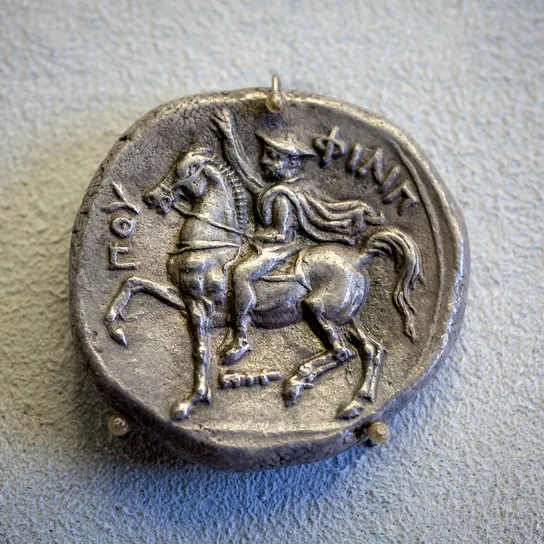
In 338 BC Athens and Thebes, old enemies, at last stood together against him, at Chaeronea in Boeotia, in August. Diodorus, writing three centuries later from lost histories, gives Philip more than 30,000 infantry and 2,000 cavalry; the Greek army was probably about as large. Philip’s 18-year-old son Alexander commanded the Macedonian left wing, facing the Thebans. Plutarch says that “he is said to have been the first man that charged the Thebans’ sacred band”.71Plutarch, Alexander 9Written c. AD 100, five to six centuries after the events, from older books. Translation by J. Dryden, revised by A. H. CloughRead on Project Gutenberg ↗ The usual modern reconstruction has Alexander lead the Companion cavalry through a gap in the Greek line, while Philip drew the Athenians forward on the other wing by pulling back; some historians argue that Alexander led infantry, because the ancient accounts never actually mention a cavalry charge.72J. Buckler and H. Beck, Central Greece and the Politics of Power in the Fourth Century BC (Cambridge, 2008), “Note on the battle of Chaeronea”Modern study that questions the usual view that Alexander led a cavalry charge at ChaeroneaRead on Cambridge Core ↗ The Greek line broke. The Sacred Band died where it stood; Plutarch says that when Philip saw the three hundred lying together, he wept and said, “Perish any man who suspects that these men either did or suffered anything that was base.”73Plutarch, Pelopidas 18Written c. AD 100, five to six centuries after the events, from older books. Translation by J. Dryden, revised by A. H. CloughRead on Project Gutenberg ↗
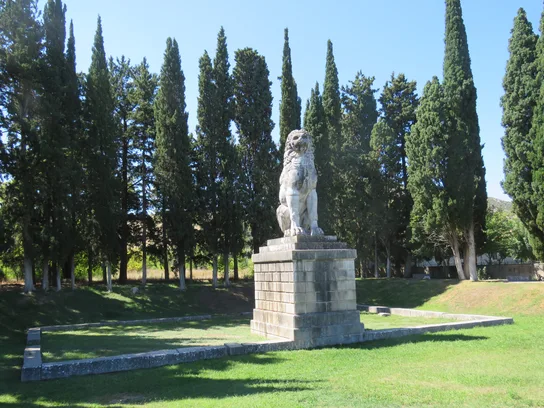
Pausanias saw the grave of the Theban dead five centuries later: “There is no inscription over them but there is a device of a lion, which may indicate their bravery.”74Pausanias, Description of Greece 9.40.10Written c. AD 160; Pausanias visited the sites. Translation by A. R. Shilleto (1886)Read on Project Gutenberg ↗ Philip treated Athens gently; he needed its fleet. In 337 BC he called the Greek cities to Corinth and formed a league under his leadership, with one declared aim: war on Persia, to avenge the temples burned in 480. Only Sparta stayed out. The cities kept their own laws, assemblies and courts for centuries, but they no longer decided war and peace for themselves. In 336 BC, before the campaign began, Philip was murdered by one of his own bodyguards, and his son Alexander became king.
A city that let others tell its story
This chapter, like almost every history of Classical Greece, sees Sparta through Athenian eyes. Sparta itself left almost no writing. From the 7th century there are fragments of the war poems of Tyrtaeus and the choral songs of Alcman, and from later centuries a few inscriptions. Spartans were famous for saying little (our word “laconic” comes from Laconia), and they had no tradition of history writing or of public speeches written down. Everything else comes from outsiders: Herodotus, Thucydides and Xenophon, who lived in exile on an estate the Spartans gave him and admired their discipline; and, centuries later, Plutarch, whose Life of Lycurgus is the main source for the Spartan upbringing but was written when Sparta had become a museum of itself for Roman visitors. Modern historians speak of a “Spartan mirage”: an image of Sparta, admired or feared, made by others.75P. Cartledge, Sparta and Lakonia: A Regional History 1300–362 BC (2nd ed., London, 2002)Modern history of Sparta and its helotsView on Google Books ↗
Thucydides saw the problem already. Sparta was never built up into a grand city; it remained a group of villages without great temples or public buildings. If it were ever deserted, he wrote, “there would be a strong disposition with posterity to refuse to accept her fame as a true exponent of her power”, while the ruins of Athens would make it look twice as powerful as it was.76Thucydides, History of the Peloponnesian War 1.10.2Written c. 431–400 BC by an Athenian general who lived through the war. Translation by R. CrawleyRead on Project Gutenberg ↗ He was right: visitors to modern Sparta find little to see.
How did the Spartans see themselves? As the defenders of Greek freedom, and the evidence supports them more often than Athenian writers admit. Sparta led the Greeks against Persia in 480–479. In 431 BC, Thucydides says, “the good wishes of men made greatly for the Lacedaemonians, especially as they proclaimed themselves the liberators of Hellas” from the Athenian empire.77Thucydides, History of the Peloponnesian War 2.8.4Written c. 431–400 BC by an Athenian general who lived through the war. Translation by R. CrawleyRead on Project Gutenberg ↗ The Spartans’ own idea of freedom was freedom for the Spartiates, the “equals”, among themselves and from foreign rule; it rested on the unfreedom of the helots, whose own voice survives nowhere at all. When Epaminondas freed Messenia in 369 BC the Messenians built their own city, and later Messenian writers told a story of heroic resistance, which Pausanias retells; but of the helots themselves, in three hundred years of servitude, not a word survives.
How close is our evidence?
For the 5th century BC our evidence is unusually good, by ancient standards. Thucydides was an eyewitness of the war he described and caught the plague himself; Aristophanes and the tragedians were writing for audiences who had lived through the same events; Plato and Xenophon knew Socrates. Herodotus wrote a generation or two after the Persian Wars, from the memories of veterans and their children. The further back we go, the thinner it gets. For Solon we have his own poems and a few later accounts; for Sparta almost nothing from inside. Army sizes and numbers of people are the weakest point: ancient writers rarely had real figures, and modern estimates for the population of Athens or the army of Xerxes differ by a factor of two or more. Coins, inscriptions such as the Tribute Lists and the excavated buildings of Athens, Olympia and Delphi give a check that does not depend on any writer.
Classical Greece in four headings
Classical Greece ended not with a collapse but with a change of master. The city-states lived on, and their culture spread further than ever, carried east by the son of the man who had defeated them at Chaeronea. In twelve years Alexander would take the whole Persian Empire, and Greek would become the language of cities from Egypt to Afghanistan.
- M. H. Hansen and T. H. Nielsen (eds), An Inventory of Archaic and Classical Poleis (Oxford, 2004)
- Herodotus, Histories 8.144.2
- Thucydides, History of the Peloponnesian War 6.3.2
- Herodotus, Histories 1.163.1
- Herodotus, Histories 1.94.1
- Thucydides, History of the Peloponnesian War 1.101.2
- Herodotus, Histories 9.10.1
- P. Cartledge, Sparta and Lakonia: A Regional History 1300–362 BC (2nd ed., London, 2002)
- Plutarch, Lycurgus 16
- Plutarch, Lycurgus 28
- Thucydides, History of the Peloponnesian War 4.80.4
- Aristotle (or a pupil), The Athenian Constitution 2
- Aristotle (or a pupil), The Athenian Constitution 6
- Plutarch, Solon 15
- Aristotle (or a pupil), The Athenian Constitution 12
- Herodotus, Histories 1.59.6
- Herodotus, Histories 5.66.2
- Aristotle (or a pupil), The Athenian Constitution 21
- Thucydides, History of the Peloponnesian War 2.37.1
- Aristotle (or a pupil), The Athenian Constitution 63
- Plutarch, Aristides 7
- Herodotus, Histories 5.97.2
- M. H. Hansen, The Athenian Democracy in the Age of Demosthenes (Oxford, 1991)
- B. Akrigg, Population and Economy in Classical Athens (Cambridge, 2019)
- Herodotus, Histories 5.78.1
- Herodotus, Histories 5.105.2
- Herodotus, Histories 6.117.1
- J. F. Lazenby, The Defence of Greece 490–479 BC (1993)
- P. Green, The Greco-Persian Wars (1996)
- Herodotus, Histories 7.144.1
- Aristotle (or a pupil), The Athenian Constitution 27
- Thucydides, History of the Peloponnesian War 1.96.2
- Thucydides, History of the Peloponnesian War 1.98.4
- Aristotle (or a pupil), The Athenian Constitution 24
- Aristotle (or a pupil), The Athenian Constitution 27
- Thucydides, History of the Peloponnesian War 2.65.9
- Plutarch, Pericles 13
- Plutarch, Pericles 12
- Thucydides, History of the Peloponnesian War 2.41.1
- Thucydides, History of the Peloponnesian War 2.45.2
- Thucydides, History of the Peloponnesian War 7.27.5
- Thucydides, History of the Peloponnesian War 1.23.6
- Thucydides, History of the Peloponnesian War 2.13.6
- Thucydides, History of the Peloponnesian War 2.48.3
- Thucydides, History of the Peloponnesian War 2.53.1
- Thucydides, History of the Peloponnesian War 3.87.3
- M. J. Papagrigorakis and others, “DNA examination of ancient dental pulp incriminates typhoid fever as a probable cause of the Plague of Athens”, International Journal of Infectious Diseases 10 (2006), pp. 206–214
- B. Shapiro, A. Rambaut and M. T. P. Gilbert, “No proof that typhoid caused the Plague of Athens (a reply to Papagrigorakis et al.)”, International Journal of Infectious Diseases 10 (2006)
- Thucydides, History of the Peloponnesian War 7.87.6
- Xenophon, Hellenica 2.1.28
- Xenophon, Hellenica 2.2.23
- Pausanias, Description of Greece 1.14.5
- Herodotus, Histories 1.1
- Thucydides, History of the Peloponnesian War 5.26.5
- Thucydides, History of the Peloponnesian War 1.22.4
- Herodotus, Histories 1.53.3
- P. Christesen, Olympic Victor Lists and Ancient Greek History (Cambridge, 2007), ch. “Whence 776?”
- Pausanias, Description of Greece 5.4.5
- Pausanias, Description of Greece 5.6.7
- Plato, Apology 28e
- Plato, Apology 21a
- Plato, Apology 24b
- Plato, Apology 38a
- Plato, Apology 36a
- Plato, Republic 5, 473d
- Plutarch, Alexander 7
- Diodorus Siculus, Library of History 12.1.4
- Xenophon, Hellenica 5.1.31
- Xenophon, Hellenica 6.4.15
- Pausanias, Description of Greece 4.26
- Plutarch, Alexander 9
- J. Buckler and H. Beck, Central Greece and the Politics of Power in the Fourth Century BC (Cambridge, 2008), “Note on the battle of Chaeronea”
- Plutarch, Pelopidas 18
- Pausanias, Description of Greece 9.40.10
- P. Cartledge, Sparta and Lakonia: A Regional History 1300–362 BC (2nd ed., London, 2002)
- Thucydides, History of the Peloponnesian War 1.10.2
- Thucydides, History of the Peloponnesian War 2.8.4