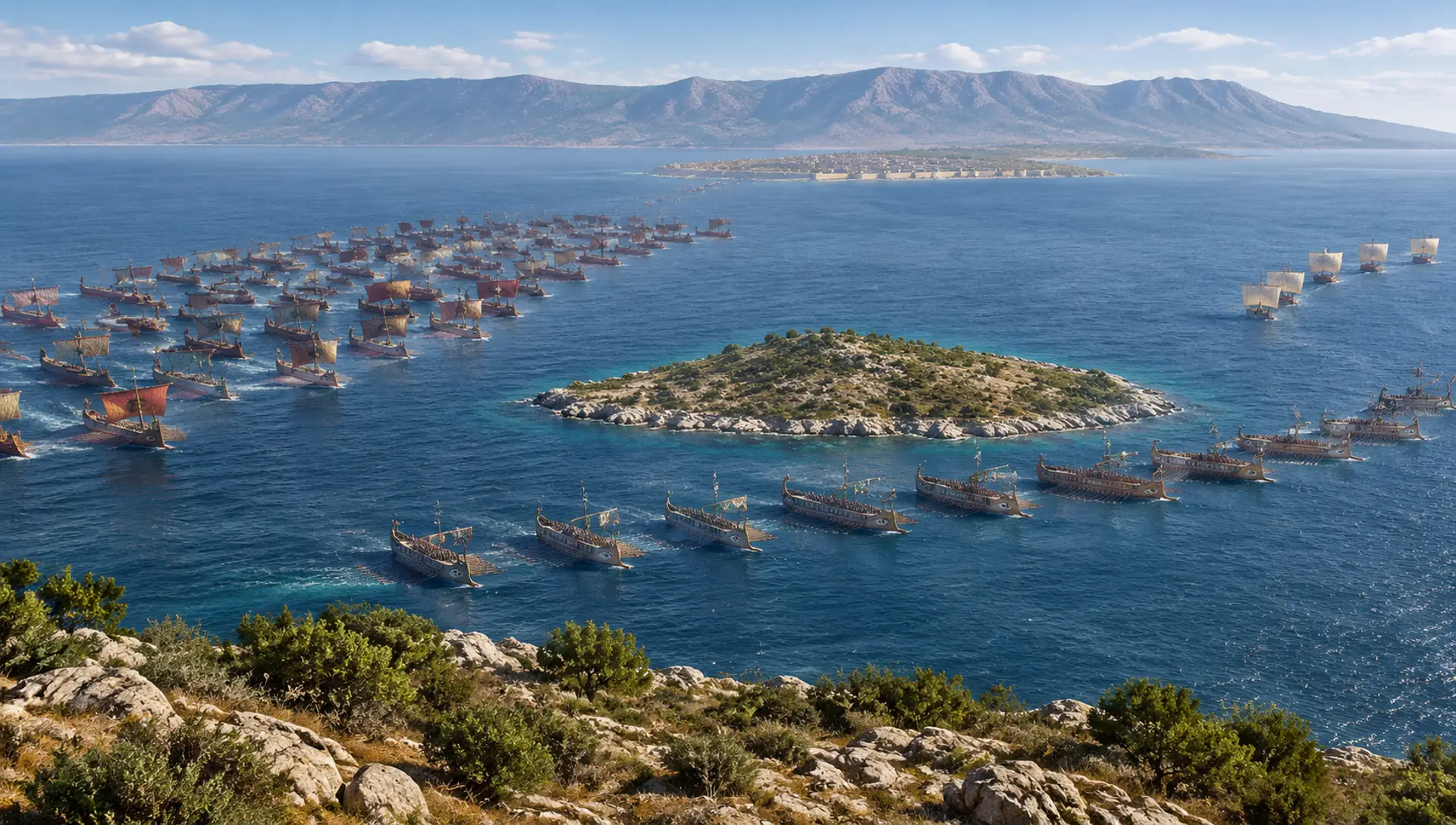
In 494 BC the Greek cities of Ionia gathered every warship they had at a small island called Lade, off Miletus, to fight the Persian empire at sea. They had 353 triremes; the king’s Phoenician fleet, Herodotus says, had 600. The battle was lost before it began: the Samians sailed away, others followed, and Miletus, the greatest Greek city of the east, was taken and emptied. This chapter tells how the Ionian Revolt ended, and why its end pointed the Persian army straight at Athens and Eretria.
Where this chapter fits
In the previous chapter the Ionians rose against Persia in 499 BC, deposed the tyrants who ruled their cities for the king, and with twenty Athenian and five Eretrian ships marched inland and burned Sardis, the seat of the Persian governor. They were beaten on the way back at Ephesus, and the Athenians went home and would not come back. But the revolt did not stop. The Ionian fleet brought Byzantium and the cities of the Hellespont over to the rebels, then sailed south and won most of Caria; Cyprus rose as well. Herodotus explains why the Ionians kept going: they had gone too far to turn back, and “despite the fact that they had been deprived of their Athenian allies, the Ionians fervently continued their war against the king”.1Herodotus, Histories 5.103Written c. 430 BC. Translation by A. D. GodleyRead on Perseus ↗
At its widest the revolt ran from Byzantium to Cyprus, along almost the whole western edge of the empire. Darius had sworn revenge on the Athenians; first he had to win back his own provinces. That took him another five years. How he did it, and how the last Ionian fleet was beaten at Lade, decided what would happen next: once Ionia was quiet again, the king’s army and fleet were free to cross the Aegean.
The Persian counter-offensive
The first Persian blow fell on Cyprus. Onesilus, who had made himself king of Salamis on Cyprus and brought the island into the revolt, was besieging Amathus, the one city that refused to join him, when news came that a Persian general, Artybius, was on his way to Cyprus with a large army.2Herodotus, Histories 5.108Written c. 430 BC. Translation by A. D. GodleyRead on Perseus ↗ The Persian army crossed from Cilicia while a Phoenician fleet sailed round the island. Onesilus called on the Ionians, and they came with a great force.
The Cypriot kings offered the Ionians a choice: fight the Persians on land or the Phoenicians at sea. The Ionians answered that they had been “sent by the common voice of Ionia to guard the seas”, not to hand their ships to the Cypriots.3Herodotus, Histories 5.109Written c. 430 BC. Translation by A. D. GodleyRead on Perseus ↗ At sea they did what they had come for: “The Ionians in their ships, displaying surpassing excellence that day, overcame the Phoenicians”, and the Samians fought best of all.4Herodotus, Histories 5.112Written c. 430 BC. Translation by A. D. GodleyRead on Perseus ↗ It was the first time in the war that a Greek fleet beat the king’s navy, and it would be remembered at Lade.
On land the Cypriots lost. Onesilus killed the Persian general Artybius, whose horse had been trained to rear up and strike at foot soldiers; his Carian shield-bearer cut its legs from under it. But in the middle of the battle Stesenor, the ruler of Curium, went over to the enemy with his large following, the war chariots of Salamis followed him, and the Cypriot army broke. Onesilus was killed. The Ionian fleet, hearing that the cause was lost and the Cypriot cities under siege, sailed home. Soli held out longest, into the fifth month, until the Persians dug a mine under its walls. “So the Cyprians, after winning freedom for a year, were enslaved once more.”5Herodotus, Histories 5.116Written c. 430 BC. Translation by A. D. GodleyRead on Perseus ↗
Meanwhile three Persian generals, all married to daughters of Darius, went after the mainland. Daurises marched to the Hellespont and took Dardanus, Abydus, Percote, Lampsacus and Paesus, one city a day. Then he turned south into Caria. The Carians fought him by the river Marsyas, a tributary of the Maeander, and lost heavily: Herodotus counts two thousand Persian dead and ten thousand Carian. The survivors fled to the sanctuary of Zeus at Labraunda; with help from Miletus they fought again and lost again. But they did not give up. When the Persians marched on their cities, the Carians laid an ambush on the road at Pedasus, and Daurises and two other generals were killed with their army.
In the north, Hymaees took Cius on the Sea of Marmara and the Aeolian towns of the Troad before he died of illness. Artaphrenes, the satrap of Sardis and Darius’ brother, and the general Otanes turned on Ionia itself and took Clazomenae, and Cyme in Aeolis. Grundy, who tried to put these campaigns in order, found Herodotus’ chronology here “hopelessly involved”; most modern reconstructions put them in 497 and 496 BC. By then Cyprus was lost, the straits were back in Persian hands, and the Persian armies were closing in on the heart of the revolt.
Aristagoras leaves, Histiaeus returns
Aristagoras, the man who had started the revolt, now looked for a way out. Herodotus judges him harshly: “a man of little courage”, who, when he saw what he had done, began to think of flight, since “it seemed to him to be impossible to overcome Darius”.6Herodotus, Histories 5.124Written c. 430 BC. Translation by A. D. GodleyRead on Perseus ↗ He asked his fellow rebels whether they should prepare a refuge, in Sardinia or at Myrcinus in Thrace, the town on the Strymon that Darius had once given to Histiaeus. The historian Hecataeus of Miletus proposed instead that Aristagoras build a fort on the small island of Leros and wait there for a chance to return.7Herodotus, Histories 5.125Written c. 430 BC. Translation by A. D. GodleyRead on Perseus ↗
Aristagoras chose Thrace. He left Miletus in the hands of a respected citizen, Pythagoras, and sailed with anyone who would follow. There the Thracians killed him and his men while he was besieging a town, even though its people had offered to leave under a truce. Grundy thought Herodotus’ verdict unfair. Aristagoras did not run away alone; he went out, with the agreement of the other leaders, to find a refuge for the Milesians, and died doing it. “Herodotus’ account of the man and all that he did, fails, when examined, to support the picture of his character which the historian has drawn.”8Grundy, The Great Persian War, ch. 3G. B. Grundy, The Great Persian War (1901). A modern study, dated in placesRead on Project Gutenberg ↗
About the same time his father-in-law Histiaeus, the former tyrant of Miletus, came down from Susa. Darius had kept him at court for years; now Histiaeus had talked the king into sending him back, promising to end the revolt and even to conquer Sardinia. At Sardis the satrap Artaphrenes was not deceived. “I will tell you, Histiaeus, the truth of this business”, he said: “it was you who stitched this shoe, and Aristagoras who put it on.”9Herodotus, Histories 6.1Written c. 430 BC. Translation by A. D. GodleyRead on Perseus ↗ Histiaeus fled to the coast that night and crossed to Chios.
To win the Ionians over, Histiaeus claimed that he had ordered the revolt because Darius planned to move the Phoenicians to Ionia and the Ionians to Phoenicia. Herodotus is plain: “The king had made no such plan, but Histiaeus wanted to frighten the Ionians.”10Herodotus, Histories 6.3Written c. 430 BC. Translation by A. D. GodleyRead on Perseus ↗ The Milesians did not want him back. Rid of Aristagoras, and having tasted freedom, they had no wish to take another tyrant. When he tried to force his way in at night, a Milesian wounded him in the thigh. He went to Lesbos, got eight triremes from Mytilene, and set himself up at Byzantium, where he seized the ships sailing out of the Black Sea. Miletus faced the coming storm without a leader of the revolt and with its old tyrant turned pirate.
Persia aims at Miletus
In 494 BC the Persians changed their method. Instead of retaking the rebel cities one by one, “the Persian generals had joined their power together and made one army, which they led against Miletus, taking less account of the other fortresses”.11Herodotus, Histories 6.6Written c. 430 BC. Translation by A. D. GodleyRead on Perseus ↗ Miletus had started the revolt and was its strongest city. Take it, and the rest would fall. The army closed in by land; the fleet came by sea. The Phoenicians were the keenest to fight, and with them came the newly subdued Cyprians, the Cilicians and the Egyptians.12Herodotus, Histories 6.6Written c. 430 BC. Translation by A. D. GodleyRead on Perseus ↗ Phoenicia, Cyprus, Cilicia and Egypt were the great naval provinces of the empire; fourteen years later they would make up the core of Xerxes’ fleet.
The Ionians sent deputies to the Panionium, their common sanctuary on Mount Mycale, to decide what to do. Their decision was clear. They would not raise an army to meet the Persians on land; the Milesians would defend their own walls, and the rest would “man their fleet to the last ship and gather as quickly as possible at Lade to fight for Miletus at sea. This Lade is a small island lying off the city of Miletus.” Grundy saw the logic: the Ionians’ strength was on the sea, Persia’s on land, and the Ionians had already beaten the Phoenicians off Cyprus. If they won at sea, Miletus could be supplied by water and might hold out indefinitely.
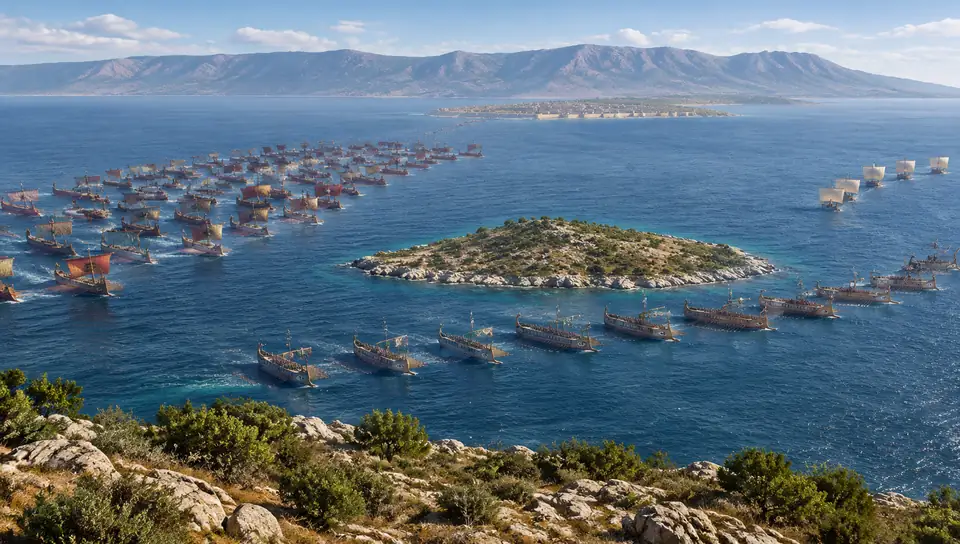
The bay looked very different then. Lade was an island at the mouth of the harbours of Miletus, and the sea reached far inland into a gulf below Mount Latmus. How and Wells already noted in 1912 that Lade was “still an island in the days of Strabo” and has since been turned “by the alluvial deposit into a hill in the plain of the Maeander”.13How and Wells, A Commentary on Herodotus, note on 6.7W. W. How and J. Wells, A Commentary on Herodotus, vol. 2 (1912). A modern commentary, now dated in placesRead on archive.org ↗ Modern drilling in the plain has shown how fast this happened: the river Maeander filled the bay with silt over the following centuries, joining the islands to the mainland and leaving the ruins of Miletus far inland. Lade was still an island in 494 BC, and the Ionian fleet could lie in the sheltered water between it and the city.14H. Brückner, M. Müllenhoff, R. Gehrels, A. Herda, M. Knipping and A. Vött, “From archipelago to floodplain: geographical and ecological changes in Miletus and its environs during the past six millennia”, Zeitschrift für Geomorphologie, Supplement 142 (2006), pp. 63–83Modern geoarchaeological study of the silting of the bay of MiletusView at the publisher ↗

The fleet at Lade
Herodotus gives the Ionian battle line city by city, from east to west. The Milesians held the eastern wing with eighty ships. Next came Priene with twelve, Myus with three, Teos with seventeen, then Chios with a hundred, Erythrae with eight, Phocaea with three, the Lesbians with seventy, and on the western wing the Samians with sixty. “The total number of all these together was three hundred and fifty-three triremes.”15Herodotus, Histories 6.8Written c. 430 BC. Translation by A. D. GodleyRead on Perseus ↗ Against them, “the ships of the foreigners were six hundred”.16Herodotus, Histories 6.9Written c. 430 BC. Translation by A. D. GodleyRead on Perseus ↗
The list is more trustworthy than most ancient numbers. How and Wells, the great commentators on Herodotus, pointed out that the “numbers of the contingents agree with the total and may well be authentic”, perhaps from a record kept at Samos or Chios.17How and Wells, A Commentary on Herodotus, note on 6.8W. W. How and J. Wells, A Commentary on Herodotus, vol. 2 (1912). A modern commentary, now dated in placesRead on archive.org ↗ The Persian figure is another matter. Herodotus gives six hundred ships for Darius’ fleet against the Scythians and again for the fleet that sailed to Marathon in 490 BC; How and Wells concluded that “half that amount (600) seems to be a conventional estimate for an important expedition”.18How and Wells, A Commentary on Herodotus, Appendix 19W. W. How and J. Wells, A Commentary on Herodotus, vol. 2 (1912), appendix on the numbers of the armies and fleetsRead on archive.org ↗ The king’s fleet was larger than the Ionian one, but by how much is not known.
The list also shows who was missing. Only Lesbos still represented the Aeolians; the cities of the Hellespont and the Troad had already been retaken. Ephesus, Colophon and Lebedus are not named at all, and Clazomenae had fallen. Grundy noticed that if Miletus, the city under attack, is left out, the cities of the mainland sent only forty-three ships between them. The real weight of the fleet lay with the three great islands, Chios, Lesbos and Samos, which could still hope to make their own peace with Persia. That would decide the battle.
Even so, it was a formidable force. Grote, writing in 1847, pointed out that it was hardly smaller than the Greek fleet that won at Salamis fourteen years later.19Grote, History of Greece, vol. 4, ch. 35G. Grote, History of Greece, vol. 4 (1847). A modern history, written 2,300 years laterRead on Project Gutenberg ↗ What the Ionians lacked was not ships but a commander. Each city brought its own generals, and nobody commanded them all.
Offers from the exiled tyrants
The Persian generals were worried. When they learned how many ships the Ionians had, they feared that they would not be able to beat them, and without command of the sea they could not take Miletus, and would then face Darius’ anger. So they turned to the men who knew the Ionians best: the tyrants Aristagoras had driven out in 499 BC, who had fled to the Persians and were now with the army. Each was to send word to his own city in the fleet with a promise: “they will suffer no harm for their rebellion, neither their temples nor their houses will be burnt”.20Herodotus, Histories 6.9Written c. 430 BC. Translation by A. D. GodleyRead on Perseus ↗
The promise came with a threat. If they fought and lost, they would be enslaved; “we will make eunuchs of their boys, and carry their maidens captive to Bactra, and hand over their land to others”.21Herodotus, Histories 6.9Written c. 430 BC. Translation by A. D. GodleyRead on Perseus ↗ Bactra, in modern Afghanistan, was about as far from Ionia as the empire reached. The messages went out by night. At first they failed: the Ionians would have no part in the treachery, each city believing that the offer had been made to it alone.22Herodotus, Histories 6.10Written c. 430 BC. Translation by A. D. GodleyRead on Perseus ↗
Grote thought this was a lesson the Persians themselves forgot. At Lade they understood that a Greek alliance could be broken city by city; at Salamis fourteen years later, Xerxes did not try. The method worked in the end. The offers were not forgotten in the camp at Lade, and when things went wrong among the Ionians, at least one city remembered them.
Dionysius of Phocaea and the seven days
The Ionians held assemblies at Lade. One of the speakers was Dionysius, the general of Phocaea, the city that brought just three ships. Herodotus gives him a famous speech: “Our affairs, men of Ionia, stand on the edge of a razor, whether to be free men or slaves, and runaway slaves at that.”23Herodotus, Histories 6.11Written c. 430 BC. Translation by A. D. GodleyRead on Perseus ↗ If they would accept hard work now, he said, they could beat the enemy; if they stayed soft and disorderly, the king would punish them. They put themselves in his hands.
Every day Dionysius took the fleet to sea in column and made the rowers practise breaking through a line of ships, with the fighting men armed on deck, and kept the ships at anchor for the rest of the day instead of letting the crews go ashore. For seven days they obeyed. Then, worn out by the work and the sun, they rebelled. They asked which god they had offended, to be “committing ourselves into the hands of this Phocaean braggart, who brings but three ships”, and said slavery could hardly be worse.24Herodotus, Histories 6.12Written c. 430 BC. Translation by A. D. GodleyRead on Perseus ↗ From then on nobody obeyed him. Like soldiers on campaign, they pitched tents on the island, sat in the shade, and would not go back to the ships.
The story is vivid, and Grote believed it, suggesting that Hecataeus was probably on Lade himself and could have described what he saw.25Grote, History of Greece, vol. 4, ch. 35G. Grote, History of Greece, vol. 4 (1847). A modern history, written 2,300 years laterRead on Project Gutenberg ↗ Later historians were more suspicious. The Ionians had already beaten the Phoenicians off Cyprus, so they were hardly beginners. Grundy argued that the tale of lazy Ionians was told to excuse the Samians who deserted in the battle: “It is not merely a story of Samian origin”, but a version put about in Samos by men who needed a defence.26Grundy, The Great Persian War, ch. 3G. B. Grundy, The Great Persian War (1901). A modern study, dated in placesRead on Project Gutenberg ↗ How and Wells added that the manoeuvre itself may be an anachronism, borrowed from the Athenian navy of Herodotus’ own time: “If H. is not guilty of an anachronism, the Athenians only perfected a manceuvre practised by the Ionians.”27How and Wells, A Commentary on Herodotus, note on 6.12W. W. How and J. Wells, A Commentary on Herodotus, vol. 2 (1912). A modern commentary, now dated in placesRead on archive.org ↗
How and Wells also saw a political reason for the story’s success. Herodotus wrote at a time when Athens ruled the Ionians in its empire and justified it by calling them poor fighters and Athenians brave and disciplined. A tale of Ionians who preferred shade to training suited that view. What can be said safely is that the fleet had no single commander, that its contingents did not trust each other, and that the Persian offers were waiting for the first city to lose heart.
The Samians sail away
The Samian generals had received one of the tyrants’ messages, from Aeaces, son of Syloson, the man who had ruled Samos for the Persians until Aristagoras deposed him. Seeing the disorder in the camp, they decided to accept it. Herodotus gives their reasoning: they could not see how to beat the king’s power, and were sure that if they beat this fleet, another five times as large would follow.28Herodotus, Histories 6.13Written c. 430 BC. Translation by A. D. GodleyRead on Perseus ↗ Better, they thought, to save their temples and their houses.
When the Phoenician fleet came on, the Ionians rowed out to meet it in column. What happened next, Herodotus admits, could not be told exactly: “which of the Ionians were brave men or cowards then in that sea-fight I cannot exactly say; for they all blame each other”.29Herodotus, Histories 6.14Written c. 430 BC. Translation by A. D. GodleyRead on Perseus ↗ The Samians, by their agreement with Aeaces, “raised their sails and gone off to Samos, leaving their post, all except eleven ships”.30Herodotus, Histories 6.14Written c. 430 BC. Translation by A. D. GodleyRead on Perseus ↗ Triremes carried their sails only for travelling; to raise them in battle was to announce that one was leaving. The Lesbians, next to them in the line, saw them go and followed, and so did most of the Ionians.
The Chians stayed. They had brought a hundred ships, each carrying forty picked citizens as fighting men, an unusually large number for a trireme. Deserted by most of their allies, they fought on with a few others “and broke the enemy's line, until they had taken many ships but lost most of their own”.31Herodotus, Histories 6.15Written c. 430 BC. Translation by A. D. GodleyRead on Perseus ↗ The surviving Chian ships escaped home. The crews of the damaged ones ran them ashore on Mycale and set out on foot. At night they entered the land of Ephesus while the women were celebrating the Thesmophoria, a festival for women only; the Ephesians took them for robbers come to seize the women, and killed them. How and Wells wondered whether the mistake was really a mistake, since Ephesus had taken no part in the battle.
Dionysius of Phocaea took three enemy ships and, seeing the cause was lost, did not go home to a city that would be enslaved. He sailed straight to Phoenicia, sank merchant ships and took their money, and went on to Sicily, where he became a pirate, “robbing Carthaginians and Tyrrhenians, but no Greeks”.32Herodotus, Histories 6.17Written c. 430 BC. Translation by A. D. GodleyRead on Perseus ↗ Of all the Ionian leaders, the man with the smallest fleet was the only one who went on fighting the king’s allies.
The fall of Miletus
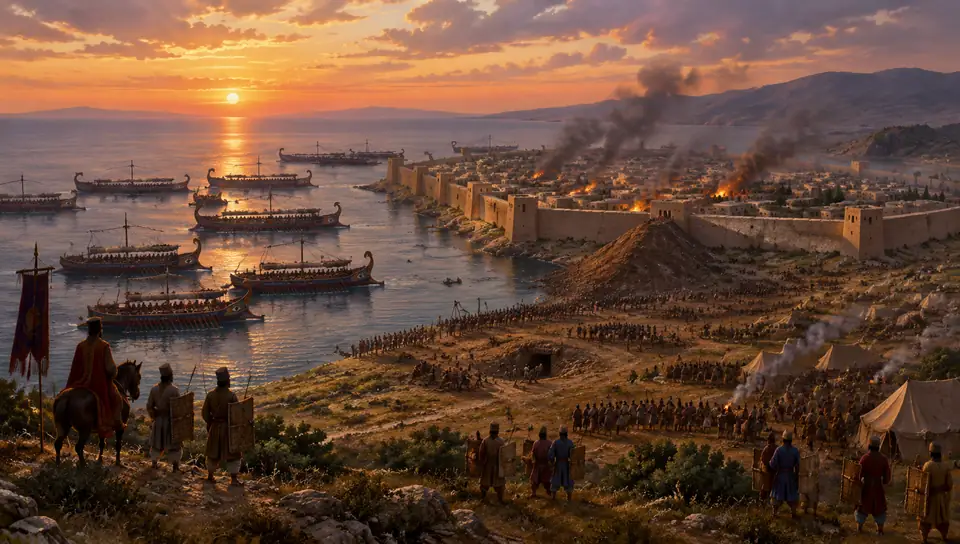
With the sea in their hands, the Persians attacked Miletus by land and water, “mining the walls and using every device against it, until they utterly captured it in the sixth year after the revolt of Aristagoras”.33Herodotus, Histories 6.18Written c. 430 BC. Translation by A. D. GodleyRead on Perseus ↗ Herodotus does not say how long the siege lasted. Older historians spread the events over several years: Grote thought the siege “may probably have been finished in 496-495 B. C.”, and How and Wells put the battle of Lade in 496 BC. Modern historians date both the battle and the capture of the city to 494 BC, counting the sixth year from the start of the revolt in 499 BC.34O. Murray, “The Ionian Revolt”, in The Cambridge Ancient History, vol. 4, 2nd ed. (1988), ch. 8Modern account of the revolt (Cambridge University Press)Read on Cambridge Core ↗ Grundy put the fall “some time in the late summer or autumn of 494”.35Grundy, The Great Persian War, ch. 3G. B. Grundy, The Great Persian War (1901). A modern study, dated in placesRead on Project Gutenberg ↗
Herodotus connects the city’s fate with an oracle given at Delphi some years before, in an answer to the Argives that also spoke of Miletus: “Then, Miletus, contriver of evil deeds, / For many will you become a banquet and glorious gifts; / Your wives will wash the feet of many long-haired men; / Other ministers will tend my Didyman shrine!”36Herodotus, Histories 6.19Written c. 430 BC. Translation by A. D. GodleyRead on Perseus ↗ The “long-haired men” were the Persians, who wore their hair long, as the reliefs at Persepolis show. All of it came true, Herodotus says: most of the men were killed, the women and children were made slaves, and the sanctuary at Didyma was plundered and burned.
The captives were taken to Susa. Darius did them no further harm and settled them at Ampe, near the mouth of the Tigris on the Persian Gulf, which Herodotus calls the Red Sea.37Herodotus, Histories 6.20Written c. 430 BC. Translation by A. D. GodleyRead on Perseus ↗ The Persians kept the land around the city and the plain for themselves and gave the hill country to Carians from Pedasa. “Miletus then was left empty of Milesians.”38Herodotus, Histories 6.22Written c. 430 BC. Translation by A. D. GodleyRead on Perseus ↗
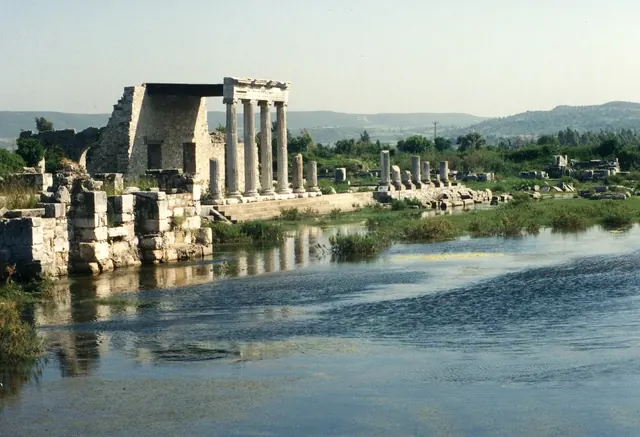
The emptying was not complete. Fifteen years later, at the battle of Mycale in 479 BC, the Persians posted Milesians to guard the mountain passes, and they led the fleeing Persians into their enemies’ hands and killed them. How and Wells drew the conclusion: the removal of the Milesians “can hardly have been complete, since Milesians destroy the fugitive Persians after Mycale”.39How and Wells, A Commentary on Herodotus, note on 6.20W. W. How and J. Wells, A Commentary on Herodotus, vol. 2 (1912). A modern commentary, now dated in placesRead on archive.org ↗ Miletus was rebuilt after the Persian Wars on the regular grid of streets whose remains visitors walk through today, but it never regained its old place in the Greek world.
Archaeology confirms a violent end. The German excavations on the hills of Kalabaktepe and Zeytintepe, at the southern edge of the archaic city, found several hundred arrowheads, which a recent study attributes, from their shapes and the layers they lay in, to the Persian assault of 494 BC.40S. Herzhoff, “Pfeilspitzen von Milet”, Archäologischer Anzeiger 2022/1Modern study of several hundred arrowheads from the excavations on Kalabaktepe and Zeytintepe at Miletus (German Archaeological Institute)Read at the DAI ↗ Excavation reports also describe a burnt destruction layer from the attack, after which some quarters seem to have stayed empty for a long time. How complete the destruction was is still debated by the excavators, but they agree that 494 BC was the turning point in the city’s history.41Miletus excavation, University of Hamburg, “History of the city of Miletus” (M. Ohlrogge)The current excavation of Miletus on the Persian destruction of 494 BCRead at the excavation website ↗
Didyma: the oracle burned
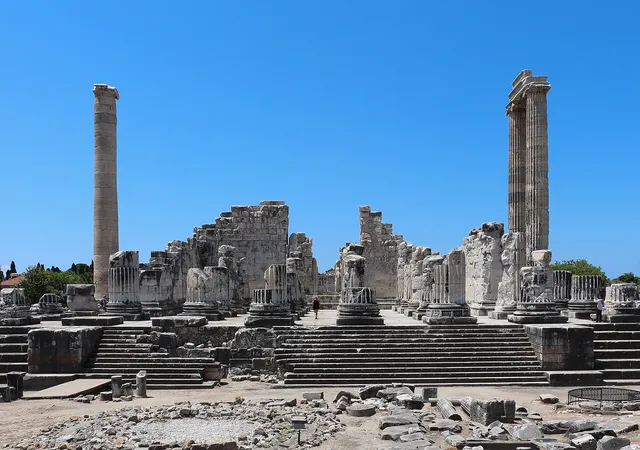
Some seventeen kilometres south of Miletus stood the great sanctuary of Apollo at Didyma, also called Branchidae after the family of priests who ran it. Its oracle was one of the most famous in the Greek world, and its treasures were rich: the Lydian king Croesus had sent offerings there. At the start of the revolt Hecataeus had advised the rebels to pay for a fleet with the treasure Croesus had dedicated in the temple.42Herodotus, Histories 5.36Written c. 430 BC. Translation by A. D. GodleyRead on Perseus ↗ They did not. In 494 BC the Persians took them instead: “the temple at Didyma with its shrine and place of divination was plundered and burnt”.43Herodotus, Histories 6.19Written c. 430 BC. Translation by A. D. GodleyRead on Perseus ↗
Not every ancient writer agreed on when this happened. Pausanias, writing about AD 160, says it was Xerxes who “took from them the brazen Apollo at Branchidæ”, as a punishment for the Milesians’ cowardice at Salamis.44Pausanias, Description of Greece 8.46Written c. AD 160. Translation by A. R. Shilleto (1886)Read on Project Gutenberg ↗ The geographer Strabo also blamed Xerxes, in 479 BC. How and Wells preferred Herodotus, who wrote much closer to the events: Strabo, they said, “can hardly be right in attributing the sack of Branchidae” to Xerxes, unless the sanctuary was plundered twice.45How and Wells, A Commentary on Herodotus, note on 6.19W. W. How and J. Wells, A Commentary on Herodotus, vol. 2 (1912). A modern commentary, now dated in placesRead on archive.org ↗ Modern scholars still debate whether the sanctuary was sacked once or twice, and how badly the temple was damaged in 494 BC; what is agreed is that the oracle fell silent and did not speak again until Alexander the Great came to Asia, more than 150 years later.46J. Fontenrose, Didyma: Apollo’s Oracle, Cult, and Companions (1988)Modern study of the sanctuary and oracle at Didyma (University of California Press)View on Google Books ↗
Samos spared, Ionia punished
Samos got what it had been promised. The Phoenicians brought Aeaces back as tyrant, and “the Samians were the only rebel people whose city and temples were not burnt”.47Herodotus, Histories 6.25Written c. 430 BC. Translation by A. D. GodleyRead on Perseus ↗ Not every Samian was content. The men of property, ashamed of their generals and unwilling to live under Aeaces, decided to emigrate rather than live as slaves of the Medes and of Aeaces.48Herodotus, Histories 6.22Written c. 430 BC. Translation by A. D. GodleyRead on Perseus ↗ With the Milesians who had escaped from Lade they sailed to Sicily, where they seized the city of Zancle. Caria, too, came back under Persian control after Miletus fell, some towns willingly, others by force.
Histiaeus had one last adventure. When he heard that Miletus had fallen, he left Byzantium, attacked Chios, whose fleet had been crippled at Lade, and then tried to take Thasos with a band of Ionian and Aeolian exiles. When the Phoenician fleet sailed north he went to Lesbos, and, short of food, crossed to the mainland to harvest grain near Atarneus. There a Persian army under Harpagus defeated his men and took Histiaeus alive. Overtaken by a Persian soldier, Histiaeus “cried out in the Persian language and revealed himself to be Histiaeus the Milesian”, hoping that the king would spare him.49Herodotus, Histories 6.29Written c. 430 BC. Translation by A. D. GodleyRead on Perseus ↗
Herodotus believed Darius would have forgiven him. But Artaphrenes and Harpagus did not take the risk. They impaled him at Sardis and sent his embalmed head to Darius at Susa. Darius blamed them, and ordered the head to be washed and buried with honour, “as of a man who had done great good to Darius himself and to Persia”: years before, Histiaeus had saved the king’s army by keeping the bridge over the Danube intact.50Herodotus, Histories 6.30Written c. 430 BC. Translation by A. D. GodleyRead on Perseus ↗
In 493 BC the Persian fleet, which had wintered at Miletus, took Chios, Lesbos and Tenedos. On each island, Herodotus says, the Persians “netted” the people: soldiers joined hands in a line from one shore to the other and swept the island from end to end. Then the threats made before Lade were carried out. The generals picked the handsomest boys and made them eunuchs, sent the most beautiful girls to the king, and burned the cities with their temples. “Thus three times had the Ionians been enslaved, first by the Lydians and now twice in a row by the Persians.”51Herodotus, Histories 6.32Written c. 430 BC. Translation by A. D. GodleyRead on Perseus ↗
Grote, sympathetic as he was, thought Herodotus had overstated this: “it must be exaggerated as to extent of depopulation and destruction”, since the same cities appear afterwards still inhabited by Greeks and in reasonable condition.52Grote, History of Greece, vol. 4, ch. 35G. Grote, History of Greece, vol. 4 (1847). A modern history, written 2,300 years laterRead on Project Gutenberg ↗ Herodotus himself shows it. Fourteen years later, in 480 BC, the Ionians sent a hundred ships to Xerxes’ fleet. The fleet then sailed north. The Persians burned the towns on the European side of the Hellespont, Proconnesus and Artace; the people of Byzantium and Chalcedon did not wait for the Phoenicians, but fled into the Black Sea and settled at Mesambria.
Artaphrenes’ settlement and Mardonius’ democracies
After the punishment came a settlement, and it was surprisingly mild. Herodotus says that in this year the Persians did nothing more against the Ionians, and that “certain things happened which greatly benefited the Ionians”. Artaphrenes summoned envoys from the cities to Sardis and “compelled the Ionians to make agreements among themselves that they would abide by the law and not rob and plunder each other”.53Herodotus, Histories 6.42Written c. 430 BC. Translation by A. D. GodleyRead on Perseus ↗ Disputes between cities would now go to arbitration, not war.
He also had their lands measured in parasangs and fixed each city’s tribute by the result. The new tribute was about the same as before, and it was still remembered in Herodotus’ day.54Herodotus, Histories 6.42Written c. 430 BC. Translation by A. D. GodleyRead on Perseus ↗ How and Wells saw in this the hand of the king himself: before the revolt, local rulers had been left a great deal of freedom, and “the organizing genius of Darius took advantage of the revolt and its suppression to put an end to this”.55How and Wells, A Commentary on Herodotus, note on 6.42W. W. How and J. Wells, A Commentary on Herodotus, vol. 2 (1912). A modern commentary, now dated in placesRead on archive.org ↗ Modern historians of Persia see it in the same way: a survey of land and a fair, fixed tribute were the normal Persian way of bringing a province back into order after a rebellion.56P. Briant, From Cyrus to Alexander: A History of the Persian Empire (2002), ch. 4 and 12Modern history of the Achaemenid empire (Eisenbrauns)View on Google Books ↗
The next spring, 492 BC, a new commander came to the coast: Mardonius, son of Gobryas, young and recently married to Darius’ daughter. He sailed along Ionia with the fleet and did something Herodotus knew his readers would not believe: “Mardonius deposed all the Ionian tyrants and set up democracies in their cities.”57Herodotus, Histories 6.43Written c. 430 BC. Translation by A. D. GodleyRead on Perseus ↗ The tyrants had been Persia’s instrument in Ionia, and they had started the revolt. How and Wells thought the change was partial and practical, made “rather by distrust of the tyranny which had proved a dangerous instrument of government, than by any preference for democracy”.58How and Wells, A Commentary on Herodotus, note on 6.43W. W. How and J. Wells, A Commentary on Herodotus, vol. 2 (1912). A modern commentary, now dated in placesRead on archive.org ↗ Some tyrants certainly survived: Aeaces in Samos, and in 480 BC a Chian named Herodotus was plotting to kill Strattis, the tyrant of Chios.59Herodotus, Histories 8.132Written c. 430 BC. Translation by A. D. GodleyRead on Perseus ↗
Whatever its extent, the new order worked. Ionia stayed quiet for the next fourteen years and sent its ships to fight for Xerxes in 480 BC. And Mardonius did not stop in Ionia. He crossed the Hellespont with a large army and fleet and marched through Thrace and Macedon, with Eretria and Athens as the stated goal. The storm that wrecked his fleet off Mount Athos is the subject of the next chapter.
Phrynichus and “The Capture of Miletus”
In Athens the news from Miletus hit hard. Miletus counted Athens as its mother city, and twenty Athenian ships had sailed with the Ionians to Sardis before Athens abandoned them. Herodotus contrasts two reactions. When Sybaris in Italy was destroyed in 510 BC, all the Milesians had shaved their heads in mourning; the Sybarites did nothing in return. The Athenians did the opposite.
The poet Phrynichus wrote a tragedy called The Capture of Miletus and put it on in the theatre of Dionysus. “The whole theater fell to weeping; they fined Phrynichus a thousand drachmas for bringing to mind a calamity that affected them so personally, and forbade the performance of that play forever.”60Herodotus, Histories 6.21Written c. 430 BC. Translation by A. D. GodleyRead on Perseus ↗ A thousand drachmas was a large sum, far more than a craftsman earned in a year. No line of the play survives.
Why was he fined? Herodotus says it was for reminding the Athenians of their own sorrows. Grote added a second reason: the subjects of tragedy “were portions of heroic legend, and not matters of recent history”, so Phrynichus had broken a rule of the stage as well.61Grote, History of Greece, vol. 4, ch. 35G. Grote, History of Greece, vol. 4 (1847). A modern history, written 2,300 years laterRead on Project Gutenberg ↗ How and Wells suspected politics: the play may have blamed Athens for deserting Miletus and urged the city to prepare against Persia, perhaps by sea. They noted that Themistocles, the champion of the navy, later paid for Phrynichus’ chorus, and that he was archon, by one ancient report, in 493 BC.62How and Wells, A Commentary on Herodotus, note on 6.21W. W. How and J. Wells, A Commentary on Herodotus, vol. 2 (1912). A modern commentary, now dated in placesRead on archive.org ↗
The date of the play is less certain than the story suggests. It is usually placed in 493 or 492 BC, soon after the city fell; one modern study dates it “between 493/92 and the year of Marathon”.63D. Rosenbloom, “Shouting ‘Fire’ in a Crowded Theater: Phrynichos’s Capture of Miletos and the Politics of Fear in Early Attic Tragedy”, Philologus 137 (1993), pp. 159–196, p. 172Modern article on the date and politics of the playFind on Google Scholar ↗ Others have argued that the “own misfortunes” were the sack of Athens itself in 480 BC, and that the trial belongs to the 470s.64F. X. Ryan, “Phrynichos kommt vor Gericht”, Studia Humaniora Tartuensia 6.A.1 (2005)Modern article on the trial of Phrynichus; argues, after J. Roisman, for a date after 480 BCRead at Studia Humaniora Tartuensia ↗ Either way, the play shows something important for the wars that followed: Athenians understood that what had happened to Miletus could happen to them, because the king had not forgotten Sardis.
Miltiades flees to Athens
One more Athenian was caught up in the end of the revolt. Miltiades, son of Cimon, ruled the Thracian Chersonese, the long peninsula on the European side of the Hellespont, which his family had ruled since the days of Pisistratus and which had been under Persian overlordship since Darius’ campaign against the Scythians. In 493 BC, when he learned that the Phoenicians were at Tenedos, he loaded five triremes with everything he could carry and sailed for Athens.65Herodotus, Histories 6.41Written c. 430 BC. Translation by A. D. GodleyRead on Perseus ↗ The Phoenicians caught him off the Chersonese. Miltiades escaped to Imbros with four ships, but the fifth was taken, and on it his eldest son, Metiochus.
The Phoenicians brought Metiochus to Darius, expecting a reward, because years before, during the king’s campaign against the Scythians, “Miltiades had declared his opinion among the Ionians that they should obey the Scythians in their demand to break the bridge of boats”, which would have left Darius stranded north of the Danube.66Herodotus, Histories 6.41Written c. 430 BC. Translation by A. D. GodleyRead on Perseus ↗ Darius surprised them. He did Metiochus no harm, but gave him a house, property and a Persian wife, whose children were counted as Persians.
Miltiades reached Athens. His enemies prosecuted him for his tyranny in the Chersonese, and he was acquitted and elected general. Three years later he would lead the Athenians at Marathon against the Persian army that came to punish Athens for Sardis. The man who knew the Persians best, and had most reason to fear them, was in Athens when they arrived.
Why it mattered: Athens and Eretria next
From the Persian side, the end of the revolt left one account unsettled. The Ionians had been punished and Ionia reorganised; the Cypriots and Carians were subjects again. But Athens and Eretria, the two cities from beyond the sea that had helped burn Sardis, had suffered nothing. Herodotus makes this the thread of the following years. In 492 BC Mardonius’ army set out “with Eretria and Athens as their goal”; in 490 BC, he says, Darius’ servant was still reminding him to remember the Athenians, and the king wanted to use the pretext to conquer all the Greeks who had not given him earth and water: “Darius desired to take this pretext for subduing all the men of Hellas who had not given him earth and water.”67Herodotus, Histories 6.94Written c. 430 BC. Translation by A. D. GodleyRead on Perseus ↗
The way the revolt ended also shaped the wars to come. Persia had learned to fight the Greeks at sea with Phoenician, Cypriot, Cilician and Egyptian ships, to strike at the strongest city first, and to split a Greek alliance with promises to each member. Exiled tyrants had proved useful; Hippias, the old tyrant of Athens, would guide the Persians to Marathon. The Greeks, for their part, had seen a fleet of 353 ships thrown away by divided command, and a great city emptied of its people. Rawlinson, the Victorian historian of Persia, summed up the Greek view of Lade in one sentence: “Laziness and insubordination began and treachery completed the work which all the force of Persia might have failed to accomplish”.68Rawlinson, The Fifth Monarchy: Persia, ch. 7G. Rawlinson, The Seven Great Monarchies, vol. 5 (1871). A Victorian history of Persia, based mostly on Greek writersRead on Project Gutenberg ↗
Grundy, who thought Herodotus unfair to the Ionians, drew the opposite lesson: “But the revolt had saved Greece.”69Grundy, The Great Persian War, ch. 3G. B. Grundy, The Great Persian War (1901). A modern study, dated in placesRead on Project Gutenberg ↗ In his view the six years of fighting cost Persia two fleets and an army with its generals, and kept the king busy in Asia during the years when mainland Greece was weakest. By the time the great invasion came in 480 BC, Athens had built the fleet that won at Salamis. Few historians today would put it so strongly; the delay was short, and Persia’s resources were barely touched. But the order of events is clear. The revolt began with Athenian ships at Sardis; it ended with Persian armies and fleets in control of the whole Aegean coast of Asia, and with their commanders’ eyes on Eretria and Athens.
Rebel subjects brought back to order
For the Greeks Lade was a tragedy. For the Persian court it was the end of a rebellion in one province among many. Darius counted the Ionians among his subject peoples from the start of his reign: in his great inscription at Behistun, carved about 520 BC, the list of lands that came to him “by the grace of Auramazda” includes Sardis “and Ionia, and Media, and Armenia”.70Darius I, Behistun inscription § 6Carved c. 520 BC by order of Darius. Translation by L. W. King and R. C. Thompson (1907)Read on archive.org ↗ The Old Persian word was Yauna, the same name that later Persian texts use for Greeks in general. The Ionians were not foreign enemies to be conquered but subjects who had broken their loyalty, and in Darius’ own words at Behistun, the provinces that rebelled against him did so because “lies made them revolt”.71Darius I, Behistun inscription § 54Carved c. 520 BC by order of Darius. Translation by L. W. King and R. C. Thompson (1907)Read on archive.org ↗
No Persian text mentions the revolt or Lade. The administrative clay tablets from Persepolis, which cover almost exactly these years, record rations for officials, workers and travellers all over the empire, but they say nothing about the war in the west. Seen from the centre, the revolt was handled by the satrap of Sardis, the king’s brother Artaphrenes, and by generals related to the royal house, with the fleets of the subject peoples.72P. Briant, From Cyrus to Alexander: A History of the Persian Empire (2002), ch. 4 and 12Modern history of the Achaemenid empire (Eisenbrauns)View on Google Books ↗ Even in Herodotus’ Greek account the Persian method is visible: patient campaigns to cut off the revolt’s outer parts, one great combined army and fleet against the centre, and the use of exiled Ionian leaders to divide the enemy.
The punishments Herodotus describes, the deportation of the Milesians to the Persian Gulf, the boys taken as eunuchs, the burned temples, were harsh but not unusual for rebels in the ancient Near East. Deportation was also a way of making use of people. The Milesians were settled at Ampe and left in peace; four years later Darius treated the captured Eretrians the same way: “he did them no harm, but settled them in a domain of his own”.73Herodotus, Histories 6.119Written c. 430 BC. Translation by A. D. GodleyRead on Perseus ↗ The same king honoured the head of Histiaeus and gave a house and a Persian wife to the son of Miltiades. Herodotus’ Darius punishes disloyalty, but rewards past service and values useful men, whatever their origin.
The settlement that followed shows a ruler who wanted a quiet and paying province, not a ruined one. Fair tribute, law instead of war between cities, and the removal of the tyrants who had proved unreliable were sensible measures, and Ionia did not revolt again until the Persian army had been beaten in Greece. Rawlinson, writing in 1871, praised Mardonius’ democracies as a measure taken “with a wisdom which we should scarcely have expected in an Oriental”.74Rawlinson, The Fifth Monarchy: Persia, ch. 7G. Rawlinson, The Seven Great Monarchies, vol. 5 (1871). A Victorian history of Persia, based mostly on Greek writersRead on Project Gutenberg ↗ In his time “Oriental” was the usual word for the peoples of Asia, and his surprise says more about the Victorian image of Persia than about Mardonius. Seen from Persepolis, the order had been restored, and the next step was to settle the account with the two Greek cities that had burned Sardis.
How close is our evidence?
For the end of the Ionian Revolt we depend almost entirely on one writer. Herodotus was born at Halicarnassus, a Carian city a short sail south of Miletus, about ten years after Lade, and he collected his stories from people whose parents had fought there. He knew the Samian version of the battle, saw the Samian pillar, and heard the different cities blame each other. He also judged the revolt harshly, as the beginning of troubles for the Greeks, and his picture of lazy Ionians and a cowardly Aristagoras was challenged already in antiquity: Plutarch, about AD 100, wrote a whole essay attacking Herodotus’ malice, and quoted Charon of Lampsacus, an older historian whose account of the march on Sardis ended, word for word, with “they returned to Miletus”.75Plutarch, On the Malice of Herodotus 24Written c. AD 100. Translation by W. W. Goodwin (1874)Read on Project Gutenberg ↗
The works that stood closest to the events, Hecataeus’ history and Phrynichus’ tragedy, are lost. What survives from 494 BC itself is in the ground at Miletus: arrowheads, burnt layers and the foundations of a city that was emptied and later rebuilt. The modern geology of the Maeander plain has shown what the bay looked like when the fleets met. The story of the battle, the speeches and the Samian excuses come from Herodotus alone, and should be read as he offered them: the best account he could get, from witnesses who all blamed each other.
- Herodotus, Histories 5.103
- Herodotus, Histories 5.108
- Herodotus, Histories 5.109
- Herodotus, Histories 5.112
- Herodotus, Histories 5.116
- Herodotus, Histories 5.124
- Herodotus, Histories 5.125
- Grundy, The Great Persian War, ch. 3
- Herodotus, Histories 6.1
- Herodotus, Histories 6.3
- Herodotus, Histories 6.6
- Herodotus, Histories 6.6
- How and Wells, A Commentary on Herodotus, note on 6.7
- H. Brückner, M. Müllenhoff, R. Gehrels, A. Herda, M. Knipping and A. Vött, “From archipelago to floodplain: geographical and ecological changes in Miletus and its environs during the past six millennia”, Zeitschrift für Geomorphologie, Supplement 142 (2006), pp. 63–83
- Herodotus, Histories 6.8
- Herodotus, Histories 6.9
- How and Wells, A Commentary on Herodotus, note on 6.8
- How and Wells, A Commentary on Herodotus, Appendix 19
- Grote, History of Greece, vol. 4, ch. 35
- Herodotus, Histories 6.9
- Herodotus, Histories 6.9
- Herodotus, Histories 6.10
- Herodotus, Histories 6.11
- Herodotus, Histories 6.12
- Grote, History of Greece, vol. 4, ch. 35
- Grundy, The Great Persian War, ch. 3
- How and Wells, A Commentary on Herodotus, note on 6.12
- Herodotus, Histories 6.13
- Herodotus, Histories 6.14
- Herodotus, Histories 6.14
- Herodotus, Histories 6.15
- Herodotus, Histories 6.17
- Herodotus, Histories 6.18
- O. Murray, “The Ionian Revolt”, in The Cambridge Ancient History, vol. 4, 2nd ed. (1988), ch. 8
- Grundy, The Great Persian War, ch. 3
- Herodotus, Histories 6.19
- Herodotus, Histories 6.20
- Herodotus, Histories 6.22
- How and Wells, A Commentary on Herodotus, note on 6.20
- S. Herzhoff, “Pfeilspitzen von Milet”, Archäologischer Anzeiger 2022/1
- Miletus excavation, University of Hamburg, “History of the city of Miletus” (M. Ohlrogge)
- Herodotus, Histories 5.36
- Herodotus, Histories 6.19
- Pausanias, Description of Greece 8.46
- How and Wells, A Commentary on Herodotus, note on 6.19
- J. Fontenrose, Didyma: Apollo’s Oracle, Cult, and Companions (1988)
- Herodotus, Histories 6.25
- Herodotus, Histories 6.22
- Herodotus, Histories 6.29
- Herodotus, Histories 6.30
- Herodotus, Histories 6.32
- Grote, History of Greece, vol. 4, ch. 35
- Herodotus, Histories 6.42
- Herodotus, Histories 6.42
- How and Wells, A Commentary on Herodotus, note on 6.42
- P. Briant, From Cyrus to Alexander: A History of the Persian Empire (2002), ch. 4 and 12
- Herodotus, Histories 6.43
- How and Wells, A Commentary on Herodotus, note on 6.43
- Herodotus, Histories 8.132
- Herodotus, Histories 6.21
- Grote, History of Greece, vol. 4, ch. 35
- How and Wells, A Commentary on Herodotus, note on 6.21
- D. Rosenbloom, “Shouting ‘Fire’ in a Crowded Theater: Phrynichos’s Capture of Miletos and the Politics of Fear in Early Attic Tragedy”, Philologus 137 (1993), pp. 159–196, p. 172
- F. X. Ryan, “Phrynichos kommt vor Gericht”, Studia Humaniora Tartuensia 6.A.1 (2005)
- Herodotus, Histories 6.41
- Herodotus, Histories 6.41
- Herodotus, Histories 6.94
- Rawlinson, The Fifth Monarchy: Persia, ch. 7
- Grundy, The Great Persian War, ch. 3
- Darius I, Behistun inscription § 6
- Darius I, Behistun inscription § 54
- P. Briant, From Cyrus to Alexander: A History of the Persian Empire (2002), ch. 4 and 12
- Herodotus, Histories 6.119
- Rawlinson, The Fifth Monarchy: Persia, ch. 7
- Plutarch, On the Malice of Herodotus 24
- Herodotus, Histories: 5.113, 5.117, 5.119, 5.121, 5.123, 5.126, 6.5, 6.7, 6.12, 6.15, 6.16, 6.21, 6.28, 6.30, 6.31, 6.33, 6.41, 6.43, 7.94, 9.104
- Grundy, The Great Persian War: ch. 3