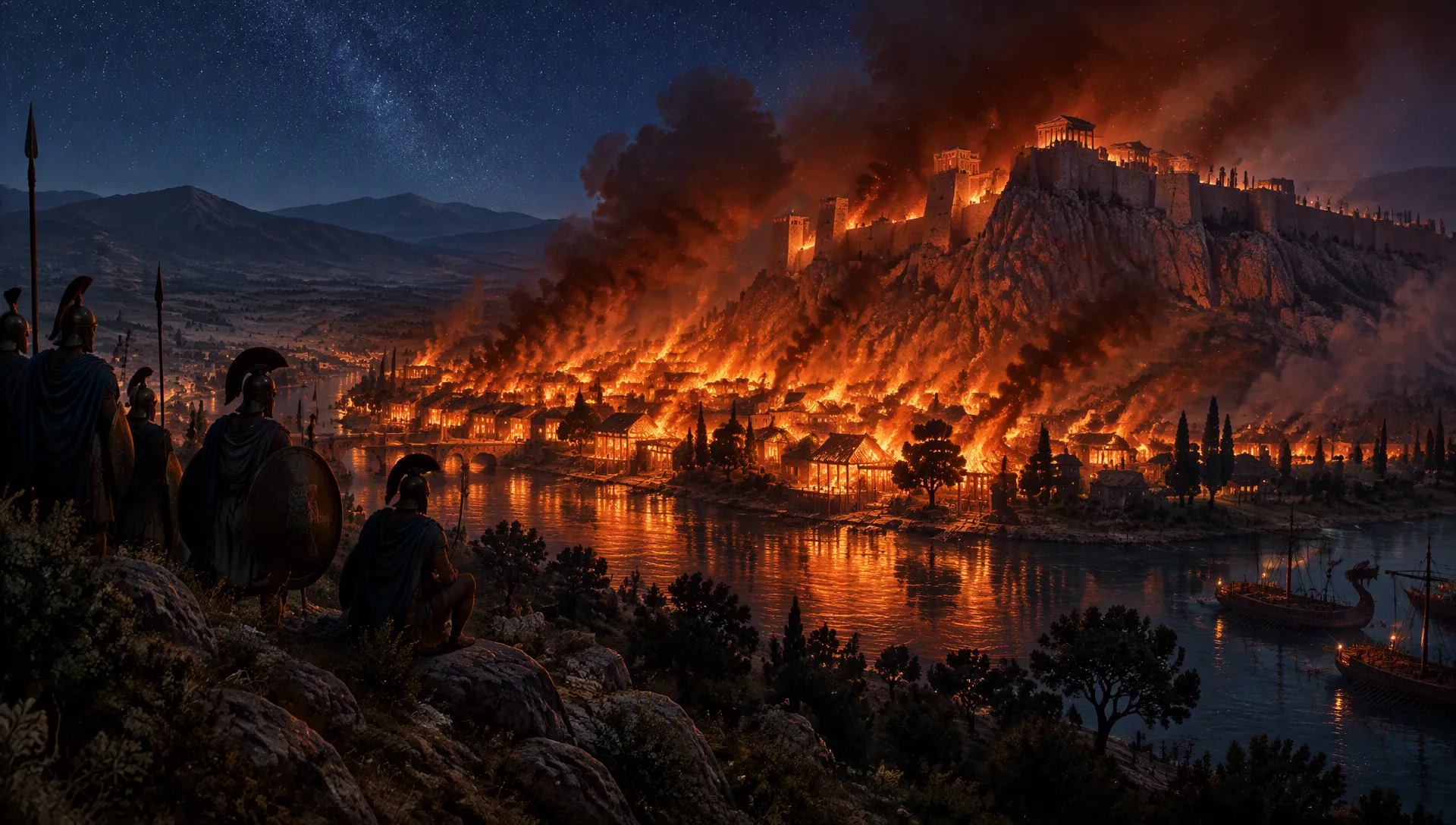
In 498 BC a Greek army marched up from the coast of Asia Minor and set fire to Sardis, the seat of the Persian governor of the west. Twenty of the ships that brought it had come from Athens, on the far side of the Aegean. The raid lasted a few days and ended in defeat, but it changed everything. To the Persian king, Athens was now an enemy that had burned one of his cities. The road from that fire leads straight to Marathon, Thermopylae and Salamis.
Where the Persian Wars begin
The Persian Wars are usually told as the story of two invasions of Greece, in 490 and 480 BC. But neither invasion came out of nowhere. Both began with a quarrel on the other side of the Aegean, in Ionia, the strip of Greek cities on the west coast of what is now Turkey. In 499 BC those cities rose against Persian rule. Athens and the small city of Eretria, on the island of Euboea, sent ships to help them, and together they burned Sardis. Herodotus, who wrote the history of the whole war about seventy years later, put his finger on that moment. Of the Athenian ships he says: “These ships were the beginning of troubles for both Greeks and foreigners.”1Herodotus, Histories 5.97.3Written c. 430 BC. Translation by A. D. GodleyRead on Perseus ↗
This chapter follows that beginning: how the Greeks of Ionia came under Persian rule, how a failed attack on the island of Naxos pushed the ruler of Miletus into rebellion, why Sparta said no and Athens said yes, what happened at Sardis, and why the Persian king never forgot it. It ends in 497 BC, with the revolt at its widest, before the Persian counter-attack that ended at Lade and Miletus, which is the subject of the next chapter.
Ionia under Persian rule
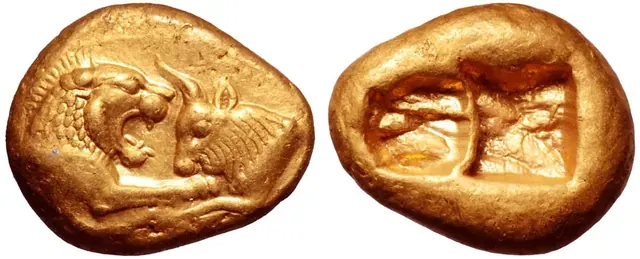
The Ionians were Greeks whose ancestors had crossed the Aegean centuries before and founded cities along the coast of Asia Minor and on the islands off it: Miletus, Ephesus, Phocaea, Chios, Samos and the rest. They shared a sanctuary of Poseidon on the headland of Mycale, the Panionion, but they never formed a single state. In the sixth century BC they were among the richest Greeks in the world, and their wealth attracted the great powers inland. First the kings of Lydia, from their capital at Sardis, made them pay tribute. Then, in the 540s BC, Cyrus the Great of Persia conquered Lydia and its king Croesus, and his generals took the Greek cities one by one. Herodotus counts it as the second loss of their freedom: “Thus Ionia was enslaved for the second time”.2Herodotus, Histories 1.169.2Written c. 430 BC. Translation by A. D. GodleyRead on Perseus ↗
Only Miletus escaped the fighting, because it had made its own treaty with Cyrus. The Spartans, asked for help, sent a herald to warn Cyrus not to harm any Greek city. Cyrus asked who these Spartans were, and answered with contempt that he had never yet feared men who met in a marketplace in the middle of their city to cheat each other.3Herodotus, Histories 1.153.1Written c. 430 BC. Translation by A. D. GodleyRead on Perseus ↗ It was the first contact between Persia and mainland Greece, and the Persians drew a lesson from it: the Greeks across the sea talked loudly and did nothing.
Under Darius I, who became king in 522 BC, the empire was organised into provinces that paid fixed tribute. The Ionians, together with their neighbours in Caria, Lycia and Pamphylia, formed the first province on Herodotus’ list and paid four hundred talents of silver a year. The centre of Persian power in the west was Sardis, the old Lydian capital, 90 kilometres inland from Ephesus. There Darius placed his own brother Artaphernes as satrap, the king’s governor of the province.
Persia did not govern the Greek cities directly. In each city it backed one local man, a “tyrant” in the Greek sense of the word, who ruled with Persian support and kept the city loyal. How much those tyrants depended on the king became clear in about 513 BC, when Darius crossed the Danube to fight the Scythians and left the Ionian tyrants to guard his bridge. The Scythians urged them to break it and leave Darius stranded. Histiaeus, tyrant of Miletus, talked the others out of it: “It is owing to Darius that each of us is sovereign of his city”, he said, and if Darius fell, the cities would choose democracy.4Herodotus, Histories 4.137.2Written c. 430 BC. Translation by A. D. GodleyRead on Perseus ↗ The tyrants stayed, and Darius got home safely.
Aristagoras and the attack on Naxos
Histiaeus was rewarded for his loyalty, but not for long. Darius gave him Myrcinus, a site on the river Strymon in Thrace, rich in timber and silver. The Persian general Megabazus warned the king that a clever Greek with forests for shipbuilding and mines of silver could become dangerous. So Darius invited Histiaeus to Susa as his friend and counsellor, and kept him there. In Miletus his place was taken by his cousin and son-in-law Aristagoras, who ruled as his deputy.
Around 500 BC a group of rich men, driven out of Naxos by the common people, came to Miletus and asked Aristagoras to bring them home. Naxos was then the most prosperous of the islands, and it was not yet under Persian rule. Aristagoras saw a chance to become master of the island. He could not do it alone, since the Naxians had eight thousand men who bore shields, so he went to Sardis and offered Artaphernes a bigger prize: Naxos, then the other Cyclades, and from there Euboea, “a great and a wealthy island, no smaller than Cyprus and very easy to take”.5Herodotus, Histories 5.31.3Written c. 430 BC. Translation by A. D. GodleyRead on Perseus ↗ He asked for a hundred ships and promised to pay the costs.
Artaphernes liked the plan so much that he offered two hundred ships, once the king had agreed. Darius did agree, and in the spring of 499 BC a Persian fleet with a large army of Persians and allies sailed under Megabates, a cousin of the king. What happened next is one of the strangest stories in Herodotus. On the way, Megabates found a ship from Myndus with no watch on deck and had its captain tied through an oar-hole, head outside and body inside. Aristagoras, a friend of the captain, freed him and told Megabates that he was only there to obey orders. In revenge, says Herodotus, Megabates secretly warned the Naxians, who had time to bring in their crops and strengthen their walls. The fleet besieged the city for four months, ran out of money and sailed home.
Few modern historians believe the story of Megabates’ treachery. How and Wells, in their commentary of 1912, called it “very improbable”: a member of the royal family would hardly ruin an expedition the king had approved, and he stayed in high favour afterwards.6How and Wells, A Commentary on Herodotus, note on 5.33W. W. How and J. Wells, A Commentary on Herodotus, vol. 2 (1912). A modern commentary, now dated in placesRead on archive.org ↗ The Naxians, who had seen Samos, Chios and Lesbos fall to Persia, hardly needed a warning when two hundred ships gathered on the coast. Whatever the reason, the failure left Aristagoras in deep trouble. He owed the costs of the campaign, he had quarrelled with a Persian of royal blood, and he expected to lose his rule over Miletus. Some modern historians treat the attack on Naxos itself as one of the causes of the revolt, and not only as Aristagoras’ private problem.7A. Keaveney, “The Attack on Naxos: a ‘Forgotten Cause’ of the Ionian Revolt”, Classical Quarterly 38 (1988), pp. 76–81Modern article on the Naxos expedition as a cause of the revoltRead on Cambridge Core ↗

The man with the marked head
At this point Herodotus brings in the most famous secret message of antiquity. Histiaeus, kept at Susa, wanted to tell Aristagoras to revolt, but the roads were watched. So he shaved the head of his most trusted slave, marked the message on his scalp, waited for the hair to grow back, and sent him to Miletus with one instruction: Aristagoras should shave his head and look at it.8Herodotus, Histories 5.35.3Written c. 430 BC. Translation by A. D. GodleyRead on Perseus ↗ The marks “signified revolt”. Herodotus also gives the motive. Histiaeus hated being held at Susa, and he reckoned that if Ionia rose, the king would send him to the coast to deal with it. If Miletus stayed quiet, he would never see it again.
The message arrived, Herodotus says, just when Aristagoras was already thinking of revolt, so that “all these things came upon Aristagoras at one and the same time”.9Herodotus, Histories 5.36.1Written c. 430 BC. Translation by A. D. GodleyRead on Perseus ↗ The coincidence is suspicious, and so is the timing. The British historian G. B. Grundy pointed out in 1901 that when Aristagoras called his friends together, Herodotus treats them as a group of men who were already in a plot. To Grundy this showed that the plan of revolt had been made before the Naxos expedition, perhaps long before: the story “indicates that the plan of revolt had been made before”.10Grundy, The Great Persian War, ch. 3G. B. Grundy, The Great Persian War (1901). A modern study, dated in placesRead on Project Gutenberg ↗ He even suggested that the expedition was Aristagoras’ way of getting the whole Ionian fleet together in one place, which was the only way a revolt could start. How and Wells answered that this was possible but could not be proved.
Modern historians still argue about the two men. One influential study reads the revolt as a struggle for leadership between Histiaeus and Aristagoras, each trying to use the rising for his own ends.11P. B. Manville, “Aristagoras and Histiaios: The Leadership Struggle in the Ionian Revolt”, Classical Quarterly 27 (1977), pp. 80–91Modern article reading the revolt as a power struggle between the two menRead on Cambridge Core ↗ What almost everyone accepts is that Herodotus’ picture of two selfish tyrants is only part of the explanation. Grundy summed up Herodotus’ view of Aristagoras in one sharp line: “Having failed to enslave the free, he tried to free the slave.”12Grundy, The Great Persian War, ch. 3G. B. Grundy, The Great Persian War (1901). A modern study, dated in placesRead on Project Gutenberg ↗
The tyrants fall
Aristagoras’ friends all spoke for revolt, except one. Hecataeus of Miletus, the greatest geographer of his day, listed the peoples of the Persian empire and the size of its armies, and advised against war. When he was outvoted, he gave a second piece of advice: if they were going to fight, they must win control of the sea, and to pay for a fleet they should take the treasures that Croesus had dedicated at the temple of Apollo at Branchidae, near Miletus. That too was rejected.13Herodotus, Histories 5.36.2Written c. 430 BC. Translation by A. D. GodleyRead on Perseus ↗ Hecataeus is one of the few people in this story who was also a writer, and some of what Herodotus knew about the revolt may go back to him.
The first blow was struck in autumn 499 BC, against the tyrants rather than the Persians. The fleet that had come back from Naxos was still gathered at Myus, near Miletus, with the tyrants of many cities on board as its commanders. A Milesian named Iatragoras was sent to seize them by a trick, and he arrested a whole group of them, among them the rulers of Mylasa, Termera, Mytilene and Cyme. Aristagoras then gave up his own position, at least in name, and gave Miletus “equality of government”, so that the Milesians would follow him willingly.14Herodotus, Histories 5.37.2Written c. 430 BC. Translation by A. D. GodleyRead on Perseus ↗
He did the same in the other cities of Ionia. Some tyrants were driven out; the ones taken from the fleet were handed over to their own cities. Most cities let them go. Mytilene took its tyrant Coes, the man whom Darius had rewarded for his advice at the Danube, and stoned him to death. Herodotus sums it up: “In this way, then, an end was made of tyrants in the cities.”15Herodotus, Histories 5.38.2Written c. 430 BC. Translation by A. D. GodleyRead on Perseus ↗ Aristagoras told each city to choose its own generals. By removing the tyrants he removed the men through whom Persia ruled, and he made the revolt popular. There was now no going back.
Why did the cities follow so readily? Herodotus tells the story as the work of two ambitious men, but his own account shows that resentment ran deep. The tyrants were the king’s men, the tribute went to Sardis, and the cities had lost the freedom to make their own war and peace. How and Wells concluded that the means by which the revolt was brought to a head were uncertain, but that discontent was general: “Discontent with the Persian and the tyrant was doubtless rife in Western Asia”.16How and Wells, A Commentary on Herodotus, note on 5.36W. W. How and J. Wells, A Commentary on Herodotus, vol. 2 (1912). A modern commentary, now dated in placesRead on archive.org ↗ Modern historians add other possible reasons: trade that suffered as Persia expanded around the Aegean and the Black Sea, and the example of free cities across the sea. They also point out that Herodotus’ own evidence sometimes contradicts the motives he gives his characters.17M. Lang, “Herodotus and the Ionian Revolt”, Historia 17 (1968), pp. 24–36Modern article that tests Herodotus’ account against his own evidenceFind in a library (WorldCat) ↗ Others argue that his account of Persian Ionia holds together better than his critics allow.18P. B. Georges, “Persian Ionia under Darius: The Revolt Reconsidered”, Historia 49 (2000), pp. 1–39Modern article on Ionia under Persian rule and the causes of the revoltRead on JSTOR ↗ Modern historians generally date the deposition of the tyrants to 499 BC and the attack on Sardis to the following year.19O. Murray, “The Ionian Revolt”, in The Cambridge Ancient History, vol. 4 (2nd ed., 1988), pp. 461–490Modern standard account of the revolt (Cambridge University Press)Read on Cambridge Core ↗
Aristagoras in Sparta
Aristagoras knew that the Ionians could not beat the Persian empire alone. In the winter of 499/498 BC he sailed to Greece to look for allies, and he went first to Sparta, the strongest military power in Greece. The king he met there was Cleomenes, a hard and unpredictable man who had driven the tyrant Hippias out of Athens ten years before. According to the Spartan version that Herodotus heard, Aristagoras brought “a bronze tablet on which the map of all the earth was engraved”.20Herodotus, Histories 5.49.1Written c. 430 BC. Translation by A. D. GodleyRead on Perseus ↗ It may have been the work of Hecataeus, who drew one of the first Greek maps of the world.
His speech was an appeal and a sales pitch at once. The Ionians, kinsmen of the Spartans, were slaves, and Sparta as the leader of Greece ought to free them. The Persians would be easy to beat: “they carry bows and short spears, and they go to battle with trousers on their legs and turbans on their heads”.21Herodotus, Histories 5.49.3Written c. 430 BC. Translation by A. D. GodleyRead on Perseus ↗ And Asia was rich. Pointing to the map, he named the peoples one after another, Lydians, Phrygians, Cappadocians, Cilicians, Armenians, as far as Susa, where the king kept his treasure: take that city, he said, and you could rival Zeus for wealth. Why fight the Messenians and Argives over poor land, when all Asia was there for the taking?
Cleomenes asked for three days to think. Then he asked one question: how many days’ journey was it from the sea to the king? Aristagoras told the truth: three months. That ended the audience. Cleomenes ordered him out of Sparta before sunset, because the Spartans would never march an army three months from the sea.22Herodotus, Histories 5.50.3Written c. 430 BC. Translation by A. D. GodleyRead on Perseus ↗ Aristagoras followed the king home as a suppliant and offered him money, ten talents, then more and more, up to fifty. Cleomenes’ daughter Gorgo, eight or nine years old, was in the room. “Father,” she said, “the stranger will corrupt you, unless you leave him and go away.” Cleomenes left the room, and Aristagoras left Sparta.23Herodotus, Histories 5.51.2Written c. 430 BC. Translation by A. D. GodleyRead on Perseus ↗
Herodotus then interrupts the story to check the answer. He describes the Royal Road from Sardis to Susa stage by stage, with its royal stations and guarded river crossings, and adds it up: 111 stages and 450 parasangs, at 150 furlongs a day exactly ninety days, plus three more from Ephesus to Sardis. Aristagoras’ bronze map made Asia look small and easy; Herodotus’ measured road shows why a Spartan king said no. A modern study reads the scene in exactly this way, as Herodotus setting his own careful inquiry against Aristagoras’ misleading picture of the world.24D. Branscome, “Herodotus and the Map of Aristagoras”, Classical Antiquity 29 (2010), pp. 1–44Modern article on the bronze map scene in Herodotus 5.49–54Read at University of California Press ↗ The Spartans’ refusal was not only caution. Grundy noted that it fitted a policy they had followed for years: Sparta “refused to become embroiled with the great empire of the East”.25Grundy, The Great Persian War, ch. 3G. B. Grundy, The Great Persian War (1901). A modern study, dated in placesRead on Project Gutenberg ↗
Why Athens said yes
From Sparta Aristagoras went to Athens. Herodotus treats the Athenian vote as a piece of folly, but he also tells us, a few chapters earlier, why Athens saw the matter differently. Athens had already quarrelled with Persia, and the quarrel had a name: Hippias.
Hippias was the son of Pisistratus and the last tyrant of Athens. The Spartans under Cleomenes had expelled him in 510 BC, and the Athenians had then built a new, more democratic order under Cleisthenes. When Cleomenes came back to undo it, and a Spartan-led army was gathering against them, the Athenians, about 507 BC, sent envoys to Sardis to ask Persia for an alliance. Artaphernes asked who these people were and where they lived, and then gave his terms: if the Athenians gave King Darius earth and water, he would make an alliance with them. The envoys agreed on their own authority. “They then returned to their own country and were there greatly blamed for what they had done.”26Herodotus, Histories 5.73.3Written c. 430 BC. Translation by A. D. GodleyRead on Perseus ↗
Hippias, meanwhile, had not given up. After the Spartans’ last attempt to restore him failed, he went to Sigeum on the Hellespont and from there to Sardis, where he did everything he could to turn Artaphernes against Athens and to bring the city under his own and Darius’ rule. The Athenians sent envoys to warn the Persians not to listen to exiles. Artaphernes replied that if they wanted to be safe, they must take Hippias back. The Athenians refused, and “it was resolved that they should be openly at war with Persia”.27Herodotus, Histories 5.96.2Written c. 430 BC. Translation by A. D. GodleyRead on Perseus ↗ The historian George Grote, writing in 1847, put it simply: “Such a reply was equivalent to a declaration of war, and so it was construed at Athens.”28Grote, History of Greece, vol. 4, ch. 35G. Grote, History of Greece, vol. 4 (1847). A modern history, written 2,300 years laterRead on Project Gutenberg ↗
So when Aristagoras arrived, the Athenians already expected a Persian attack sooner or later, with Hippias riding at the head of it. Aristagoras gave the same speech as in Sparta, about the riches of Asia and the poor fighting qualities of the Persians, and added that the Milesians were colonists from Athens, so Athens had a duty to save them. He promised everything, and he won. Herodotus comments drily that it is easier to deceive many than one: he could not fool Cleomenes alone, but he fooled thirty thousand Athenians. The Athenians voted to send twenty ships under Melanthius, a respected citizen. How and Wells thought the quip about the many and the one probably came from a Spartan source.
Grote disagreed with Herodotus. Athens and Sparta were not in the same position: “the Athenians had a material interest in the quarrel, political as well as sympathetic, while the Spartans had none”.29Grote, History of Greece, vol. 4, ch. 35G. Grote, History of Greece, vol. 4 (1847). A modern history, written 2,300 years laterRead on Project Gutenberg ↗ A revolt that kept the Persian fleet and army busy in Asia was the best defence Athens could have. How and Wells went further. On Herodotus’ own showing, the Persians had already planned the conquest of Greece, and Athens was openly threatened; the vote “did but forestall an inevitable attack”. In their view Athens’ fault was not that it helped the Ionians, but that it soon abandoned them.30How and Wells, A Commentary on Herodotus, note on 5.97W. W. How and J. Wells, A Commentary on Herodotus, vol. 2 (1912). A modern commentary, now dated in placesRead on archive.org ↗
Eretria, a city on Euboea, sent five triremes of its own. Herodotus says it came not for Athens’ sake but to repay an old debt: Miletus had once helped Eretria in its war against Chalcis. Grote called it generous; it would cost Eretria dearly.
The march on Sardis
The ships reached Miletus in the spring of 498 BC. Aristagoras did not lead the army himself. He stayed in Miletus and gave the command to his brother Charopinus and another Milesian, Hermophantus. Before the march he played one more card against Darius: he sent word to the Paeonians, a people from the Strymon whom the Persians had deported to Phrygia, that they could go home. Many of them walked to the coast and crossed back to Europe with the help of the islanders.31Herodotus, Histories 5.98.3Written c. 430 BC. Translation by A. D. GodleyRead on Perseus ↗ It did nothing for the Ionians, Herodotus says, and was meant only to annoy the king.
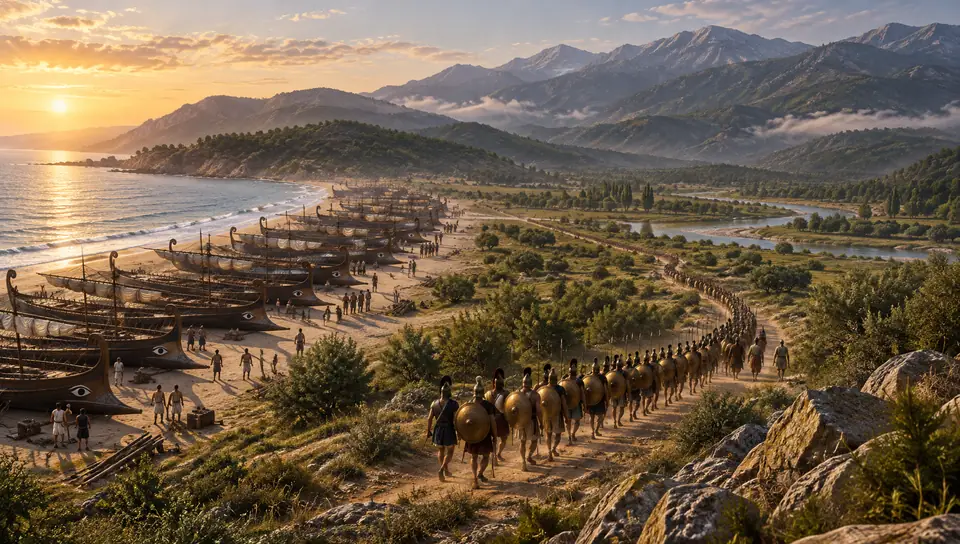
The army sailed to Ephesus and left the ships at Coresus, on the coast nearby. With Ephesians as guides it marched inland up the river valley, crossed the mountain range of Tmolus and came down on Sardis. Herodotus says the city fell “without any resistance”; only the citadel held out, defended by Artaphernes himself with a strong force.32Herodotus, Histories 5.100.1Written c. 430 BC. Translation by A. D. GodleyRead on Perseus ↗ How and Wells noted that the normal road led up the valley of the Cayster and over the Tmolus by an easy pass, and that the need for guides suggests the Greeks took mountain paths to arrive by surprise.33How and Wells, A Commentary on Herodotus, note on 5.100W. W. How and J. Wells, A Commentary on Herodotus, vol. 2 (1912). A modern commentary, now dated in placesRead on archive.org ↗
Why was the capital of the west taken so easily? Herodotus does not say. A different tradition survives in Plutarch, who wrote an essay, On the Malice of Herodotus, around AD 100 to defend the Greeks Herodotus had criticised. Plutarch says the Persians were besieging Miletus at the time, and that the Greeks marched on Sardis “that so they might raise the siege of Miletus”, which they did.34Plutarch, On the Malice of Herodotus 24Written c. AD 100; quotes the lost historian Charon of Lampsacus. Translation by W. W. Goodwin (1874)Read on Project Gutenberg ↗ If that is right, Artaphernes’ troops were away at Miletus, which would explain both the empty city and the speed with which they came back. Grote accepted this; Grundy thought it so well suited to the situation that it could hardly be invented. Herodotus says nothing of a siege, and it cannot be proved.
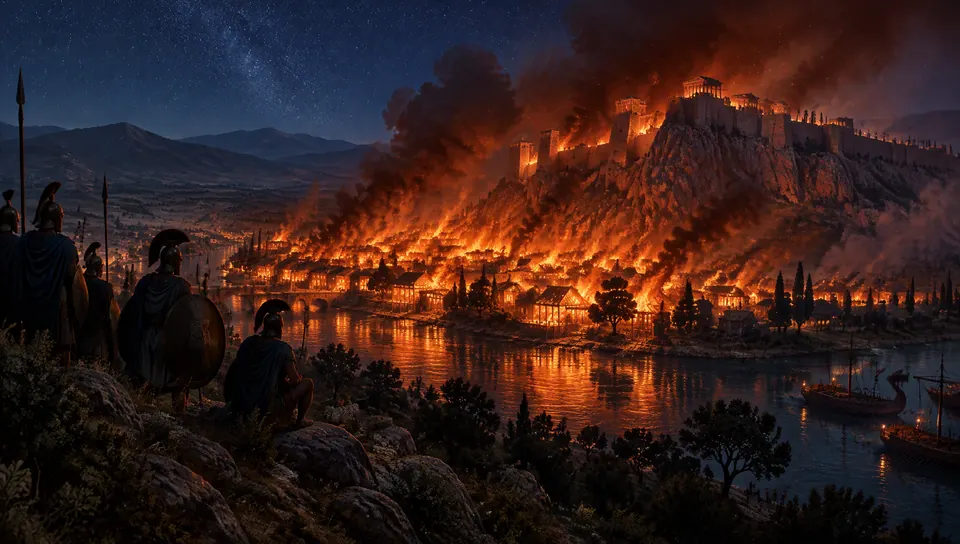
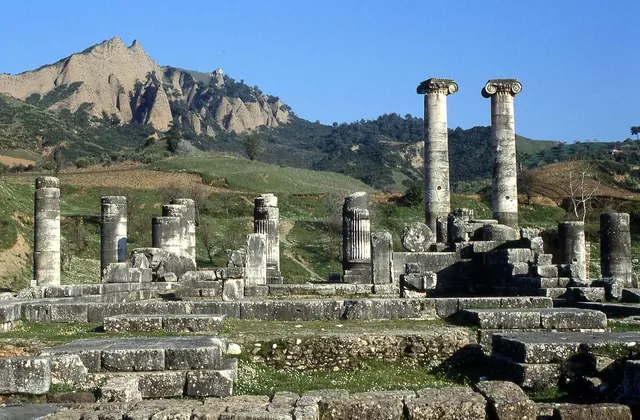
Then the city caught fire. Most houses in Sardis were made of reeds, and even the brick houses had roofs of reed. When a soldier set one house alight, the fire ran from roof to roof through the whole lower city. Driven out by the flames, the Lydians and the Persians in the city crowded into the marketplace on the banks of the Pactolus, the little river that carried gold dust down from Tmolus, and there they turned to fight. The Greeks saw some of the enemy standing their ground and many more coming up, lost their nerve, and pulled back to Mount Tmolus. At nightfall they set off for the ships.
The temple of Cybebe
Among the buildings that burned was a sanctuary of the great goddess of the Lydians. Herodotus records it in one sentence that matters more than the whole battle: “In the fire at Sardis, a temple of Cybebe, the goddess of that country, was burnt, and the Persians afterwards made this their pretext for burning the temples of Hellas.”35Herodotus, Histories 5.102.1Written c. 430 BC. Translation by A. D. GodleyRead on Perseus ↗ Eight years later the Persian army that landed in Euboea plundered and burned the temples of Eretria “in revenge for the temples that were burnt at Sardis”.36Herodotus, Histories 6.101.3Written c. 430 BC. Translation by A. D. GodleyRead on Perseus ↗ In 480 BC, Xerxes’ army burned the temples on the Acropolis of Athens.
How much the burned temple really mattered to the Persians is doubtful. How and Wells listed the Greek sanctuaries the Persians later destroyed and those they spared, such as Delos, and concluded that “The Persians needed no excuse for destroying Hellenic shrines”, and that “the accidental destruction of a Lydian temple was clearly not the reason”.37How and Wells, A Commentary on Herodotus, note on 5.102W. W. How and J. Wells, A Commentary on Herodotus, vol. 2 (1912). A modern commentary, now dated in placesRead on archive.org ↗ But as a grievance it was useful. A king who claimed to rule by the will of the gods could present the war on Athens as a just punishment for sacrilege.
The fire may also have cost the Ionians the Lydians. Grundy noticed that the Lydians, who might have been natural allies against Persia, “not merely stood apart and remained neutral, but actually fought on the Persian side”, and suggested that the burning of their city and their goddess’s sanctuary turned them against the rebels.38Grundy, The Great Persian War, ch. 3G. B. Grundy, The Great Persian War (1901). A modern study, dated in placesRead on Project Gutenberg ↗ Burning the enemy’s base had seemed a brilliant stroke. It left the Greeks with nothing to hold, a hostile population, and an enemy with a grievance.
Defeat at Ephesus, and Athens goes home
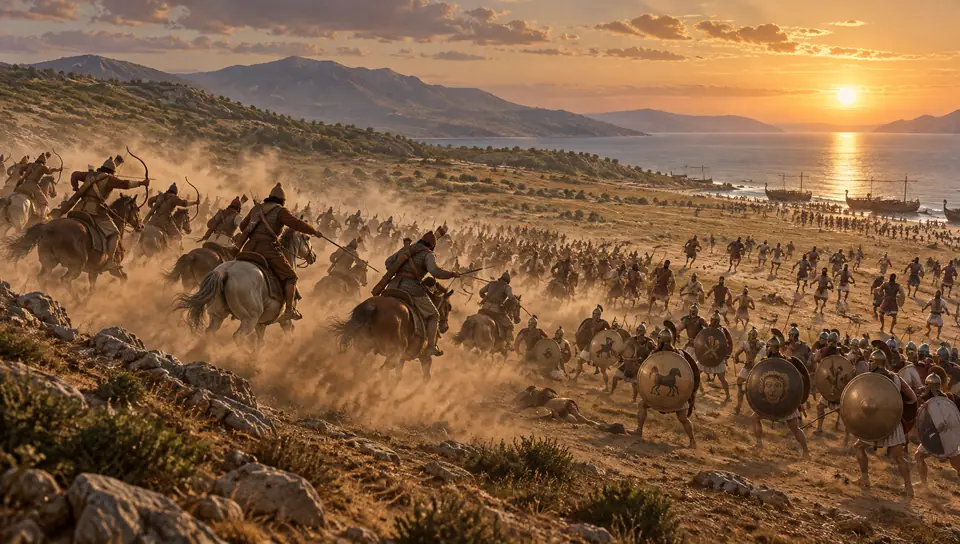
News of the attack spread through the Persian provinces west of the river Halys, and their troops gathered to help the Lydians. They found Sardis empty, followed the Greeks down to the coast, and caught them near Ephesus. The Ionians formed up to fight “but were utterly routed in the battle”.39Herodotus, Histories 5.102.2Written c. 430 BC. Translation by A. D. GodleyRead on Perseus ↗ Among the dead was Eualcides, the general of the Eretrians, a victor at the games whom the poet Simonides had praised. The survivors scattered to their cities.
Not every ancient writer told it this way. Plutarch quotes Charon of Lampsacus, a historian from a city on the Hellespont who wrote in the fifth century BC, perhaps before Herodotus, and whose work is lost. Charon’s account of the expedition, as Plutarch gives it word for word, has no defeat at all: “The Athenians set forth with twenty galleys to the assistance of the Ionians, and going to Sardis, took all thereabouts, except the King’s wall; which having done, they returned to Miletus.”40Plutarch, On the Malice of Herodotus 24Written c. AD 100; quotes the lost historian Charon of Lampsacus. Translation by W. W. Goodwin (1874)Read on Project Gutenberg ↗ Grundy went further and argued that the revolt spread so fast afterwards that “Ephesus was not the disaster which Herodotus represents it to have been”.41Grundy, The Great Persian War, ch. 3G. B. Grundy, The Great Persian War (1901). A modern study, dated in placesRead on Project Gutenberg ↗
Whatever the scale of the defeat, the Athenians went home and stayed there. Herodotus says they “wholly separated themselves from the Ionians and refused to aid them”, although Aristagoras begged them to come back.42Herodotus, Histories 5.103.1Written c. 430 BC. Translation by A. D. GodleyRead on Perseus ↗ He gives no reason. Grote guessed that the Ionians had let them down in some way; How and Wells thought it more likely that Athens had more pressing troubles closer to home. Athens was at war with Aegina, whose navy was stronger, and could not keep twenty ships on the far side of the Aegean. They also thought the friends of Hippias may have gained ground in Athens: in 496 BC a kinsman of the tyrants, Hipparchus son of Charmus, was elected chief archon.43How and Wells, A Commentary on Herodotus, note on 5.103W. W. How and J. Wells, A Commentary on Herodotus, vol. 2 (1912). A modern commentary, now dated in placesRead on archive.org ↗ For the Ionians, the loss of twenty ships was small. For Athens, it was too late to undo what had been done.
The revolt spreads
The defeat at Ephesus did not end the revolt. The burning of Sardis, as Grote put it, had the opposite effect on the two sides, “encouraging the revolters, as well as incensing the Persians”.44Grote, History of Greece, vol. 4, ch. 35G. Grote, History of Greece, vol. 4 (1847). A modern history, written 2,300 years laterRead on Project Gutenberg ↗ The Ionians had gone too far to turn back, and they knew it. Their fleet sailed north to the Hellespont and the Sea of Marmara and brought Byzantium and the other cities there into the revolt. Then it sailed south and won over most of Caria; even Caunus, which had held back, joined after the burning of Sardis.45Herodotus, Histories 5.103.2Written c. 430 BC. Translation by A. D. GodleyRead on Perseus ↗
The revolt reached Cyprus too. Onesilus, the younger brother of the king of Salamis on Cyprus, had long urged his brother Gorgus to break with Persia. When Gorgus refused, Onesilus shut him out of the city, made himself king, and brought every city of Cyprus into the revolt except Amathus, which he besieged. Now the rising stretched from Byzantium to Cyprus, along almost the whole western edge of the empire. It was the most serious challenge Darius had faced since the rebellions that greeted him when he took the throne in 522 BC.
Persia answered in force. An army under Artybius crossed to Cyprus while a Phoenician fleet sailed round the island. The Ionian ships beat the Phoenicians at sea, but on land the Cypriots were betrayed by some of their own allies, and Onesilus was killed. The Cypriots, Herodotus says, “after winning freedom for a year, were enslaved once more”.46Herodotus, Histories 5.116.1Written c. 430 BC. Translation by A. D. GodleyRead on Perseus ↗ On the mainland, Persian generals married to daughters of Darius took the cities of the Hellespont one after another, and the Carians fought on in battles of their own. Aristagoras himself lost heart, left Miletus and sailed for Thrace, where he was killed. The war went on without him, and its end at Lade and Miletus is told in chapter 2.
“Remember the Athenians”
Herodotus tells how the news reached Susa. When Darius heard that Sardis had been taken and burnt by the Athenians and the Ionians, he did not worry about the Ionians, it is said, because he knew they would be punished. Instead he asked who the Athenians were. When he was told, he called for his bow, shot an arrow into the sky and prayed: “O Zeus, grant me vengeance on the Athenians.” Then he ordered a servant to say to him three times, whenever his dinner was served: “Master, remember the Athenians.”47Herodotus, Histories 5.105.2Written c. 430 BC. Translation by A. D. GodleyRead on Perseus ↗
Herodotus marks the story with “it is said”, and it is probably a Greek tale rather than a report from the court. A Persian king would have prayed to Auramazda, not to Zeus, and his question “who are the Athenians?” is a stock motif: Cyrus had asked the same about the Spartans fifty years earlier. Grundy thought the details could not be taken as serious history, but that the core was true: Darius “was both exasperated and alarmed at this first instance of an active interference of the European Greeks in his West Asian dominions”.48Grundy, The Great Persian War, ch. 3G. B. Grundy, The Great Persian War (1901). A modern study, dated in placesRead on Project Gutenberg ↗ For the first time, Greeks from beyond the sea had marched into the king’s territory and burned one of his capitals.
In the same passage Darius summons Histiaeus and accuses him of being behind his deputy’s revolt. Histiaeus swears he knew nothing, blames the king for keeping him away from Ionia, and promises that if he is sent to the coast he will hand over Aristagoras and not change his tunic until he has made Sardinia pay tribute too. Darius believes him and lets him go.49Herodotus, Histories 5.107.1Written c. 430 BC. Translation by A. D. GodleyRead on Perseus ↗ What Histiaeus did next belongs to the following chapter. Whether or not Darius ever had a servant remind him at dinner, Herodotus comes back to the phrase when the Persian fleet sails for Greece in 490 BC: the king’s servant was “constantly reminding him to remember the Athenians”, and the exiled family of Hippias was at his side.50Herodotus, Histories 6.94.1Written c. 430 BC. Translation by A. D. GodleyRead on Perseus ↗
Why it mattered for the Persian Wars
The burning of Sardis turned a revolt inside the Persian empire into a quarrel between Persia and the Greeks of the mainland. Before 498 BC Athens and Eretria were small, distant cities that had once given earth and water. After it, they were cities that had sent ships and soldiers into the king’s land and burned a royal capital. Every later Persian expedition against Greece names them. When Darius sent Datis and Artaphernes, the satrap’s son, across the Aegean in 490 BC, his orders were to enslave Athens and Eretria and bring the captives before him; Eretria was burned, and the Persians landed at Marathon with Hippias as their guide. Ten years later, according to Herodotus, Xerxes told his council that he would not rest until he had burned Athens, because the Athenians “came to Sardis with our slave Aristagoras the Milesian and burnt the groves and the temples”.51Herodotus, Histories 7.8B.3Written c. 430 BC. Translation by A. D. GodleyRead on Perseus ↗
Was the burning of Sardis the cause of the Persian Wars? Herodotus seems to have thought so, and he blamed the Athenians for it. Grundy judged that he was “evidently convinced that Athens, and Athens alone, was really responsible for that war having taken place at all”, and that his error lay in “assuming that what was only a contributory cause was the whole efficient cause”.52Grundy, The Great Persian War, ch. 3G. B. Grundy, The Great Persian War (1901). A modern study, dated in placesRead on Project Gutenberg ↗ Persia had been expanding into Europe for some fifteen years, across the Bosporus into Thrace and Macedonia, and the attempt on Naxos showed that the islands were next. Hippias was at Sardis offering Athens to the king long before Aristagoras came to Athens.
Already in antiquity Herodotus was criticised for his phrase “the beginning of troubles”. Plutarch, writing as a patriotic Greek, protested that Herodotus had been “so audacious as to call the ships which the Athenians sent to the assistance of the Ionians, who had revolted from the King, the beginning of evils”, when they had tried to free so many Greek cities.53Plutarch, On the Malice of Herodotus 24Written c. AD 100; quotes the lost historian Charon of Lampsacus. Translation by W. W. Goodwin (1874)Read on Project Gutenberg ↗ Most modern historians would put it between the two. Persian pressure on the Aegean would probably have reached mainland Greece sooner or later. But the twenty ships decided where it would land first, and gave the king a reason the whole empire could understand: revenge on the men who had burned Sardis.
Rebels on the western edge
No Persian text mentions the Ionian Revolt, the burning of Sardis or the Athenians. Everything we know about the war comes from the Greek side. The administrative tablets found at Persepolis, written in exactly these years (about 509 to 493 BC), record rations for workers and travellers on the roads of the empire, but they say nothing of a war in the west. To see how the king looked at a revolt, we have to turn to what Darius said about himself.
On the cliff of Behistun, in western Iran, Darius had his own account of his first years carved in three languages around 520 BC. It lists the lands he ruled, among them Sparda, the Persian name for Sardis and Lydia, and Yauna, the Ionians, and states the principle: “These are the provinces which are subject unto me ; by the grace of Auramazda they became subject unto me ; they brought tribute unto me.”54Darius I, Behistun inscription § 6–7Carved c. 520 BC by order of Darius. Translation by L. W. King and R. C. Thompson (1907)Read on archive.org ↗ The king’s duty was just as plain: “whosoever was a [friend], him have I surely protected ; whosoever was hostile, him have I utterly destroyed.”55Darius I, Behistun inscription § 8Carved c. 520 BC by order of Darius. Translation by L. W. King and R. C. Thompson (1907)Read on archive.org ↗ In the same inscription every rebel is a liar, a man who rose against the order the god had given the king, and every revolt ends with the rebel defeated and punished.
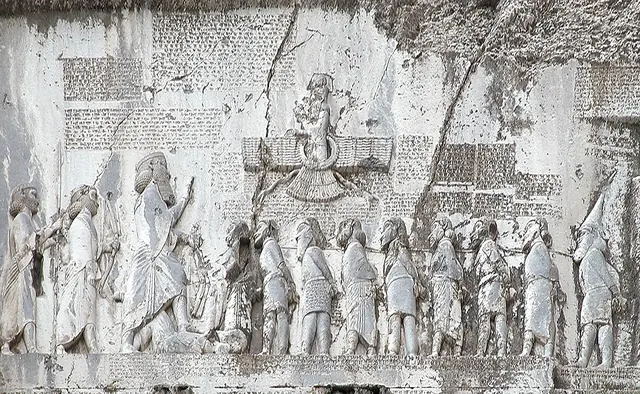
Seen from Persepolis or Susa, then, the Ionian Revolt was not a war of liberation but a rebellion of subjects who had broken their faith, in a small province on the far western edge of an empire that reached to India. The Ionians were one people among some twenty-three, and Herodotus’ remark that Darius “took no account of the Ionians” reflects how the Greeks thought the kings saw them. How and Wells called it “The regular attitude of the Persian kings”.56How and Wells, A Commentary on Herodotus, note on 5.105W. W. How and J. Wells, A Commentary on Herodotus, vol. 2 (1912). A modern commentary, now dated in placesRead on archive.org ↗ The Athenians were worse than rebels. Their envoys had given earth and water at Sardis around 507 BC; in Persian eyes Athens had accepted the king and then sent an army against his city. The fire at Sardis also burned a sanctuary, and a king who ruled “by the grace of Auramazda” could present punishment for it as his duty.
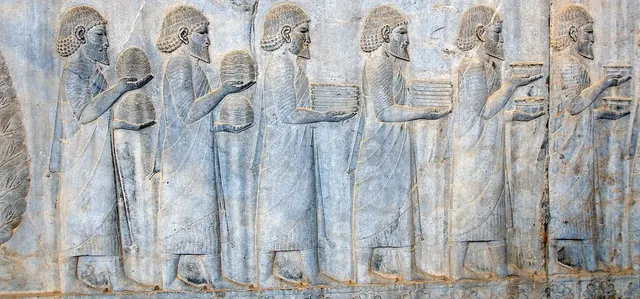
The Ionians do appear in Persian art. On the great staircase of the Apadana, the audience hall at Persepolis built under Darius and Xerxes, delegations of the subject peoples climb toward the king with gifts. One group, usually identified as Ionians, carries folded cloth, bowls and what seem to be balls of wool. The identification of some delegations is uncertain, and the reliefs show an ideal of willing loyalty rather than any real event. But they show the place the Ionians were meant to have in the king’s world: one people among many, bringing their tribute in order.
The revolt cost Persia a great deal. It took about six years, at least one fleet and several armies to put down, and in Caria a Persian army was destroyed in a night ambush together with its generals, among them Daurises, a son-in-law of the king. The burning of Sardis itself was a humiliation more than a disaster: the citadel held, the attackers were beaten on their way back, and Artaphernes stayed in office. What it left behind was a grievance, and the Persian kings did not forget grievances.
How close is our evidence?
Almost everything in this chapter comes from one writer. Herodotus was born in Halicarnassus, a Greek city on the coast of Caria, a few years after the burning of Sardis, and he wrote his history around 430 BC. He could talk to people who remembered the revolt, and to the sons of men who had fought in it. But he was writing in a world shaped by what came after: Persian invasions, Athenian power, and a long argument among Greeks about who had done well and who badly. Modern historians have noticed how hard he is on the Ionians and on Aristagoras, and Grundy thought his informants came partly from the Dorian cities of Asia, which had stayed out of the revolt. Grundy called the tale of the marked head “evidently a celebrated tale of the time”, the kind of story that survives because it is good to tell.57Grundy, The Great Persian War, ch. 3G. B. Grundy, The Great Persian War (1901). A modern study, dated in placesRead on Project Gutenberg ↗
Other voices survive only as fragments. Charon of Lampsacus, quoted by Plutarch, told the march on Sardis without the defeat at Ephesus. Lysanias of Mallus, in a history of Eretria now lost, praised the Eretrians, and Plutarch claims that they had beaten a Cypriot fleet in Pamphylian waters before the march. The poet Simonides, a contemporary, praised the Eretrian general Eualcides, but his poem is lost. On the Persian side there is nothing about the revolt at all: only the king’s inscriptions and reliefs, which show how the empire wanted to be seen. Where the sources disagree, as on the battle of Ephesus and on why Athens went home, the honest answer is often that we do not know.
- Herodotus, Histories 5.97.3
- Herodotus, Histories 1.169.2
- Herodotus, Histories 1.153.1
- Herodotus, Histories 4.137.2
- Herodotus, Histories 5.31.3
- How and Wells, A Commentary on Herodotus, note on 5.33
- A. Keaveney, “The Attack on Naxos: a ‘Forgotten Cause’ of the Ionian Revolt”, Classical Quarterly 38 (1988), pp. 76–81
- Herodotus, Histories 5.35.3
- Herodotus, Histories 5.36.1
- Grundy, The Great Persian War, ch. 3
- P. B. Manville, “Aristagoras and Histiaios: The Leadership Struggle in the Ionian Revolt”, Classical Quarterly 27 (1977), pp. 80–91
- Grundy, The Great Persian War, ch. 3
- Herodotus, Histories 5.36.2
- Herodotus, Histories 5.37.2
- Herodotus, Histories 5.38.2
- How and Wells, A Commentary on Herodotus, note on 5.36
- M. Lang, “Herodotus and the Ionian Revolt”, Historia 17 (1968), pp. 24–36
- P. B. Georges, “Persian Ionia under Darius: The Revolt Reconsidered”, Historia 49 (2000), pp. 1–39
- O. Murray, “The Ionian Revolt”, in The Cambridge Ancient History, vol. 4 (2nd ed., 1988), pp. 461–490
- Herodotus, Histories 5.49.1
- Herodotus, Histories 5.49.3
- Herodotus, Histories 5.50.3
- Herodotus, Histories 5.51.2
- D. Branscome, “Herodotus and the Map of Aristagoras”, Classical Antiquity 29 (2010), pp. 1–44
- Grundy, The Great Persian War, ch. 3
- Herodotus, Histories 5.73.3
- Herodotus, Histories 5.96.2
- Grote, History of Greece, vol. 4, ch. 35
- Grote, History of Greece, vol. 4, ch. 35
- How and Wells, A Commentary on Herodotus, note on 5.97
- Herodotus, Histories 5.98.3
- Herodotus, Histories 5.100.1
- How and Wells, A Commentary on Herodotus, note on 5.100
- Plutarch, On the Malice of Herodotus 24
- Herodotus, Histories 5.102.1
- Herodotus, Histories 6.101.3
- How and Wells, A Commentary on Herodotus, note on 5.102
- Grundy, The Great Persian War, ch. 3
- Herodotus, Histories 5.102.2
- Plutarch, On the Malice of Herodotus 24
- Grundy, The Great Persian War, ch. 3
- Herodotus, Histories 5.103.1
- How and Wells, A Commentary on Herodotus, note on 5.103
- Grote, History of Greece, vol. 4, ch. 35
- Herodotus, Histories 5.103.2
- Herodotus, Histories 5.116.1
- Herodotus, Histories 5.105.2
- Grundy, The Great Persian War, ch. 3
- Herodotus, Histories 5.107.1
- Herodotus, Histories 6.94.1
- Herodotus, Histories 7.8B.3
- Grundy, The Great Persian War, ch. 3
- Plutarch, On the Malice of Herodotus 24
- Darius I, Behistun inscription § 6–7
- Darius I, Behistun inscription § 8
- How and Wells, A Commentary on Herodotus, note on 5.105
- Grundy, The Great Persian War, ch. 3
- Herodotus, Histories: 3.90.1, 5.23.2, 5.25.1, 5.33.4, 5.35.1, 5.53.1, 5.97.2, 5.99.1, 5.101.1, 5.104.3