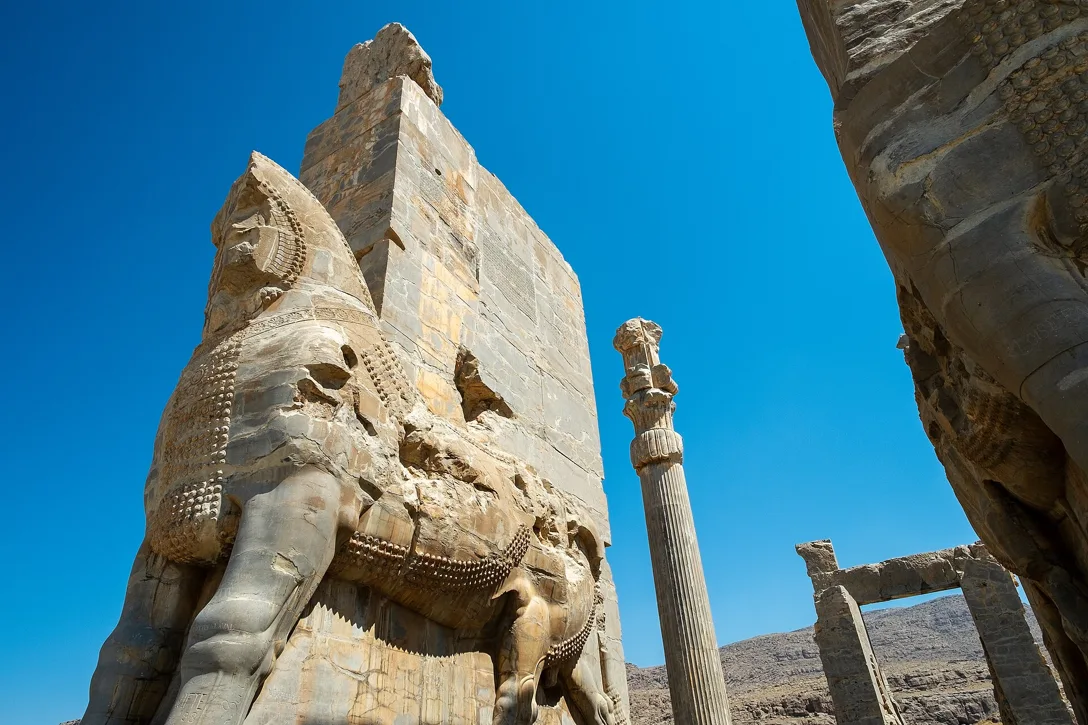
In 336 BC a twenty-year-old became king of Macedon, a rough kingdom on the northern edge of the Greek world. Thirteen years later he was dead in Babylon, and the largest empire the world had yet seen, the Persian Empire, was his. Alexander the Great won every battle he fought, from the Granicus to the Indus, but he left no adult heir and no plan for what should follow. His generals divided his conquests into Greek-ruled kingdoms, and for three centuries, until Rome swallowed them, Greek kings, Greek cities and the Greek language ruled from Egypt to Afghanistan. This is the story of how one man conquered so much so fast, and of the Hellenistic world that came out of it.
Macedon and Philip II
Chapter 1 ended with the Greek city-states exhausted by their own wars and a northern king standing over them. Macedon lay north of Mount Olympus, in the plains around the river Haliacmon and the gulf of Thermai, today’s northern Greece. It was not a city-state but a kingdom, with a king, a warrior nobility and farmers and herdsmen who lived in villages. Its kings spoke Greek, took part in the Olympic Games and claimed descent from Heracles, but many southern Greeks looked down on the Macedonians as half-barbarians who drank their wine unmixed and married several wives.
Philip II, who became king in 359 BC, turned this backward kingdom into the strongest power in the Balkans. He gave his infantry a pike about five and a half metres long, the sarissa, and drilled them to fight in a deep, bristling block, the phalanx. Beside it he built up a heavy cavalry of nobles, the Companions. He paid for the army with the gold and silver mines around Mount Pangaion, which he took from the Thracians and the Athenians. Bit by bit he swallowed his neighbours, and in 338 BC he crushed Athens and Thebes at Chaeronea. Alexander, eighteen years old, led the cavalry on one wing. A year later Philip called the Greek states to Corinth and made them his allies in a league, the League of Corinth, with himself as its leader. Its first task was announced at once: a war against Persia, to punish the Persians for burning the temples of Greece in 480 BC.
Murder at Aegae, 336 BC
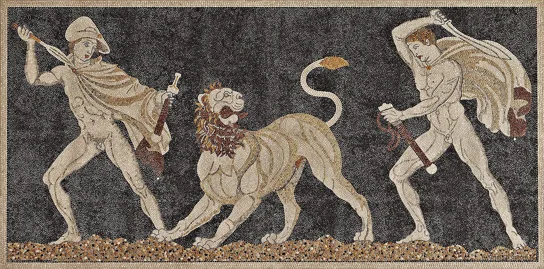
The invasion had already begun when Philip died. An advance force under his general Parmenion crossed into Asia in 336 BC. That summer Philip held a great festival at Aegae, the old royal capital, for the wedding of his daughter Cleopatra. On the morning of the games he walked into the theatre without his guards, to show the Greeks that he trusted them, and one of his own bodyguards, a young noble named Pausanias, stabbed him to death. Pausanias was cut down as he ran for his horse.
Why he did it was argued about even then. Aristotle, writing a few years later, says only that Pausanias had a private grievance: he had been insulted by Attalus, the uncle of Philip’s newest wife, and Philip had done nothing about it. Plutarch, writing four centuries later, repeats the story and adds the suspicions that went round the court. “The guilt of which fact was laid for the most part upon Olympias”, Alexander’s mother, who had been pushed aside by the new marriage, “and some sort of suspicion attached even to Alexander himself”.1Plutarch, Life of Alexander 10Written c. AD 100, about 420 years after Alexander. Translation by J. Dryden, revised by A. H. CloughRead on Project Gutenberg ↗ Alexander, for his part, later blamed the Persian king. Modern historians do not know, and most think the personal grudge is enough to explain the deed, with the court suspects possible but unproven.
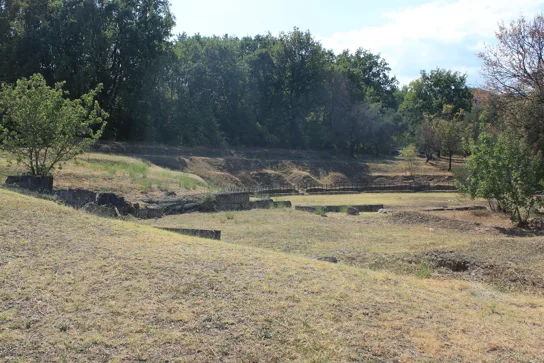
The royal tombs of Aegae were found in 1977 under a great mound at Vergina. Tomb II, never robbed, held a gold casket with burnt bones, a gold wreath and armour, and its excavator, Manolis Andronikos, believed it was Philip’s grave. That is still disputed. Some scholars think Tomb II belonged to Alexander’s half-brother Philip III, who was buried there in 316 BC, and a study of the bones in 2015 argued that Philip II lay in the plainer Tomb I, where the leg bones of a man show a knee wound like the one Philip is known to have suffered.2A. Bartsiokas, J. L. Arsuaga, E. Santos, M. Algaba and A. Gómez-Olivencia, “The lameness of King Philip II and Royal Tomb I at Vergina, Macedonia”, PNAS 112 (2015), pp. 9844–9848Modern study of the bones from the royal tombs (open access)Read on PNAS ↗
The young king and his teacher
Alexander was born in Pella in the summer of 356 BC. Plutarch dates his birth to the same day as the burning of the great temple of Artemis at Ephesus,3Plutarch, Life of Alexander 3Written c. AD 100, about 420 years after Alexander. Translation by J. Dryden, revised by A. H. CloughRead on Project Gutenberg ↗ a coincidence that was too good for later writers to resist. His mother, Olympias, was a princess from Epirus, in today’s north-western Greece and southern Albania, who claimed descent from Achilles. Alexander grew up between a father who was always at war and a mother who was always at court, and he admired both and quarrelled with both.
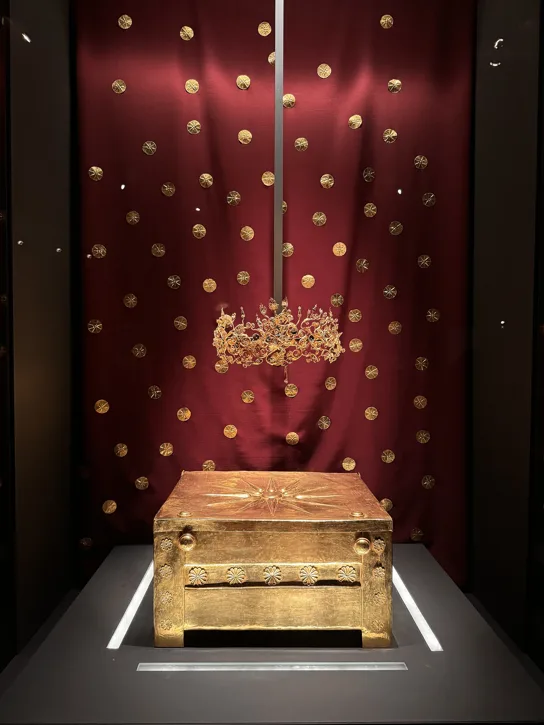
When he was thirteen, Philip hired the most famous thinker of the age to teach him. Aristotle taught Alexander and a group of young nobles for about three years at a shrine of the Nymphs near Mieza, where, Plutarch says, “to this very day, they show you Aristotle’s stone seats, and the shady walks which he was wont to frequent”.4Plutarch, Life of Alexander 7Written c. AD 100, about 420 years after Alexander. Translation by J. Dryden, revised by A. H. CloughRead on Project Gutenberg ↗ Alexander learned philosophy, medicine and above all Homer. He took a copy of the Iliad corrected by Aristotle on campaign and kept it under his pillow with his dagger. He wanted to be a new Achilles.
Plutarch also tells the story of the horse. A Thessalian dealer offered Philip a big black stallion called Bucephalus for thirteen talents, an enormous price, but nobody could ride him. The boy Alexander noticed that the horse was afraid of its own shadow, turned it towards the sun and rode it. Philip is supposed to have said: “O my son, look thee out a kingdom equal to and worthy of thyself, for Macedonia is too little for thee.”5Plutarch, Life of Alexander 6Written c. AD 100, about 420 years after Alexander. Translation by J. Dryden, revised by A. H. CloughRead on Project Gutenberg ↗ Whether or not the words were spoken, Bucephalus was real: he carried Alexander for almost twenty years, as far as India.
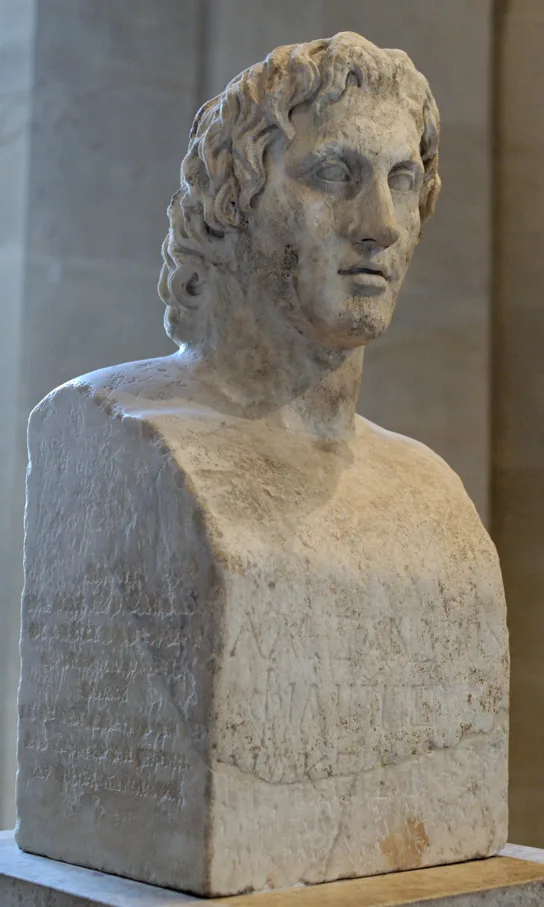
Danube and Thebes, 335 BC
When Philip died, Macedon’s enemies saw their chance. Thracian and Illyrian tribes in the north rose, and in Athens the orator Demosthenes celebrated. Alexander first had his rivals at court killed, then marched south and had himself recognised as leader of the League of Corinth. In the spring of 335 BC he turned north, defeated the Triballians in today’s Bulgaria and crossed the Danube by night on boats and stuffed tent-skins to scatter the Getae on the far bank. It was a demonstration: no Macedonian king had gone so far.
While he was away a rumour spread that he had been killed, and Thebes rebelled against its Macedonian garrison. Alexander came south so fast that the Thebans hardly believed it was him. He offered terms; they refused. The city was stormed, and the League’s council, made up mainly of Thebes’ old Greek enemies, voted to destroy it. Diodorus, writing three centuries later, gives the figures: “Over six thousand Thebans perished, more than thirty thousand were captured”,6Diodorus Siculus, Library of History 17.14.1Written c. 30 BC, mainly from Cleitarchus, who wrote a generation after Alexander. Translation by C. Bradford Welles (Loeb, 1963)Read on LacusCurtius ↗ and the captives were sold as slaves. The city was razed to the ground. Only the temples and one house were left standing.
The lesson was understood. Athens, which had been about to join the revolt, sent envoys to congratulate the king. For the rest of his reign the Greek cities stayed quiet, apart from one Spartan war in 331 BC, which Alexander’s regent Antipater crushed. Plutarch says Alexander later regretted his harshness towards Thebes.
The Persian Empire
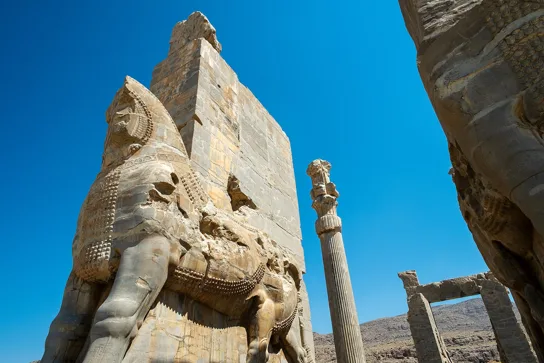
The target was enormous. The Persian Empire had been founded by Cyrus the Great two centuries earlier and stretched from Egypt and the Aegean coast to the Indus, from the Black Sea to the Persian Gulf. It was divided into about twenty provinces under governors called satraps, linked by royal roads with relay stations, and ruled from several capitals: Susa, Babylon, Ecbatana and Persepolis. Its kings had huge treasuries of gold and silver, a fleet manned mainly by Phoenicians, and armies raised from every people of the empire, with Greek mercenaries as their best heavy infantry.
The empire had problems. Egypt had broken away for sixty years and had only been retaken in 343 BC. The royal family had just been through a bloodbath: the powerful eunuch Bagoas poisoned King Artaxerxes III in 338 BC and his son Artaxerxes IV two years later, and put a distant relative on the throne, Darius III, who then had Bagoas forced to drink poison himself. Darius came to power in 336 BC, the same year as Alexander. Greek writers later painted him as a coward, but he had a reputation for personal bravery before he became king, and in the first years of his reign he restored order and kept the empire together.8P. Briant, Darius in the Shadow of Alexander (Cambridge, Mass., 2015)Modern study of how the image of Darius III was made by Greek and Roman writersFind in a library (WorldCat) ↗
For the Greeks the war had an official purpose: revenge for Xerxes’ invasion of 480 BC. Alexander himself put it this way in a letter to Darius after the battle of Issus, as Arrian gives it: “Your ancestors came into Macedonia and the rest of Greece and treated us ill, without any previous injury from us”, and he, “wishing to take revenge on the Persians, crossed over into Asia”.9Arrian, Anabasis 2.14Written c. AD 130–150, from the memoirs of Ptolemy and Aristobulus, who served with Alexander. Translation by E. J. Chinnock (1884)Read on Project Gutenberg ↗ But revenge was also a good excuse. Macedon’s treasury was in debt, the army needed pay and plunder, and the treasure-houses of Persia held more silver than the whole of Greece.
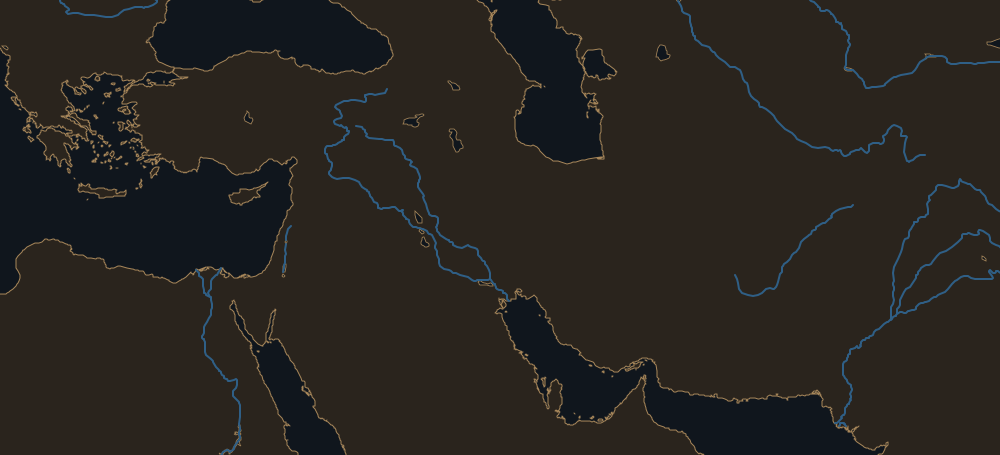
- 1Pella · 336 BC
- 2Granicus · 334 BC
- 3Gordium · 333 BC
- 4Issus · 333 BC
- 5Tyre · 332 BC
- 6Alexandria · 331 BC
- 7Siwa · 331 BC
- 8Gaugamela · 331 BC
- 9Babylon · 331 and 323 BC
- 10Susa · 331 and 324 BC
- 11Persepolis · 330 BC
- 12Ecbatana · 330 BC
- 13Bactra · 329–327 BC
- 14Maracanda (Samarkand) · 329–328 BC
- 15Alexandria Eschate · 329 BC
- 16Hydaspes · 326 BC
- 17Hyphasis · 326 BC
- 18Pattala · 325 BC
- 19Gedrosian desert · 325 BC
Into Asia: the Granicus, 334 BC
In the spring of 334 BC Alexander left his father’s general Antipater in charge of Macedon and Greece and marched to the Hellespont, the narrow strait between Europe and Asia. Arrian says he “led not much above 30,000 infantry together with light-armed troops and archers, and more than 5,000 cavalry”.10Arrian, Anabasis 1.11Written c. AD 130–150, from the memoirs of Ptolemy and Aristobulus, who served with Alexander. Translation by E. J. Chinnock (1884)Read on Project Gutenberg ↗ Diodorus gives a more detailed list, adding up to about the same. It was not a large army for the task, and Alexander had little money: some ancient writers say he had only seventy talents in his treasury when he set out.
The Persian satraps of Asia Minor met him at the river Granicus, near the Sea of Marmara, in May 334 BC. The Greek mercenary general Memnon of Rhodes had advised them to burn the crops and avoid battle, but they would not destroy their own lands. They lined the steep far bank with cavalry, with Greek mercenary infantry behind. Alexander charged across the river at the head of his Companions, straight at the Persian nobles. In the fighting a Persian split his helmet, and another, Spithridates, raised his sword over the king’s head, “when Clitus, son of Dropidas, anticipated his blow, and hitting him on the arm, cut it off, scimitar and all”.12Arrian, Anabasis 1.15Written c. AD 130–150, from the memoirs of Ptolemy and Aristobulus, who served with Alexander. Translation by E. J. Chinnock (1884)Read on Project Gutenberg ↗ The Persian cavalry broke. The Greek mercenaries were surrounded and cut to pieces; about 2,000 survivors were sent to Macedonia in chains as traitors to the Greek cause.
Alexander sent 300 suits of Persian armour to Athens, to hang on the Acropolis, with an inscription: “Alexander, son of Philip, and all the Greeks except the Lacedaemonians, present this offering from the spoils taken from the foreigners inhabiting Asia.”13Arrian, Anabasis 1.16Written c. AD 130–150, from the memoirs of Ptolemy and Aristobulus, who served with Alexander. Translation by E. J. Chinnock (1884)Read on Project Gutenberg ↗ The jab at Sparta, which had refused to join the League, was deliberate. Then the cities of the coast fell one after another. Sardis, the Persian capital of the west, surrendered without a fight; Miletus and Halicarnassus were taken by siege. In the Greek cities Alexander replaced the pro-Persian rulers with democracies and abolished the tribute to Persia, but he kept collecting taxes for himself.
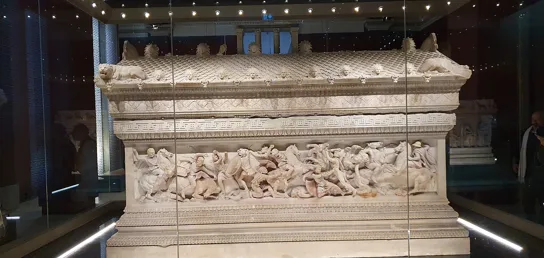
The Gordian knot, 333 BC
Alexander spent the winter of 334–333 BC in Asia Minor and in the spring came to Gordium, the old capital of Phrygia, in the middle of today’s Turkey. On the citadel stood an ancient wagon, said to have belonged to Gordius, father of the legendary King Midas, and its yoke was tied to the pole with a knot of bark so tangled that no ends could be seen. A prophecy said that whoever undid it would rule Asia.
The ancient writers tell two versions. In the famous one, Alexander, unable to find the ends, “struck the cord with his sword and cut it through, saying that it had been untied by him”.14Arrian, Anabasis 2.3Written c. AD 130–150, from the memoirs of Ptolemy and Aristobulus, who served with Alexander. Translation by E. J. Chinnock (1884)Read on Project Gutenberg ↗ Arrian adds the second: “But Aristobulus says that he pulled out the pin of the wagon-pole, which was a wooden peg driven right through it, holding the cord together.”15Arrian, Anabasis 2.3Written c. AD 130–150, from the memoirs of Ptolemy and Aristobulus, who served with Alexander. Translation by E. J. Chinnock (1884)Read on Project Gutenberg ↗ Aristobulus was there, and his version is less dramatic, which may be a reason to trust it. Either way that night brought thunder and lightning, which Alexander’s seers read as a sign from Zeus, and the story spread across the empire. It was exactly the kind of story Alexander wanted told about himself: the man who solves the unsolvable by refusing to play by the rules.
The real problem that year was the Persian fleet. Memnon of Rhodes, now Darius’ commander in the Aegean, was taking back the islands and threatening to carry the war into Greece. Then, in the summer of 333 BC, Memnon fell ill and died at the siege of Mytilene, and the danger passed. Alexander marched south-east through the Cilician Gates, a narrow pass in the Taurus mountains, and nearly died himself of a fever after swimming in the icy river at Tarsus.
Issus, 333 BC
Darius now came in person, with the royal army. In November 333 BC the two armies blundered past each other in the hills of the Gulf of Issus, at the corner between today’s Turkey and Syria, and Darius ended up behind Alexander, cutting him off from his supplies. Alexander turned back and found the Persians drawn up behind the little river Pinarus, on a narrow coastal plain between the mountains and the sea where Darius could not use his numbers.
Once again Alexander led the Companion cavalry on the right, broke through the Persian left and turned towards the king. The Macedonian phalanx in the centre struggled against Darius’ Greek mercenaries, and for a while the battle hung in the balance. Then Darius, seeing his left wing collapse and Alexander coming towards him, turned his chariot and fled. “Darius fled through the night with a few attendants”, Arrian writes;16Arrian, Anabasis 2.13Written c. AD 130–150, from the memoirs of Ptolemy and Aristobulus, who served with Alexander. Translation by E. J. Chinnock (1884)Read on Project Gutenberg ↗ the Persian army broke up behind him.
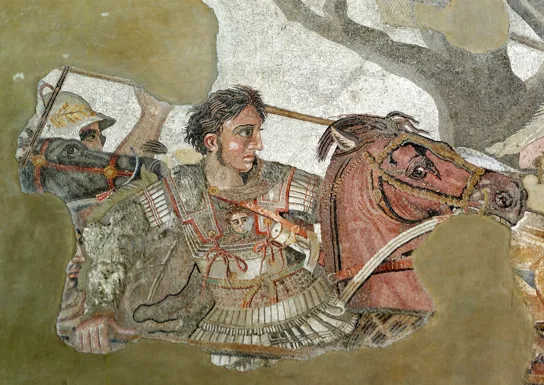
In the Persian camp the Macedonians found Darius’ mother, his wife and his daughters. Alexander treated them as royalty, let them keep their titles and servants, and promised that they would be safe. Ptolemy and Aristobulus said he sent word that “he had not undertaken the war against Darius from a feeling of hatred, but he had conducted it in a legitimate manner for the empire of Asia”.17Arrian, Anabasis 2.12Written c. AD 130–150, from the memoirs of Ptolemy and Aristobulus, who served with Alexander. Translation by E. J. Chinnock (1884)Read on Project Gutenberg ↗ A more famous story says that Darius’ mother bowed by mistake to Alexander’s friend Hephaestion, who was taller, and that Alexander told her it did not matter, because Hephaestion was Alexander too.
Darius tried to negotiate. The ancient accounts of his offers differ, and some details may have been invented later, but Arrian says that during the siege of Tyre Darius offered “ten thousand talents” for his family, all the land west of the Euphrates and his daughter in marriage.18Arrian, Anabasis 2.25Written c. AD 130–150, from the memoirs of Ptolemy and Aristobulus, who served with Alexander. Translation by E. J. Chinnock (1884)Read on Project Gutenberg ↗ Parmenion is supposed to have said that if he were Alexander, he would accept; Alexander answered that so would he, if he were Parmenion. He wanted everything.
Tyre and Gaza, 332 BC
Alexander did not chase Darius east. He went south, along the coast of Syria and Phoenicia, to take the ports of the Persian fleet; without its bases the fleet would melt away, and Greece would be safe behind him. Most of the Phoenician cities opened their gates. Tyre, the greatest of them, offered friendship but refused to let him into the city.
Tyre stood on an island about 800 metres off the coast, and it was, in Arrian’s words, “fortified all round with lofty walls”.19Arrian, Anabasis 2.18Written c. AD 130–150, from the memoirs of Ptolemy and Aristobulus, who served with Alexander. Translation by E. J. Chinnock (1884)Read on Project Gutenberg ↗ The Tyrians thought it could not be taken without a fleet. Alexander decided to build a causeway, a mole, out across the sea. His engineers drove piles into the sea bed and filled them with stones and timber, while Tyrian ships and divers attacked the workers and fireships burned the siege towers at the end. When the Cypriot and Phoenician kings changed sides and brought their fleets to Alexander, he could blockade both harbours. After seven months, in July or August 332 BC, the wall was breached from ships and the city stormed. Diodorus judges that Tyre had “undergone the siege bravely rather than wisely”.20Diodorus Siculus, Library of History 17.46.5Written c. 30 BC, mainly from Cleitarchus, who wrote a generation after Alexander. Translation by C. Bradford Welles (Loeb, 1963)Read on LacusCurtius ↗ Thousands were killed and most of the survivors were sold as slaves.

The mole changed the coast for good. Geologists who drilled into the neck of land in the 2000s found that a natural sandbar had already been growing under water towards the island, and that Alexander’s engineers built on top of it. Once the mole was there, sand piled up against it, and within a few centuries Tyre had become a peninsula.21N. Marriner, C. Morhange and S. Meulé, “Holocene morphogenesis of Alexander the Great’s isthmus at Tyre in Lebanon”, PNAS 104 (2007), pp. 9218–9223Modern geological study of how Tyre became joined to the land (open access)Read on PNAS ↗ Further south, Gaza held out for two more months on its hill, before it was stormed. By the end of 332 BC the whole coast of the eastern Mediterranean was Alexander’s, and the Persian fleet had ceased to exist.
Egypt, Alexandria and Siwa, 332–331 BC
Egypt had suffered under Persian rule and had only been reconquered nine years earlier. The Persian satrap Mazaces had no army, and he handed the country over without a fight. Alexander sacrificed to the Apis bull at Memphis, the old capital, and the Egyptian priests treated him as their pharaoh: in temples at Luxor and Karnak he appears in reliefs with the crowns of Egypt, making offerings to the god Amun.
On the coast, west of the mouths of the Nile, between the sea and Lake Mareotis, he chose the site for a new city. Arrian says that Alexander “himself marked out the boundaries of the city, pointing out the place where the agora was to be constructed, where the temples were to be built”, including one for the Egyptian goddess Isis.22Arrian, Anabasis 3.1Written c. AD 130–150, from the memoirs of Ptolemy and Aristobulus, who served with Alexander. Translation by E. J. Chinnock (1884)Read on Project Gutenberg ↗ The city was laid out on a grid of straight streets, with a harbour sheltered by the island of Pharos. Alexander never saw it built. Within a century Alexandria was the largest city of the Greek world, and it would remain one of the great cities of the Mediterranean for a thousand years.
Then Alexander did something that puzzled his officers. He marched west along the coast and then south through the desert to the oasis of Siwa, near today’s border with Libya, to consult the oracle of Ammon, a god whom the Greeks identified with Zeus. The army lost its way in a sandstorm; Ptolemy said two snakes guided it, Aristobulus two ravens. At the temple the priest greeted him, it seems, as son of the god, the normal greeting for a pharaoh. What else Alexander asked and heard, he never told. Arrian says only that he left “having heard what was agreeable to his wishes, as he himself said”.23Arrian, Anabasis 3.4Written c. AD 130–150, from the memoirs of Ptolemy and Aristobulus, who served with Alexander. Translation by E. J. Chinnock (1884)Read on Project Gutenberg ↗ From then on Alexander let it be known that he was the son of Zeus-Ammon, and on later coins his successors showed him with the curling ram’s horns of Ammon.
Gaugamela, 331 BC
In the spring of 331 BC Alexander marched back north through Syria, crossed the Euphrates and the Tigris and found Darius waiting for him on a wide, flat plain near the village of Gaugamela, east of the Tigris near today’s Mosul and Erbil in northern Iraq. Eleven days before the battle there was an eclipse of the moon, which modern astronomers date to the night of 20–21 September 331 BC; the battle itself took place on 1 October. This time Darius had chosen the ground. He had raised a new army from the eastern half of the empire, Bactrians, Scythian horse archers, Indians with fifteen elephants, and he had the plain levelled so that his two hundred scythed chariots could charge.
How big was the Persian army? Arrian says it “was said to contain 40,000 cavalry, 1,000,000 infantry, and 200 scythe-bearing chariots”;24Arrian, Anabasis 3.8Written c. AD 130–150, from the memoirs of Ptolemy and Aristobulus, who served with Alexander. Translation by E. J. Chinnock (1884)Read on Project Gutenberg ↗ Diodorus gives 800,000 infantry and 200,000 cavalry. No modern historian accepts these figures. An army of a million could not have been fed or watered in one place, and the plain could not have held it. The German military historian Hans Delbrück argued a century ago that the Persians may have been hardly more numerous than the Macedonians,25H. Delbrück, History of the Art of War, vol. 1: Warfare in Antiquity (1920; English translation 1975)Classic modern study that first rejected the ancient army sizes on practical groundsFind in a library (WorldCat) ↗ and studies of how ancient armies were supplied show why the ancient figures are impossible.26D. W. Engels, Alexander the Great and the Logistics of the Macedonian Army (Berkeley, 1978)Modern study of how armies of the time could be fed and movedFind in a library (WorldCat) ↗ Modern estimates mostly fall between about 50,000 and 100,000 men. Most historians think the Persian army was larger than Alexander’s, especially in cavalry, and its line was certainly much longer. Alexander had about 40,000 infantry and 7,000 cavalry.
Alexander’s answer was a moving battle. He set his army at an angle, with a second line behind the first to face attacks from the flanks, and led the right wing further and further to the right, off the levelled ground. The Persian left followed him to stop him outflanking them, and the scythed chariots charged; the Macedonian light troops shot down the drivers and the phalanx opened its ranks to let the rest through. As the Persian left wing stretched, a gap opened in its line. Alexander formed his Companions into a wedge and drove into the gap, straight towards Darius in the centre. For the second time Darius fled. On the other wing Parmenion was nearly overwhelmed by the Persian cavalry, and Alexander had to break off the pursuit to help him. But the battle was won, and with it the empire. Darius escaped into the mountains of Media with a small following; he would never raise another army.
Babylon, Susa and the fire at Persepolis
After Gaugamela the capitals of the empire fell one after the other. Babylon opened its gates; its satrap Mazaeus, who had commanded the Persian right at Gaugamela, surrendered and was kept on as governor, the first Persian to receive such a post from Alexander. At Susa, in December 331 BC, Alexander took possession of the royal treasure, which Arrian puts at “50,000 talents”,27Arrian, Anabasis 3.16Written c. AD 130–150, from the memoirs of Ptolemy and Aristobulus, who served with Alexander. Translation by E. J. Chinnock (1884)Read on Project Gutenberg ↗ as well as the bronze statues of the Athenian tyrant-slayers Harmodius and Aristogeiton, which Xerxes had carried off from Athens. Alexander sent them back. A talent was about 26 kilograms of silver; 50,000 talents was more than a thousand tonnes.
The way to Persepolis led through the Persian Gates, a mountain pass in the Zagros held by the satrap Ariobarzanes. Alexander found a path round it, as Xerxes had once done at Thermopylae. Persepolis, the ceremonial heart of the empire, was given to the soldiers to plunder. In its treasury Diodorus says “the total was found to be one hundred and twenty thousand talents”, when the gold was counted in silver.28Diodorus Siculus, Library of History 17.71.2Written c. 30 BC, mainly from Cleitarchus, who wrote a generation after Alexander. Translation by C. Bradford Welles (Loeb, 1963)Read on LacusCurtius ↗ It took thousands of mules and camels to carry it away.
In the spring of 330 BC the great palace terrace of Persepolis went up in flames. The two traditions disagree about why. Arrian, following Ptolemy, says it was a deliberate act: Alexander burnt the palace “though Parmenio advised him to preserve it”, saying that he wanted to punish the Persians for the burning of Athens and the temples of Greece.29Arrian, Anabasis 3.18Written c. AD 130–150, from the memoirs of Ptolemy and Aristobulus, who served with Alexander. Translation by E. J. Chinnock (1884)Read on Project Gutenberg ↗ Diodorus, Curtius and Plutarch tell a different story: at a drunken feast an Athenian courtesan, “Thaïs by name and Attic by origin”, urged the guests to burn the palace in revenge for Athens, and Alexander himself threw the first torch.30Diodorus Siculus, Library of History 17.72.2Written c. 30 BC, mainly from Cleitarchus, who wrote a generation after Alexander. Translation by C. Bradford Welles (Loeb, 1963)Read on LacusCurtius ↗ Plutarch adds that “all agree that he soon repented of it, and gave order to put out the fire”.31Plutarch, Life of Alexander 38Written c. AD 100, about 420 years after Alexander. Translation by J. Dryden, revised by A. H. CloughRead on Project Gutenberg ↗
Modern historians are still divided. The excavations of the 1930s found the burnt layer, the melted metal and the smashed treasury, so the fire is certain; and there are signs that the treasury was emptied before it burned, which fits a planned act. Some suggest both versions may be partly true: a decision taken, or carried out, at a feast. What is clear is that the fire was a message, to the Greeks that the war of revenge was complete, and perhaps to the Persians that the old order was over. It sat uneasily with Alexander’s claim, made at the same time, to be the rightful king of Asia.32E. N. Borza, “Fire from heaven: Alexander at Persepolis”, Classical Philology 67 (1972), pp. 233–245Modern study comparing the two ancient versions of the fireRead on the publisher’s site ↗
The death of Darius and the King of Asia
Darius fled to Ecbatana in Media and then east towards Bactria, with Alexander chasing him in forced marches. In July 330 BC, beyond the Caspian Gates, his own nobles turned on him. Bessus, the satrap of Bactria, and his fellow conspirators put the king in chains, and when Alexander’s cavalry came close they stabbed him and left him in a covered wagon by the road. “Darius died from his wounds soon after, before Alexander had seen him.”33Arrian, Anabasis 3.21Written c. AD 130–150, from the memoirs of Ptolemy and Aristobulus, who served with Alexander. Translation by E. J. Chinnock (1884)Read on Project Gutenberg ↗ Alexander sent the body to Persepolis to be buried in the royal tombs, and presented himself as Darius’ avenger and heir.
The war of revenge was over. At Ecbatana Alexander sent home the troops of the League of Corinth with their pay and a bonus; those who wanted to could stay on as mercenaries. From now on he fought as King of Asia, the successor of the Persian kings. He began to wear parts of the Persian royal dress, the diadem and the striped tunic, although not the trousers, and to hold court in the Persian way. He gave Persian nobles high posts as satraps and took Persian youths into his army. To many Macedonians this looked like betrayal. Even Arrian, an admirer, writes: “Nor do I by any means commend him for changing the Macedonian style of dress which his fathers had adopted, for the Median one”.34Arrian, Anabasis 4.7Written c. AD 130–150, from the memoirs of Ptolemy and Aristobulus, who served with Alexander. Translation by E. J. Chinnock (1884)Read on Project Gutenberg ↗
The tension soon turned deadly. In the autumn of 330 BC Philotas, the son of Parmenion and commander of the Companion cavalry, was accused of keeping quiet about a plot against the king. He was tried before the army and executed. Alexander then sent messengers to Ecbatana to have Parmenion himself killed, without trial, because a father whose son had been executed was too dangerous to leave alive at the head of an army. Whether there was a real plot is doubtful. The old general who had served Philip and Alexander for decades was gone.

Bactria and Sogdiana: Cleitus, Callisthenes and Roxana
Bessus fled across the Hindu Kush to Bactria, the land around Balkh in today’s northern Afghanistan, and declared himself king as Artaxerxes V. Alexander followed him over the mountains in the spring of 329 BC. Bessus was handed over by his own allies, mutilated and executed. But the far north-east of the empire, Bactria and Sogdiana, today’s Afghanistan, Uzbekistan and Tajikistan, did not give in. Local lords led by Spitamenes fought a war of raids and ambushes from fortresses on mountain peaks, supported by the nomad horsemen of the steppe. On the river Jaxartes, the Syr Darya, Alexander founded a city as a frontier post, Alexandria Eschate, “the furthest”, today’s Khujand in Tajikistan. It took him almost three years and many massacres to win the war. In the end the nomads who had sheltered Spitamenes “cut off the head of Spitamenes and sent it to him”.35Arrian, Anabasis 4.17Written c. AD 130–150, from the memoirs of Ptolemy and Aristobulus, who served with Alexander. Translation by E. J. Chinnock (1884)Read on Project Gutenberg ↗
The strain showed in Alexander’s own circle. In the autumn of 328 BC, at a feast at Maracanda, today’s Samarkand, the drinking went on too long, and flatterers compared Alexander with the gods and belittled his father. Cleitus, the officer who had saved his life at the Granicus, lost his temper and told the king that he owed his victories to the Macedonians and to Philip. Alexander, drunk and furious, snatched a weapon from a guard, “with which he struck Clitus and killed him”.36Arrian, Anabasis 4.8Written c. AD 130–150, from the memoirs of Ptolemy and Aristobulus, who served with Alexander. Translation by E. J. Chinnock (1884)Read on Project Gutenberg ↗ Afterwards he lay in his tent for three days without eating, weeping for his friend.
In 327 BC Alexander tried to make Greeks and Macedonians greet him the Persian way. At a banquet a cup was passed round; each guest drank, bowed to the king and received a kiss. When his turn came, the court historian Callisthenes, Aristotle’s great-nephew, drank and came forward “wishing to kiss the king without performing the act of prostration”.37Arrian, Anabasis 4.12Written c. AD 130–150, from the memoirs of Ptolemy and Aristobulus, who served with Alexander. Translation by E. J. Chinnock (1884)Read on Project Gutenberg ↗ Alexander refused him the kiss, and Callisthenes said he would go away one kiss the poorer. The experiment was dropped, but Callisthenes did not survive it for long. When some of the royal pages plotted to kill the king that year, he was accused of having encouraged them and died in custody: Ptolemy said he was tortured and hanged, Aristobulus that he died of illness in chains.
In the spring of 327 BC Alexander’s men took the Sogdian Rock, a mountain fortress that was thought impossible to climb, by sending 300 volunteers up the cliff at night with iron tent-pegs and ropes. Among the captives was Roxana, the daughter of the Bactrian noble Oxyartes, whom Alexander’s soldiers called “the most beautiful of all Asiatic women, with the single exception of the wife of Darius”.38Arrian, Anabasis 4.19Written c. AD 130–150, from the memoirs of Ptolemy and Aristobulus, who served with Alexander. Translation by E. J. Chinnock (1884)Read on Project Gutenberg ↗ Alexander married her. The marriage was probably also a political one: it bound the local nobility to the new king. Her father became his ally and later satrap. Alexander left behind more than ten thousand soldiers in garrisons and new towns, many of them Greek mercenaries who hated being stranded at the end of the world; after his death several thousand of them tried to march home.39F. L. Holt, Into the Land of Bones: Alexander the Great in Afghanistan (Berkeley, 2005)Modern study of the war in Bactria and SogdianaFind in a library (WorldCat) ↗
India: Porus and the Hydaspes, 326 BC
Beyond the Hindu Kush lay India, which to the Greeks meant the lands of the river Indus, today’s Pakistan. The Persian kings had once ruled part of it, and Alexander meant to take it all. In the spring of 326 BC he crossed the Indus and was welcomed at Taxila by its king, who hoped for help against his neighbour Porus, the ruler of the lands beyond the river Hydaspes, today’s Jhelum.
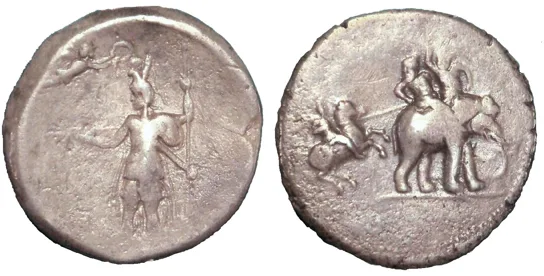
Porus waited on the far bank with an army and some two hundred war elephants. It was the start of the monsoon, and the river was swollen. For days Alexander made noise and marched troops up and down the bank at night until Porus’ scouts stopped reacting. Then, on a stormy night, he took part of his army about 25 kilometres upstream, crossed at a wooded island in pouring rain and came down on Porus’ flank. The battle was the hardest Alexander fought. The elephants terrified the horses and trampled the phalanx, but the Macedonians shot their drivers and slashed at their legs, and in the end the wounded and panicking animals turned back into their own lines.
Porus, a very tall man, fought on from his elephant until he was wounded, and was brought before Alexander. Arrian tells the most famous exchange of the campaign. Asked how he wished to be treated, “the report goes that Porus replied: ‘Treat me, O Alexander, in a kingly way!’”40Arrian, Anabasis 5.19Written c. AD 130–150, from the memoirs of Ptolemy and Aristobulus, who served with Alexander. Translation by E. J. Chinnock (1884)Read on Project Gutenberg ↗ Alexander let him keep his kingdom and gave him more land, and Porus stayed loyal. Near the battlefield Alexander founded two cities: Nicaea, “Victory”, and Bucephala, named after his horse, who died there aged about thirty.
The Hyphasis and the Gedrosian desert, 326–325 BC
Alexander wanted to go on to the Ganges and, as he believed, to the edge of the world, where the great Ocean surrounded the land. But on the bank of the river Hyphasis, the Beas in today’s Punjab, in the late summer of 326 BC, his army refused to go further. The men had marched and fought for eight years, many thousands of kilometres; the monsoon rains had rotted their equipment, and they were told that huge armies with thousands of elephants waited beyond the river. When Alexander called his officers together, nobody spoke, until “at last, Coenus, son of Polemocrates, plucked up courage and spoke”41Arrian, Anabasis 5.27Written c. AD 130–150, from the memoirs of Ptolemy and Aristobulus, who served with Alexander. Translation by E. J. Chinnock (1884)Read on Project Gutenberg ↗ for the soldiers: they wanted to see their parents, wives and children again. Alexander sulked in his tent for three days, then gave in. He ordered twelve huge altars to be built on the bank, to mark the end of his march.
He did not go home the way he had come. He had a fleet built and sailed down the Hydaspes and the Indus to the ocean, fighting the peoples along the river all the way. In an assault on a town of the Malli he jumped down inside the wall almost alone and was hit in the chest by an arrow that pierced his lung. For days the army thought he was dead. Then, in the late summer of 325 BC, he led part of the army west through the Gedrosian desert, today’s Makran coast of Pakistan and Iran, while his admiral Nearchus took the fleet along the coast. The march was a disaster. A flash flood swept away the camp, men and animals died of heat and thirst, and the guides lost the way. Arrian writes: “Most of the historians of Alexander’s reign assert that all the hardships which his army suffered in Asia were not worthy of comparison with the labours undergone here.”42Arrian, Anabasis 6.24Written c. AD 130–150, from the memoirs of Ptolemy and Aristobulus, who served with Alexander. Translation by E. J. Chinnock (1884)Read on Project Gutenberg ↗ How many died is unknown; Plutarch’s claim that only a quarter of the army came back is generally thought too high.43A. B. Bosworth, Conquest and Empire: The Reign of Alexander the Great (Cambridge, 1988)Modern history of the reign, critical of the ancient admirersFind in a library (WorldCat) ↗
Susa and Opis: a fusion of peoples?
Back in Persia, Alexander found that many of the satraps he had left behind had ruled as if he would never return. Several were executed, and his treasurer Harpalus fled to Greece with a large part of the treasure. Then, at Susa in the spring of 324 BC, he held a mass wedding in the Persian style. Alexander himself married Darius’ eldest daughter, called Barsine or Stateira, and a daughter of an earlier Persian king, Artaxerxes III. Arrian writes: “He himself married Barsine, the eldest daughter of Darius”;44Arrian, Anabasis 7.4Written c. AD 130–150, from the memoirs of Ptolemy and Aristobulus, who served with Alexander. Translation by E. J. Chinnock (1884)Read on Project Gutenberg ↗ his friend Hephaestion married her sister, and about eighty of his officers married daughters of Persian and Median nobles. Ten thousand soldiers who had taken Asian wives were given wedding presents. At the same time 30,000 young Persians, trained and armed in the Macedonian way, arrived to join the army. Alexander called them his “Successors”, the Epigonoi.
The Macedonian veterans felt pushed aside. At Opis on the Tigris, when Alexander announced that the old and wounded would be sent home, the army mutinied and shouted that he could go on campaign with his father Ammon. Alexander had the ringleaders executed, shut himself away and began to give the commands to Persians. Within three days the Macedonians gave in, came to his tent weeping and asked to be forgiven. He made peace with them at a great banquet, where Macedonians and Persians sat together and Greek seers and Persian Magi led the ceremonies, and Alexander “prayed for other blessings, and especially that harmony and community of rule might exist between the Macedonians and Persians”.45Arrian, Anabasis 7.11Written c. AD 130–150, from the memoirs of Ptolemy and Aristobulus, who served with Alexander. Translation by E. J. Chinnock (1884)Read on Project Gutenberg ↗ Ten thousand veterans then went home under the general Craterus.
What was Alexander trying to do? In the 1930s the British scholar W. W. Tarn argued that he dreamed of the unity of mankind, a brotherhood of all peoples, an idea that goes back to Plutarch’s speeches in praise of Alexander. Most historians now reject this. In 1958 Ernst Badian showed that the prayer at Opis was about Macedonians and Persians only, the two ruling peoples, and that Alexander’s policy is better explained as power politics: he needed the Persian nobility to govern the empire and Persian soldiers to replace Macedonians who were tired and unreliable, and he wanted a new ruling class loyal to himself alone.46E. Badian, “Alexander the Great and the unity of mankind”, Historia 7 (1958), pp. 425–444Modern study that rejected the idea that Alexander planned a brotherhood of peoplesRead on JSTOR ↗ Of the Susa marriages, almost all were abandoned after his death; one of the few that lasted was that of his general Seleucus to Apama, the daughter of Spitamenes, and their son would rule Asia.
Death in Babylon, 323 BC
In the autumn of 324 BC Hephaestion, Alexander’s closest friend, died of a fever at Ecbatana. Alexander’s grief was extreme: he is said to have had the doctor executed, and he planned a funeral pyre in Babylon that cost a fortune. In the spring of 323 BC he was back in Babylon, receiving embassies from all over the Mediterranean and preparing a fleet for the conquest of Arabia. At the end of May, after a long night of drinking at the house of his friend Medius, he fell ill with a fever. The court journals, which both Arrian and Plutarch quote, describe the next days: bathing, sacrifices, more fever, briefing his officers on the voyage, until he could no longer speak.47Plutarch, Life of Alexander 76Written c. AD 100, about 420 years after Alexander. Translation by J. Dryden, revised by A. H. CloughRead on Project Gutenberg ↗ His soldiers forced their way in to see him, and he greeted them one by one with his eyes. He died on the evening of 10 or 11 June 323 BC, aged thirty-two. Aristobulus, as Arrian reports, said “he lived thirty-two years, and had reached the eighth month of his thirty-third year”.48Arrian, Anabasis 7.28Written c. AD 130–150, from the memoirs of Ptolemy and Aristobulus, who served with Alexander. Translation by E. J. Chinnock (1884)Read on Project Gutenberg ↗
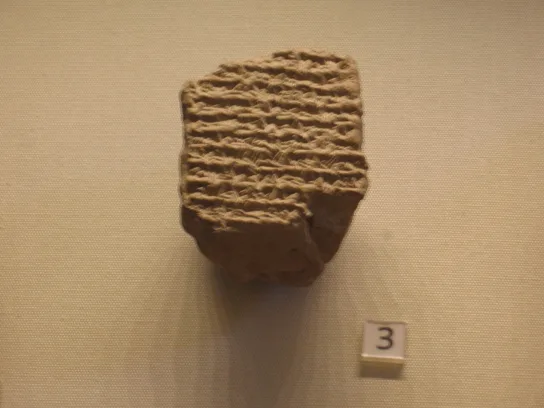
The one source written at the time is not Greek. A Babylonian astronomer, recording the night sky as his colleagues had done for centuries, noted under the 29th day of the month Aiaru, which corresponds to 11 June 323 BC, two words: “the king died”.49A. J. Sachs and H. Hunger, Astronomical Diaries and Related Texts from Babylonia, vol. 1 (Vienna, 1988), nos. −330 and −322Modern edition and translation of the Babylonian astronomical diariesFind in a library (WorldCat) ↗
Rumours of poison began almost at once. Arrian knew that “poison was sent for him by Antipater”, carried by Antipater’s son Iollas, Alexander’s cup-bearer, but he did not believe it.50Arrian, Anabasis 7.27Written c. AD 130–150, from the memoirs of Ptolemy and Aristobulus, who served with Alexander. Translation by E. J. Chinnock (1884)Read on Project Gutenberg ↗ Modern historians have shown that the poison story was spread a few years later for political reasons, in the wars between Alexander’s mother Olympias and Antipater’s family.51A. B. Bosworth, “The death of Alexander the Great: rumour and propaganda”, Classical Quarterly 21 (1971), pp. 112–136Modern study of the poison stories and who spread themRead on Cambridge Core ↗ The symptoms, a fever lasting about twelve days after heavy drinking, in a man weakened by wounds and in the marshy country around Babylon, fit an illness better: malaria and typhoid are the most common suggestions, but there are many others, and nobody can be sure.52E. N. Borza and J. Reames-Zimmerman, “Some new thoughts on the death of Alexander the Great”, Ancient World 31 (2000), pp. 22–30Modern study of the medical explanations (fever, typhoid and others)Find in a library (WorldCat) ↗
Alexander left no plan for the succession. His half-brother Philip Arrhidaeus was mentally disabled, his young son Heracles, by the Persian noblewoman Barsine (not Darius’ daughter), was illegitimate and Roxana was pregnant. When his friends asked him on his deathbed to whom he left the kingdom, Diodorus says, “he replied: ‘To the strongest.’”53Diodorus Siculus, Library of History 17.117.4Written c. 30 BC, mainly from Cleitarchus, who wrote a generation after Alexander. Translation by C. Bradford Welles (Loeb, 1963)Read on LacusCurtius ↗ Arrian has the same story, as something “some say”. True or not, it described what happened next.
Politics and war: the Successors, 323–275 BC
At Babylon the generals and the infantry nearly came to blows over the succession. They agreed on a compromise: the throne went to Philip Arrhidaeus, “on condition that Roxana’s child, when born, if it were a son, should share the throne with him”.54Photius, Bibliotheca, codex 92 (summary of Arrian, Events after Alexander)Arrian wrote c. AD 150; the summary is from the 9th century AD. Translation by J. H. Freese (1920)Read on Project Gutenberg ↗ Roxana had a son, Alexander IV. Neither king really ruled. Power lay with the generals, the Diadochi or Successors, who shared out the provinces as satraps: Ptolemy took Egypt, Antipater stayed in Macedon, Antigonus the One-Eyed held central Asia Minor, Lysimachus Thrace, and Perdiccas stayed with the kings as regent.
The body itself became a prize. It was embalmed and placed on a magnificent funeral carriage, which took two years to build. Then, as Diodorus tells it, Ptolemy met the procession in Syria with an army and “he brought the body of the king from Babylon to Egypt”, against the wishes of the regent.55Diodorus Siculus, Library of History 18.28.2Written c. 30 BC, mainly from Hieronymus of Cardia, who took part in the wars of the Successors. Translation by R. M. Geer (Loeb, 1947)Read on LacusCurtius ↗ Alexander’s tomb in Alexandria was a place of pilgrimage for centuries; Roman emperors visited it. Where it was is now unknown.
For forty years the Successors fought each other in a confusing series of wars and changing alliances. Perdiccas was murdered by his own officers in 320 BC after failing to invade Egypt. Alexander’s family was wiped out: his mother Olympias was killed in 316 BC on the orders of Antipater’s son Cassander, and Cassander had Roxana and the young Alexander IV quietly murdered around 310 BC. In 306–305 BC the generals, one after another, took the title of king. The most ambitious, Antigonus, tried to rebuild Alexander’s whole empire and was killed at Ipsus in 301 BC, aged over eighty, fighting a coalition of the others. In 281 BC Seleucus defeated and killed Lysimachus, the last of Alexander’s companions besides himself, and was murdered a few months later. Then Celtic tribes, the Gauls, broke into Macedon and Greece; in 279 BC they attacked Delphi. Antigonus Gonatas, grandson of the One-Eyed, beat them in 277 BC and became king of Macedon.
By about 275 BC three great kingdoms had come out of the wars, each ruled by a Macedonian dynasty. The Ptolemies ruled Egypt from Alexandria, with Cyprus and for long periods southern Syria. The Seleucids ruled the largest share, from Syria and southern Turkey to Iran and at first Central Asia, from their capitals Antioch and Seleucia on the Tigris. The Antigonids ruled Macedon and dominated Greece. Smaller states grew up in their shadow: the kingdom of Pergamon in western Asia Minor, the trading republic of Rhodes, the leagues of Greek cities, and later a Greek kingdom in Bactria. The German historian J. G. Droysen called the three centuries from Alexander to the death of Cleopatra in 30 BC the Hellenistic Age, from the Greek hellenizein, to speak Greek, to behave like a Greek.
Economy: silver, grain and trade
Alexander put the hoarded treasure of the Persian kings into circulation. The silver that the Achaemenids had collected as tribute for two centuries and stored in the palaces was coined to pay soldiers, build cities and reward friends. His mints from Macedon to Babylon struck coins of one standard, the Attic weight used by Athens, with his name and the same designs: Heracles on one side, Zeus on the other. These coins became the common money of the eastern Mediterranean, and cities kept striking them for two hundred years after his death. Modern studies of the coinage warn that the effect was gradual and that much of the treasure was still unspent in 323 BC, but the long-term result was a much wider use of money across the Near East.56G. Le Rider, Alexander the Great: Coinage, Finances, and Policy (Philadelphia, 2007)Modern study of Alexander’s coins and how fast the Persian treasure was spentFind in a library (WorldCat) ↗
The kings were rich and competed with each other in display. Egypt’s grain fed the Greek cities and paid for the Ptolemies’ fleets; the Ptolemies organised the country like a great estate, with taxes and royal monopolies on oil, papyrus and beer recorded in thousands of papyri. Goods from India and Arabia, spices, ivory and incense, came by caravan and by sea to Seleucia, Antioch and Alexandria. In the Aegean the island of Rhodes became the great trading port and banking centre. When an earthquake in the 220s BC “overthrew the great Colossus and the larger part of the walls and dockyards”, Polybius writes, kings and cities competed to send the Rhodians money, grain, timber and catapults.57Polybius, Histories 5.88Written c. 150 BC by a Greek statesman who lived through Rome’s conquest of Greece. Translation by E. S. Shuckburgh (1889)Read on Project Gutenberg ↗
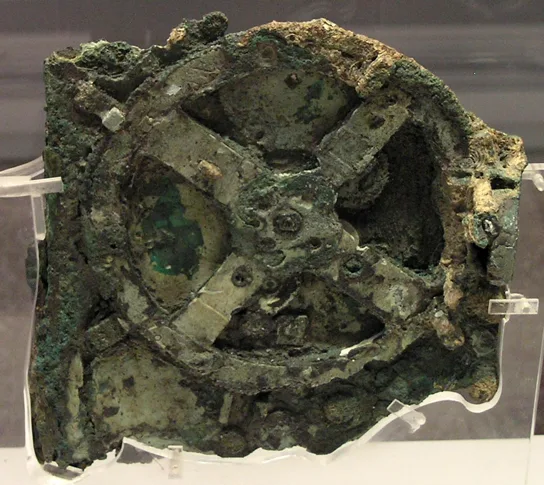
Money paid for engineers and artists. Hellenistic kings and cities built harbours, lighthouses, siege engines and warships of a size never seen before. A shipwreck found off the island of Antikythera in 1900 held a box of bronze gearwheels, at least thirty of them, from about 100 BC or a little earlier. X-ray scans have shown that it was a calculator for the sky: turning a handle showed the positions of the sun and moon, the phases of the moon, the dates of the Olympic Games and the eclipses to come.59T. Freeth et al., “Decoding the ancient Greek astronomical calculator known as the Antikythera Mechanism”, Nature 444 (2006), pp. 587–591Modern study of the mechanism with X-ray scansRead on Nature ↗ Nothing as complicated is known again until the astronomical clocks of medieval Europe.
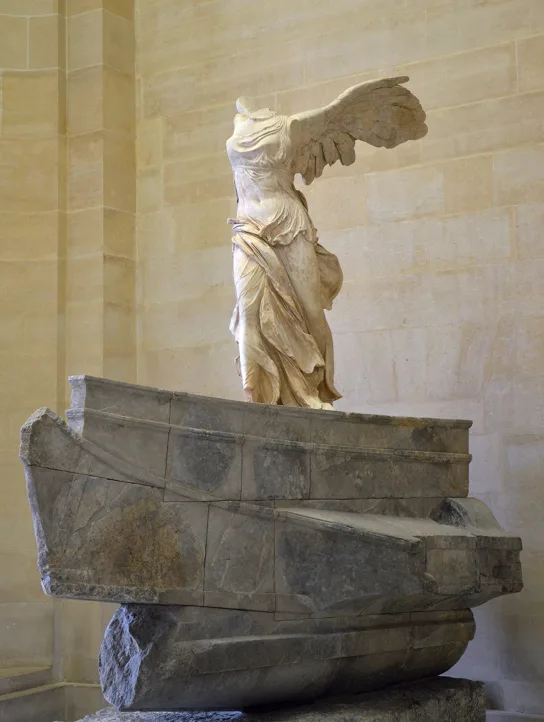
Society and culture: Greek from Marseille to Afghanistan
Across this new world a simplified common Greek, the koine, became the language of government, trade and learning. A merchant could make himself understood in it from the Greek colony of Massalia, today’s Marseille, to Egypt, Babylon and the Oxus. The Greek New Testament was later written in it. The kings ruled through Greek and Macedonian settlers, soldiers and officials, and for most of the Hellenistic period the local peoples stayed below them. But local elites who learned Greek could rise, especially in Egypt and Babylonia, and Greek culture changed by taking in the cultures around it.
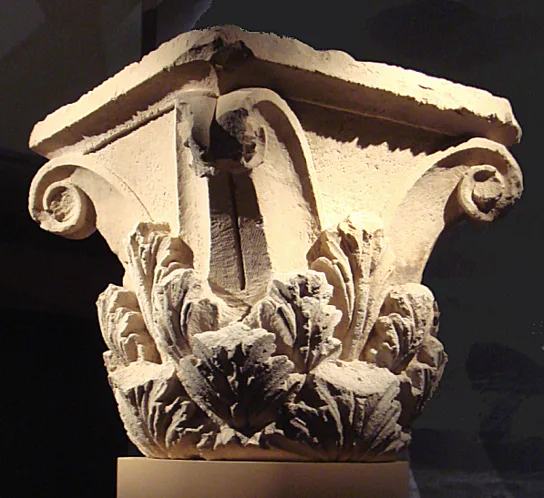
The centre of Greek life in the new cities was the gymnasium, where young men exercised naked, studied and learned to be Greek. In 1961 the king of Afghanistan was shown a Corinthian capital found on the bank of the Oxus, the Amu Darya, on the border with Tajikistan. French archaeologists then excavated a whole Greek city there, Ai Khanoum, with a palace, a theatre for about 5,000 spectators, one of the largest gymnasiums of the Greek world and Greek inscriptions. One of them records that a man named Clearchus had copied the wise sayings of Delphi and set them up in the city, more than 5,000 kilometres from Delphi itself: “As a child, be well-behaved; as a young man, self-controlled; in middle age, just; as an old man, wise; at death, without sorrow.”60L. Robert, “De Delphes à l’Oxus: inscriptions grecques nouvelles de la Bactriane”, Comptes rendus de l’Académie des Inscriptions 112 (1968), pp. 416–457Modern edition of the Greek inscriptions from Ai KhanoumRead on Persée ↗ The city was destroyed by nomads around 145 BC.
In Egypt the Ptolemies ruled two peoples. For the Greeks they were Macedonian kings; for the Egyptians, pharaohs who built temples in the old style and were shown in the old crowns. Their decrees were published in Greek and in Egyptian. The Rosetta Stone is a copy of one of them, a decree of the priests in honour of Ptolemy V from 196 BC, written in hieroglyphs, in the everyday Egyptian script called Demotic, and in Greek. Because the Greek could be read, it allowed Jean-François Champollion to decipher hieroglyphs in 1822. In Babylon priests went on writing cuneiform and observing the sky for the Seleucid kings, and dated their tablets by the new Seleucid era, which began in 311 BC. Further east, Indian kings came into contact with the Greeks: the emperor Ashoka, around 260 BC, had his edicts carved in Greek and Aramaic at Kandahar and sent envoys to the Hellenistic kings.

Society and culture: Alexandria, the Library and science
The greatest of the new cities was Alexandria. The Ptolemies made it the capital of Egypt and filled it with palaces, temples and harbours. On the island of Pharos they built a lighthouse more than 100 metres high, finished around 280 BC, which was counted among the Seven Wonders of the World and gave its name to the word for lighthouse in several languages. Next to the palace Ptolemy I or his son founded the Museum, a temple of the Muses where scholars were paid by the king to study, and beside it the Library, which tried to collect a copy of every Greek book.
How many books it held nobody knows. Ancient writers give figures from 40,000 to 700,000 scrolls, and modern historians think all of them are guesses, the higher ones very probably exaggerated. Nor was the Library destroyed in one great fire. It declined over centuries: in 145 BC a Ptolemaic king drove many scholars out of the city, in 48 BC fighting during Julius Caesar’s stay burned books near the harbour, and the palace quarter was ruined in wars of the 3rd century AD. By the time Christian crowds destroyed the temple of Serapis in AD 391, there was probably little left of the great royal library.61R. S. Bagnall, “Alexandria: library of dreams”, Proceedings of the American Philosophical Society 146 (2002), pp. 348–362Modern study of what is really known about the LibraryRead on JSTOR ↗
What is certain is what was done there. Around 300 BC Euclid wrote the Elements, the textbook of geometry that was still used in schools in the 20th century. Herophilus dissected human bodies and discovered that the brain, not the heart, is the centre of the nerves. Eratosthenes, head of the Library in the later 3rd century BC, worked out the size of the Earth from the angle of the sun’s shadow. Archimedes of Syracuse, who corresponded with the scholars of Alexandria, worked out the law of the lever and the principle of floating bodies, and calculated π more accurately than anyone before him. In one of his books he reports that the astronomer Aristarchus of Samos had suggested that the Earth goes round the sun, an idea that found almost no followers until Copernicus, 1,800 years later.
His method was simple and correct. On midsummer day the sun stood straight overhead at Syene, today’s Aswan, so that it shone to the bottom of a well; at the same time at Alexandria, to the north, a pointer cast a shadow showing that the sun was a fiftieth of a full circle from straight above. The distance between the cities, about 5,000 stades, was therefore a fiftieth of the Earth’s circumference: 250,000 stades. Depending on the length of the stade he used, that is between about 2 and 20 per cent off, a remarkable result for a man with a stick and a measured road.62D. W. Roller, Eratosthenes’ Geography (Princeton, 2010)Modern edition of the fragments of Eratosthenes, with his measurement of the EarthFind in a library (WorldCat) ↗
Religion: new gods, god-kings and philosophers
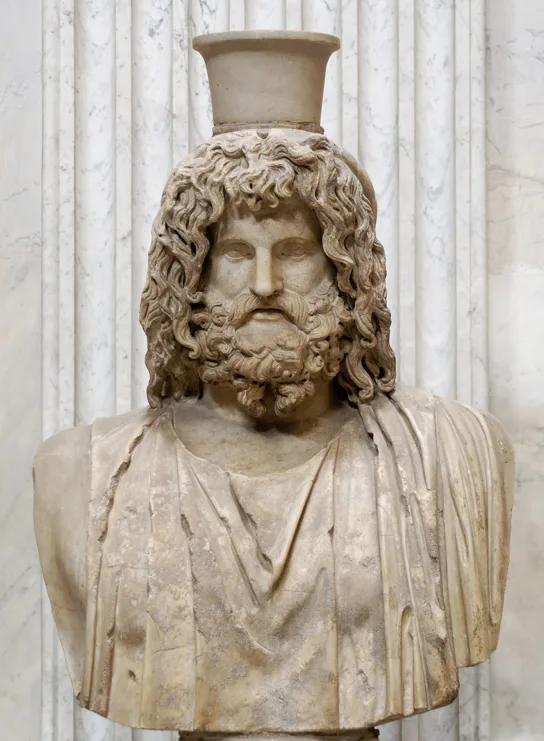
The old Greek gods were still worshipped in the old temples, but the Greeks who settled in Egypt and Asia met other gods and made room for them. Ptolemy I promoted a new god, Serapis, who combined the Egyptian Osiris and the sacred Apis bull of Memphis with the look of a bearded Greek Zeus, for both his Greek and his Egyptian subjects. The Egyptian goddess Isis, the loving mother and protector of sailors, found worshippers all over the Mediterranean, from Delos to Rome. Many people also turned to mystery cults, which promised their members a better life after death.
Kings now received honours like gods. Alexander is said to have asked the Greek cities to honour him as a god in 324 BC. His successors were given titles like Soter, “Saviour”, and Epiphanes, god made manifest, by the cities they protected, and in Egypt the Ptolemies were worshipped as gods in their own lifetime. Ptolemy I owed his name of Soter to Rhodes: Pausanias, who saw his statue in Athens, says it was “a name the Rhodians gave him”63Pausanias, Description of Greece 1.8.6Written c. AD 160. Translation by A. R. Shilleto (1886)Read on Project Gutenberg ↗ after he helped them survive a great siege in 304 BC. For most Greeks such honours were a way of saying thank you to a power that, unlike the old gods, could be seen and was close at hand.
Educated Greeks looked for guidance in philosophy, which now taught how to live well in a large and uncertain world rather than how to run a city. In Athens Zeno of Citium, from Cyprus, taught in the Painted Stoa from about 300 BC; his Stoics taught that the world is ruled by reason, that virtue is the only good, and that all people are citizens of one world. Epicurus, in his Garden from 306 BC, taught that the gods do not interfere with human life and that happiness lies in a calm mind free from fear. The Cynics, following Diogenes, mocked all conventions. Plutarch tells how Alexander found Diogenes lying in the sun at Corinth and asked if he could do anything for him, and Diogenes answered: “I would have you stand from between me and the sun”.64Plutarch, Life of Alexander 14Written c. AD 100, about 420 years after Alexander. Translation by J. Dryden, revised by A. H. CloughRead on Project Gutenberg ↗
For one people the meeting with Greek culture became a struggle for their religion. Many Jews lived in Alexandria, and in the 3rd century BC the Jewish scriptures were translated into Greek there; this translation, the Septuagint, became the Bible of Greek-speaking Jews and later of the early Christians. In Judaea, ruled by the Seleucids from 200 BC, some leading families adopted Greek ways and even built a gymnasium in Jerusalem. In 167 BC King Antiochus IV, in the middle of this internal conflict, banned the Jewish laws and set up an altar to Zeus in the Temple. A priest, Mattathias, and his sons, led by Judas, called the Maccabee, “the Hammer”, began a revolt. In 164 BC they retook Jerusalem and purified the Temple, a victory still remembered in the festival of Hanukkah, and their family went on to rule an independent Jewish kingdom.
Rome takes over, 200–30 BC
The Hellenistic kingdoms were rich and powerful, but they spent their strength fighting each other. Around 200 BC a new power from the west came into their wars: Rome, which had just defeated Carthage and Hannibal. Polybius, a Greek statesman who was taken to Rome as a hostage and became a friend of Roman generals, set out to explain to the Greeks how “almost the whole inhabited world was conquered and brought under the dominion of the single city of Rome, and that too within a period of not quite fifty-three years”,65Polybius, Histories 1.1Written c. 150 BC by a Greek statesman who lived through Rome’s conquest of Greece. Translation by E. S. Shuckburgh (1889)Read on Project Gutenberg ↗ from 220 to 167 BC.
It happened in stages. Rome defeated Philip V of Macedon at Cynoscephalae in 197 BC and proclaimed the Greeks free, and in 190 BC it beat the Seleucid king Antiochus III and drove him out of Asia Minor. In 168 BC the legions crushed the Macedonian phalanx at Pydna, and the last Antigonid king, Perseus, was led through the streets of Rome in a triumph. Macedon became a Roman province in 146 BC, and the same year a Roman army destroyed Corinth, the richest city of Greece, and sold its people as slaves. In 133 BC the last king of Pergamon left his kingdom to Rome in his will. The Seleucid kingdom, squeezed between the Parthians in the east and Rome in the west, was ended by the Roman general Pompey in 64 BC. The last of the Ptolemies, Cleopatra VII, tried to save her kingdom through alliances with Julius Caesar and Mark Antony. After their defeat at Actium in 31 BC she killed herself, and in 30 BC Egypt became a Roman province.

Rome had conquered the Hellenistic world, but the Hellenistic world had shaped Rome. The Romans brought home Greek statues, books and teachers, copied Greek art, read Greek philosophy and wrote their own literature in Greek forms; educated Romans spoke Greek, and the eastern half of the Roman Empire went on speaking it. The Roman poet Horace summed it up: “Captive Greece took captive her fierce conqueror, and introduced her arts into rude Latium.”66Horace, Epistles 2.1.156Written c. 12 BC by a Roman poet. Prose translation by C. Smart, revised (Project Gutenberg)Read on Project Gutenberg ↗
What historians now think
Alexander has been a hero and a villain for more than two thousand years: a philosopher-king spreading civilisation for some Roman and Victorian writers, a bloodthirsty conqueror for others. Modern historians try to separate what the sources can show from what was added later, and several of the best-known claims about him look different today. The ancient army figures at Gaugamela are impossible; the cause of his death is unknown; the reason for the fire at Persepolis is still disputed; and the idea of a planned “fusion” or brotherhood of peoples has few defenders. Plutarch says Alexander founded more than seventy cities, but a careful modern study accepts only a handful as certain foundations of his, and many of the others were small military colonies or older towns renamed.67P. M. Fraser, Cities of Alexander the Great (Oxford, 1996)Modern study of which cities Alexander really foundedFind in a library (WorldCat) ↗
An empire that changed its king
No Persian history of Alexander’s war survives, and probably none was written: the Persian court kept records and administrative archives, not narrative histories. Almost everything we know about Darius III comes from his enemies, and Greek and Roman writers made him the weak, cowardly king who ran away twice, the perfect opposite of the young hero. Modern historians of Persia point out that this picture is a Greek story, and that until Issus Darius was a capable ruler who held a very large empire together.68P. Briant, Darius in the Shadow of Alexander (Cambridge, Mass., 2015)Modern study of how the image of Darius III was made by Greek and Roman writersFind in a library (WorldCat) ↗
The closest view from inside the empire comes from Babylon. The astronomical diaries of the temple astronomers record, besides the sky, the events of the day. The diary for 331 BC notes the battle of Gaugamela in a few broken lines, says that the king’s troops deserted him, and records how “Alexander, king of the world” sent a message to the Babylonians before he entered their city.69A. J. Sachs and H. Hunger, Astronomical Diaries and Related Texts from Babylonia, vol. 1 (Vienna, 1988), nos. −330 and −322Modern edition and translation of the Babylonian astronomical diariesFind in a library (WorldCat) ↗ For the Babylonians the war was one more change of ruler: Alexander was treated as a legitimate king, and he ordered their temple of Marduk to be rebuilt.
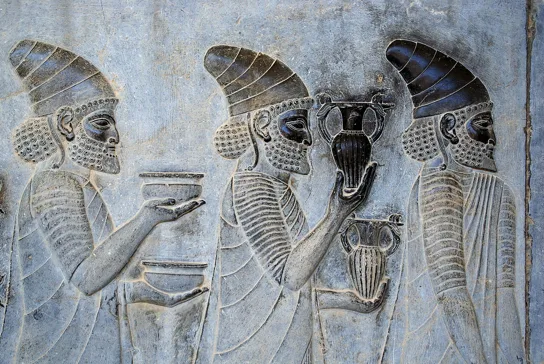
For the Persian elite the conquest was a disaster but not the end of the world. Many nobles kept their lands, and some, like Mazaeus at Babylon and Artabazus in Bactria, served Alexander as satraps; Persian women married Macedonian generals, and Persian soldiers fought in Alexander’s army. The empire’s system of satrapies, roads and taxes survived under the Seleucids. Memory was harsher. In the Zoroastrian tradition, written down centuries later in Middle Persian books, Alexander is “the accursed”, the destroyer who killed the priests and burned the holy books. In the Persian Book of Kings of Ferdowsi, around AD 1010, he became Iskandar, a hero of Iranian legend and even a half-brother of Darius, so that the conqueror of Persia was turned into a Persian king.70P. Briant, From Cyrus to Alexander: A History of the Persian Empire (Winona Lake, 2002)Modern history of the Persian Empire from its own documentsFind in a library (WorldCat) ↗
How close is our evidence?
No account by an eyewitness of Alexander’s campaigns survives. Several men who marched with him wrote histories: his court historian Callisthenes, his general Ptolemy, who later became king of Egypt, the engineer Aristobulus, the admiral Nearchus. A generation later Cleitarchus, who lived in Alexandria, wrote a lively and popular history. All of these are lost and known only through the writers who used them. The five histories that survive were written between about 30 BC and the 2nd century AD. Diodorus, Curtius and Justin follow mainly Cleitarchus, and tell a more colourful story, with the drunken fire at Persepolis and a king corrupted by Persian luxury. Arrian, a Greek senator and governor in the Roman Empire, wrote in the 2nd century AD and explains in his preface that he trusted Ptolemy and Aristobulus, because both had served with Alexander: “the narratives of Ptolemy and Aristobulus are more worthy of credit than the rest”.71Arrian, Anabasis prefaceWritten c. AD 130–150, from the memoirs of Ptolemy and Aristobulus, who served with Alexander. Translation by E. J. Chinnock (1884)Read on Project Gutenberg ↗ Most modern historians agree that he is the most reliable, but Ptolemy had his own reasons to make himself look good and to make Alexander look heroic.
Against all these late books stand a few things written at the time: the Babylonian astronomical diaries, inscriptions set up by Greek cities, Alexander’s coins and the buildings and cities that archaeologists have excavated, from Vergina to Ai Khanoum. For the Hellenistic age after Alexander the evidence is better: Polybius lived through Rome’s conquest of Greece, Diodorus’ books 18–20 follow Hieronymus of Cardia, who fought in the wars of the Successors, and from Egypt thousands of papyri show everyday life, taxes and law. Where the ancient writers disagree, and where they give numbers, it is wise to remember how far they were from the events.
- Plutarch, Life of Alexander 10
- A. Bartsiokas, J. L. Arsuaga, E. Santos, M. Algaba and A. Gómez-Olivencia, “The lameness of King Philip II and Royal Tomb I at Vergina, Macedonia”, PNAS 112 (2015), pp. 9844–9848
- Plutarch, Life of Alexander 3
- Plutarch, Life of Alexander 7
- Plutarch, Life of Alexander 6
- Diodorus Siculus, Library of History 17.14.1
- Arrian, Anabasis 1.9
- P. Briant, Darius in the Shadow of Alexander (Cambridge, Mass., 2015)
- Arrian, Anabasis 2.14
- Arrian, Anabasis 1.11
- Diodorus Siculus, Library of History 17.17.2
- Arrian, Anabasis 1.15
- Arrian, Anabasis 1.16
- Arrian, Anabasis 2.3
- Arrian, Anabasis 2.3
- Arrian, Anabasis 2.13
- Arrian, Anabasis 2.12
- Arrian, Anabasis 2.25
- Arrian, Anabasis 2.18
- Diodorus Siculus, Library of History 17.46.5
- N. Marriner, C. Morhange and S. Meulé, “Holocene morphogenesis of Alexander the Great’s isthmus at Tyre in Lebanon”, PNAS 104 (2007), pp. 9218–9223
- Arrian, Anabasis 3.1
- Arrian, Anabasis 3.4
- Arrian, Anabasis 3.8
- H. Delbrück, History of the Art of War, vol. 1: Warfare in Antiquity (1920; English translation 1975)
- D. W. Engels, Alexander the Great and the Logistics of the Macedonian Army (Berkeley, 1978)
- Arrian, Anabasis 3.16
- Diodorus Siculus, Library of History 17.71.2
- Arrian, Anabasis 3.18
- Diodorus Siculus, Library of History 17.72.2
- Plutarch, Life of Alexander 38
- E. N. Borza, “Fire from heaven: Alexander at Persepolis”, Classical Philology 67 (1972), pp. 233–245
- Arrian, Anabasis 3.21
- Arrian, Anabasis 4.7
- Arrian, Anabasis 4.17
- Arrian, Anabasis 4.8
- Arrian, Anabasis 4.12
- Arrian, Anabasis 4.19
- F. L. Holt, Into the Land of Bones: Alexander the Great in Afghanistan (Berkeley, 2005)
- Arrian, Anabasis 5.19
- Arrian, Anabasis 5.27
- Arrian, Anabasis 6.24
- A. B. Bosworth, Conquest and Empire: The Reign of Alexander the Great (Cambridge, 1988)
- Arrian, Anabasis 7.4
- Arrian, Anabasis 7.11
- E. Badian, “Alexander the Great and the unity of mankind”, Historia 7 (1958), pp. 425–444
- Plutarch, Life of Alexander 76
- Arrian, Anabasis 7.28
- A. J. Sachs and H. Hunger, Astronomical Diaries and Related Texts from Babylonia, vol. 1 (Vienna, 1988), nos. −330 and −322
- Arrian, Anabasis 7.27
- A. B. Bosworth, “The death of Alexander the Great: rumour and propaganda”, Classical Quarterly 21 (1971), pp. 112–136
- E. N. Borza and J. Reames-Zimmerman, “Some new thoughts on the death of Alexander the Great”, Ancient World 31 (2000), pp. 22–30
- Diodorus Siculus, Library of History 17.117.4
- Photius, Bibliotheca, codex 92 (summary of Arrian, Events after Alexander)
- Diodorus Siculus, Library of History 18.28.2
- G. Le Rider, Alexander the Great: Coinage, Finances, and Policy (Philadelphia, 2007)
- Polybius, Histories 5.88
- Polybius, Histories 5.88
- T. Freeth et al., “Decoding the ancient Greek astronomical calculator known as the Antikythera Mechanism”, Nature 444 (2006), pp. 587–591
- L. Robert, “De Delphes à l’Oxus: inscriptions grecques nouvelles de la Bactriane”, Comptes rendus de l’Académie des Inscriptions 112 (1968), pp. 416–457
- R. S. Bagnall, “Alexandria: library of dreams”, Proceedings of the American Philosophical Society 146 (2002), pp. 348–362
- D. W. Roller, Eratosthenes’ Geography (Princeton, 2010)
- Pausanias, Description of Greece 1.8.6
- Plutarch, Life of Alexander 14
- Polybius, Histories 1.1
- Horace, Epistles 2.1.156
- P. M. Fraser, Cities of Alexander the Great (Oxford, 1996)
- P. Briant, Darius in the Shadow of Alexander (Cambridge, Mass., 2015)
- A. J. Sachs and H. Hunger, Astronomical Diaries and Related Texts from Babylonia, vol. 1 (Vienna, 1988), nos. −330 and −322
- P. Briant, From Cyrus to Alexander: A History of the Persian Empire (Winona Lake, 2002)
- Arrian, Anabasis preface