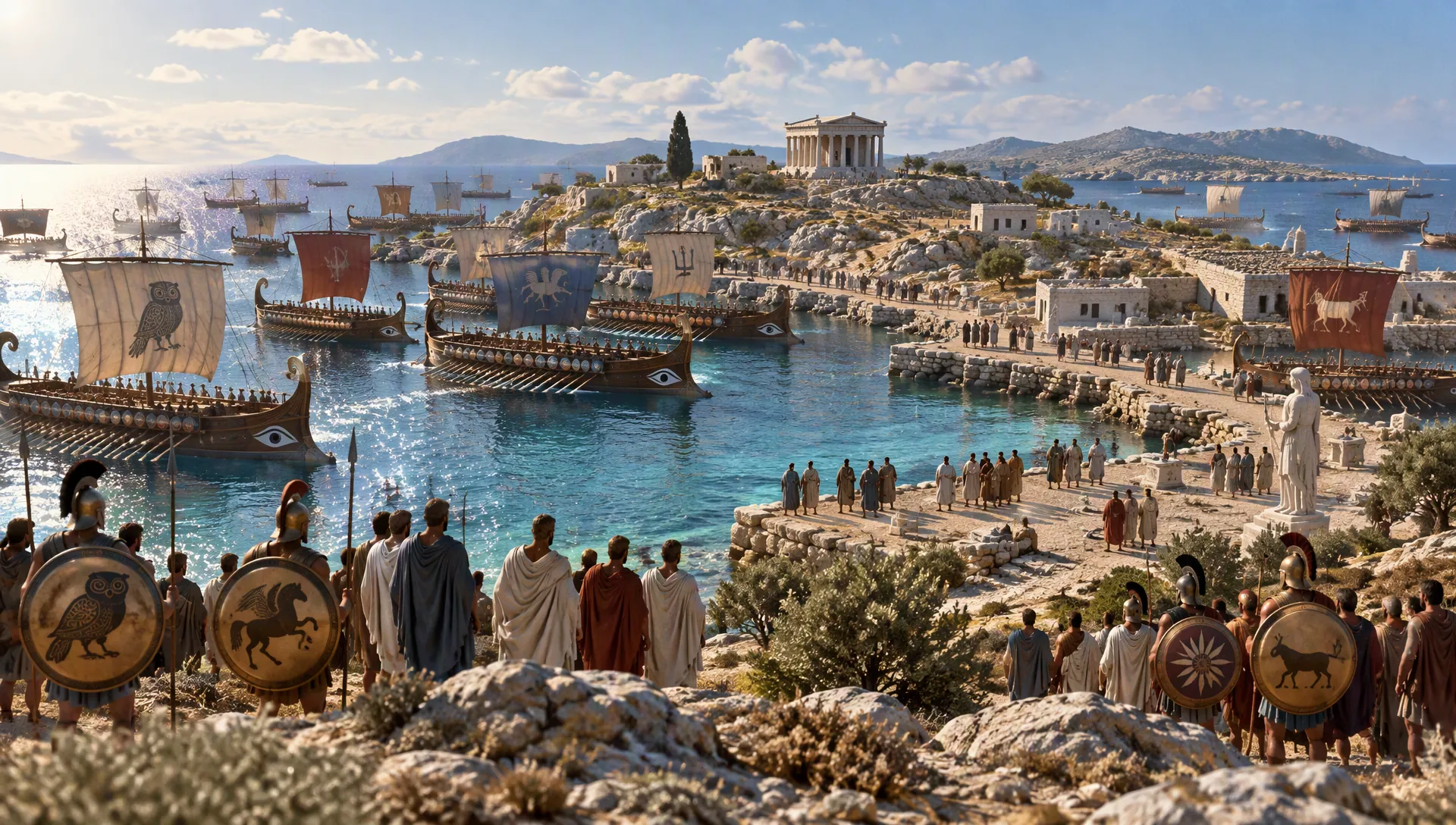
In 479 BC the Persian invasion of Greece was over, but the war was not. The Greeks of the islands and the coast of Asia Minor were free for the moment, with a Persian empire just across the water. Within two years they had formed a new alliance with its treasury on the sacred island of Delos and Athens at its head. Within twenty years that alliance had become something else: an Athenian empire that kept its members in by force.
Where this chapter fits
This chapter opens the fourth and last part of the Persian Wars, the Greek counterattack. In the previous chapter the Greeks defeated the Persian army at Plataea and the Persian camp and fleet at Mycale, in the summer of 479 BC. After Mycale the allies argued at Samos about what to do with the Greeks of Ionia. The Peloponnesians wanted to move them to Greece, onto the land of the Greeks who had sided with Persia; the Athenians refused to let Sparta decide the fate of their colonists, and the islanders were taken into the alliance instead.
That quarrel showed where the alliance of 481 BC would split. Sparta led the Greeks on land and had little interest in a long war overseas. Athens had the largest fleet, the strongest ties with the Ionians, and every reason to keep the Persians far from the Aegean. The years that followed, which the Greeks later remembered as the time between the Persian war and the war between Athens and Sparta, are told in detail by only one historian, Thucydides, who wrote that his predecessors had left them out.1Thucydides, History of the Peloponnesian War 1.97Written c. 400 BC. Translation by R. CrawleyRead on Project Gutenberg ↗
The siege of Sestos
From Mycale the allied fleet sailed north to the Hellespont to destroy Xerxes’ bridges, and found them already broken. The Spartan king Leotychidas and the Peloponnesians decided to go home. The Athenians under Xanthippus, the father of Pericles, stayed with the Ionians and the Greeks of the Hellespont and laid siege to Sestos, the strongest fortress on the European shore of the straits.2Herodotus, Histories 9.114Written c. 430 BC. Translation by A. D. GodleyRead on Perseus ↗ Thucydides tells the same story in one sentence: the Athenians and the allies from Ionia and the Hellespont “remained and laid siege to Sestos, which was still held by the Medes”, wintered before it and took it when the defenders left.3Thucydides, History of the Peloponnesian War 1.89Written c. 400 BC. Translation by R. CrawleyRead on Project Gutenberg ↗
Herodotus fills the siege with detail. The Persian governor of the region, Artayctes, had plundered the shrine of the hero Protesilaus at nearby Elaeus, and the local Greeks hated him for it. By the autumn the defenders were so short of food that they boiled the leather straps of their beds and ate them. Then the Persians slipped out by night; the next morning the people of the Chersonese signalled from the towers and opened the gates. Artayctes was caught, and the Athenian general refused his offer of a ransom. On the headland where Xerxes had bridged the strait, the Athenians nailed him to boards and hanged him, and stoned his son before his eyes.
With that Herodotus ends his history. The Athenians sailed home in 478 BC carrying the cables of Xerxes’ bridges, to be dedicated in their temples. For the next fifty years we depend on Thucydides, on scattered inscriptions, and on writers who lived centuries later.
Pausanias at Cyprus and Byzantium
In 478 BC the allies were still led by Sparta. The Spartans sent Pausanias, the victor of Plataea, to command the fleet, with twenty ships from the Peloponnese, thirty from Athens and others from the allies. He sailed first to Cyprus and freed most of the island from Persian rule, then turned north and forced the Persian garrison of Byzantium to surrender. Diodorus, writing four centuries later, gives slightly different numbers: fifty ships from the Peloponnese and thirty from Athens under Aristides.4Diodorus Siculus, Library of History 11.44Written c. 30 BC. Translation by C. H. Oldfather (1946)Read on LacusCurtius ↗
Byzantium controlled the passage between the Black Sea and the Aegean, and its capture should have been the high point of Pausanias’ career. Instead it began his fall. According to Thucydides, Pausanias secretly released some of the king’s relatives captured in the city and sent them home to Xerxes, together with a letter: “I propose also, with your approval, to marry your daughter, and to make Sparta and the rest of Hellas subject to you.”5Thucydides, History of the Peloponnesian War 1.128Written c. 400 BC. Translation by R. CrawleyRead on Project Gutenberg ↗ Xerxes answered by sending Artabazus, a general who had fought at Plataea, to take over the province of Dascylium on the Hellespont and act as go-between.
Whatever the truth of the letters, the allies saw a change in Pausanias. He began to dress like a Persian, travelled through Thrace with a bodyguard of Medes and Egyptians, kept a Persian table, and treated the allied captains with such violence that no one could approach him. To Thucydides there had been in him “more of the mimicry of a despot than of the attitude of a general”.6Thucydides, History of the Peloponnesian War 1.95Written c. 400 BC. Translation by R. CrawleyRead on Project Gutenberg ↗
The allies turn to Athens
The Ionians and the newly freed islanders went to the Athenians and asked them, as their kinsmen, to become their leaders and to protect them from Pausanias. The Athenians agreed. Plutarch, writing about AD 100, tells a dramatic version: two captains, Uliades of Samos and Antagoras of Chios, rammed Pausanias’ own flagship near Byzantium, told him to thank the luck that had fought for him at Plataea, and sailed off to join the Athenians.7Plutarch, AristidesWritten c. AD 100. Translation by J. Dryden, revised by A. H. CloughRead on Project Gutenberg ↗
Sparta recalled Pausanias to answer the accusations. He was cleared of the gravest charges, but he was not sent back. A new Spartan commander, Dorcis, arrived with a small force and found that the allies would no longer accept Spartan leadership; he went home, and Sparta sent no one else. Thucydides gives the Spartans’ reasons: they feared that other commanders abroad would go the way of Pausanias, they wanted to be rid of the war against Persia, and they thought the Athenians capable of leading it and, for the moment, friendly. The nineteenth-century historian George Grote saw the new alliance in the same light: it was the islanders’ fear of Persia, more than Athenian ambition, that created it.
An alliance on Delos
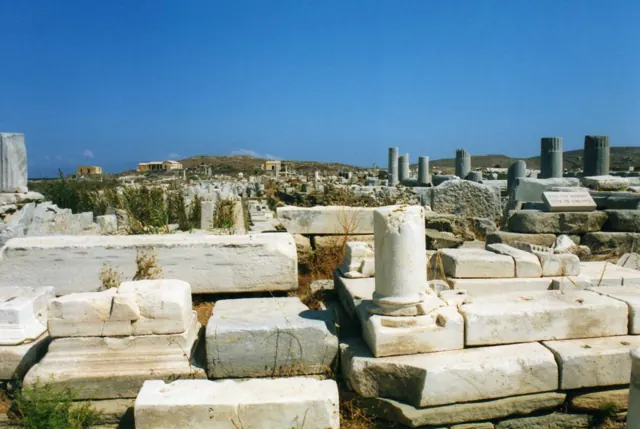
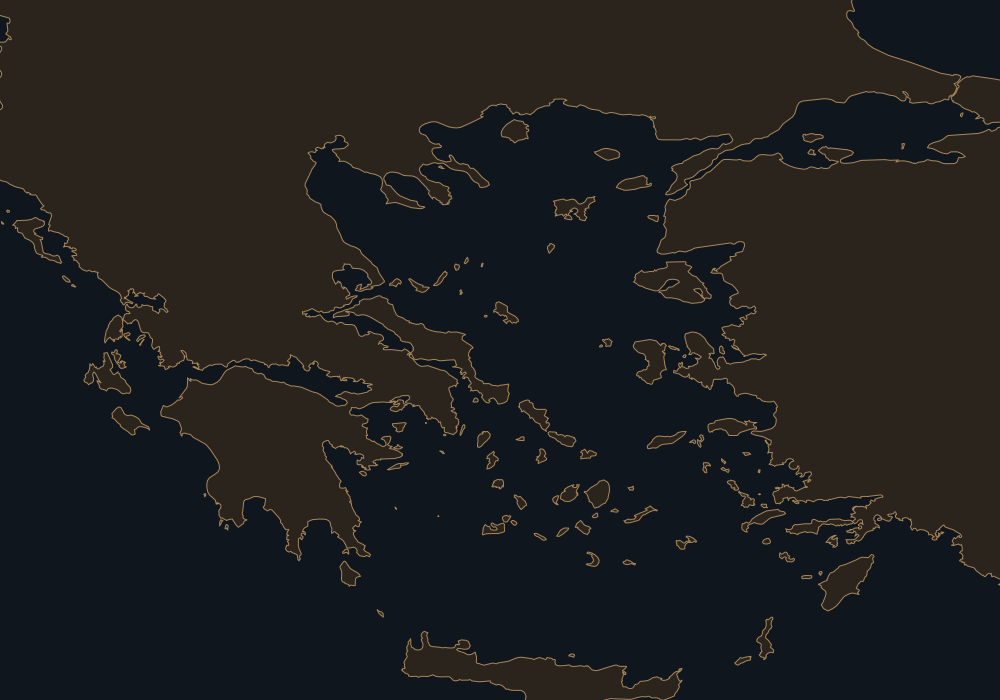
The new alliance was founded in the winter of 478/477 BC. Its members were the cities of the Aegean islands, of Ionia and Aeolis on the coast of Asia Minor, and of the Hellespont, under Athenian leadership. Its stated purpose, in Thucydides’ words, was “to retaliate for their sufferings by ravaging the King’s country”: to carry the war into Persian territory and to keep the Persians out of the Aegean.8Thucydides, History of the Peloponnesian War 1.96Written c. 400 BC. Translation by R. CrawleyRead on Project Gutenberg ↗ Modern historians usually date the founding to 478/477 BC; some sources simply give 478 BC.9J. Roisman (ed.), translated by J. C. Yardley, Ancient Greece from Homer to Alexander: The Evidence (2011), timeline, p. xliiiModern sourcebook with a timeline of the periodView on Google Books ↗
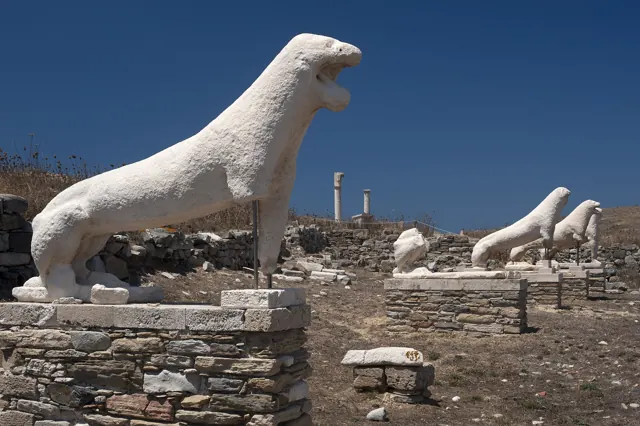
The alliance had no name of its own. Modern historians call it the Delian League, after its centre. Delos was an obvious choice: a small island in the middle of the Cyclades, sacred to Apollo, with an old festival that had once brought the Ionian Greeks together. The treasury of the League was kept in the temple, and the members met there in a common congress. Thucydides stresses that at first Athens led “independent allies who acted on the resolutions of a common congress”.
The members swore to keep the alliance for ever. Plutarch says Aristides administered the oath for the Athenians and threw lumps of red-hot iron into the sea, calling down curses on anyone who broke the vow: the alliance was to last until the iron floated.10Plutarch, AristidesWritten c. AD 100. Translation by J. Dryden, revised by A. H. CloughRead on Project Gutenberg ↗
Ships or money: the first assessment
A fleet costs money, and every member had to contribute. The Athenians decided which cities would provide ships and which would pay money instead. They created a new board of Athenian officials, the “Treasurers for Hellas”, to receive the money, which was called the phoros. The first total, according to Thucydides, was 460 talents.
The task of fixing each city’s share fell to Aristides, the Athenian commander whom the allies trusted most. Plutarch says he travelled round, surveyed each city’s land and revenue, and set the amounts so fairly that the allies later remembered his assessment as a golden age; he went out poor and came back poorer. Plutarch gives the same total as Thucydides, 460 talents. Diodorus, writing much later, says 560.11Diodorus Siculus, Library of History 11.47Written c. 30 BC. Translation by C. H. Oldfather (1946)Read on LacusCurtius ↗
Modern historians have long debated whether the first assessment really came to 460 talents. Some think that figure is too high for the money paid in the first years and may include the value of the ships that many allies supplied instead; others defend Thucydides’ figure.12P. J. Rhodes, The Athenian Empire (Greece & Rome New Surveys in the Classics 17, Oxford 1985), pp. 7–8Modern survey of the evidence on the Delian LeagueFind in a library (WorldCat) ↗13A. French, “The Guidelines of the Delian Alliance”, Antichthon 22 (1988), pp. 12–25Modern article on the founding terms of the LeagueRead on Cambridge Core ↗
Cimon’s campaigns: Eion, Scyros and Carystus
The League’s first commander was Cimon, son of Miltiades, the victor of Marathon. His first target was Eion, a Persian fortress at the mouth of the river Strymon in Thrace. Thucydides says only that the Athenians besieged and took it and enslaved its people. Plutarch adds that Cimon cut off the town’s supplies by driving the Thracians from the land around it, until the Persian commander Boges, whom Plutarch calls Butes, set fire to the town and burned himself and his family rather than surrender. The translator of Diodorus dates the capture of Eion to 476 BC.14C. H. Oldfather, note to Diodorus 11.60 (1946)Modern note by the translator of the Loeb edition of DiodorusRead on LacusCurtius ↗
Next came Scyros, a rocky island in the Aegean whose inhabitants, Dolopians, lived by piracy. The Athenians enslaved them and settled the island with their own colonists. Then the League turned on Carystus, a city at the southern tip of Euboea that the Greek fleet had already ravaged in 480 BC for taking the Persian side; it was forced to surrender on terms. Diodorus compresses all these campaigns into a single year, which his translator notes is wrong by about ten years.
The bones of Theseus
The conquest of Scyros had a religious sequel that made Cimon famous at home. According to legend, Theseus, the hero-king of Athens, had died on Scyros, murdered by its king Lycomedes. Plutarch says an oracle had told the Athenians to bring home his bones, but the islanders had never let them search. After the conquest Cimon found a grave, carried the remains onto his ship, and brought them to Athens with great ceremony, about four hundred years after Theseus was said to have left the city. Pausanias, who travelled in Greece in the second century AD, also credits Cimon with finding the bones.15Pausanias, Description of Greece 3.3.7Written c. AD 160; Pausanias visited the sites. Translation by A. R. Shilleto (1886)Read on Project Gutenberg ↗
The story mattered in Athens. Theseus was the hero who was believed to have united Attica, and bringing him home connected the new Athenian leadership at sea with the city’s legendary past. Plutarch says the Athenians welcomed the relics with processions and sacrifices, as if Theseus himself had come back. Whether the bones were really his, no one can say; the ancient writers report what the Athenians believed.
Naxos: the first ally kept in by force
Around 470 BC the large island of Naxos, one of the original members, decided to leave the League. The Athenians and their allies besieged it and forced it back in. For Thucydides this was a turning point: it was “the first instance of the engagement being broken by the subjugation of an allied city, a precedent which was followed by that of the rest in the order which circumstances prescribed”.16Thucydides, History of the Peloponnesian War 1.98Written c. 400 BC. Translation by R. CrawleyRead on Project Gutenberg ↗ Thucydides gives no date; modern reconstructions put the revolt between about 471 and 467 BC.
Thucydides explains why such revolts happened, and why they failed. The commonest causes were unpaid tribute, ships not delivered and men refusing to serve, because the Athenians were strict and demanding with allies who were not used to constant campaigning. And the allies had partly themselves to blame: to avoid serving away from home, most of them chose to pay money instead of supplying ships, so that Athens built up its own navy with their money, while they had neither the ships nor the experience to resist when they wanted to leave.17Thucydides, History of the Peloponnesian War 1.99Written c. 400 BC. Translation by R. CrawleyRead on Project Gutenberg ↗
Plutarch tells the same story from the other side, as a deliberate policy of Cimon. Instead of punishing allies who would not serve, Cimon accepted money and empty ships from them and let them stay at home, while he kept large numbers of Athenians at sea and trained them in constant campaigns. In the end, Plutarch writes, the allies “found themselves after a while allies no longer, but unwittingly become tributaries and slaves”.18Plutarch, CimonWritten c. AD 100. Translation by J. Dryden, revised by A. H. CloughRead on Project Gutenberg ↗
From alliance to empire
Thucydides, who lived through the war that this empire caused, describes the change without sentiment. Athens took over the leadership with the allies’ consent, then gradually turned the alliance into a source of power: “Athens, on the contrary, had by degrees deprived hers of their ships, and imposed instead contributions in money on all except Chios and Lesbos.”19Thucydides, History of the Peloponnesian War 1.19Written c. 400 BC. Translation by R. CrawleyRead on Project Gutenberg ↗ By 431 BC, he says, Athens drew an average of 600 talents a year from the tribute of the allies.20Thucydides, History of the Peloponnesian War 2.13Written c. 400 BC. Translation by R. CrawleyRead on Project Gutenberg ↗ Plutarch adds that the total was later doubled and then trebled.21Plutarch, AristidesWritten c. AD 100. Translation by J. Dryden, revised by A. H. CloughRead on Project Gutenberg ↗
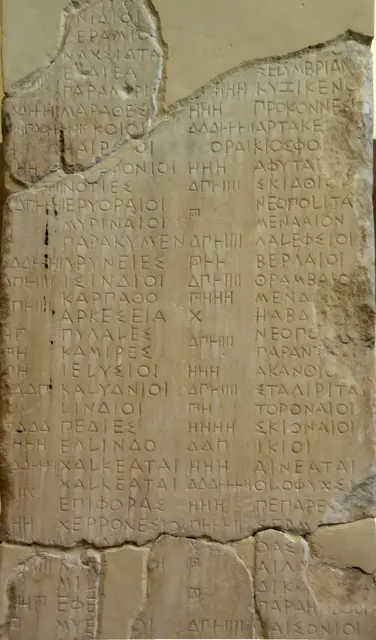
The clearest sign of the change came in 454 BC, when the treasury was moved from Delos to Athens. From that year the Athenians inscribed on stone the sixtieth part of each city’s tribute that was dedicated to Athena, and the fragments of these “tribute lists”, found on the Acropolis, are the most important documents of the League that survive.22R. Meiggs, The Athenian Empire (Oxford, Clarendon Press, 1972)Standard modern study of the League, its tribute and the tribute listsFind in a library (WorldCat) ↗ Plutarch reports a revealing remark attributed to Aristides himself: when the Samians proposed moving the money to Athens, he said that it was not just, but it was expedient.23Plutarch, AristidesWritten c. AD 100. Translation by J. Dryden, revised by A. H. CloughRead on Project Gutenberg ↗ Whether the story is true is uncertain; Aristides probably died before 454 BC.
The end of Pausanias
Pausanias did not accept his removal. He returned to Byzantium on his own account in a ship from Hermione, was driven out by the Athenians, and settled for a time at Colonae in the Troad, where he was said to be intriguing with the Persians. Recalled to Sparta a second time, he was imprisoned and released, but suspicion grew: he was said to have promised the helots freedom and citizenship if they would rise with him.
The proof, Thucydides says, came from his own messenger, a man from Argilus, who noticed that none of the earlier messengers to the Persian governor had come back. He opened the letter he was carrying and found an order to have him killed. He took the letter to the ephors and went as a suppliant to Taenarus, where he hid some of the ephors behind a partition in his hut so that they heard Pausanias admit everything. When the ephors came to arrest him in the street, Pausanias fled into the temple of Athena of the Brazen House. The ephors took off the roof of the room where he had taken refuge, walled him in and starved him; they carried him out just before he died, so as not to pollute the temple. Diodorus adds that Pausanias’ own mother placed the first brick in the doorway.24Diodorus Siculus, Library of History 11.45Written c. 30 BC. Translation by C. H. Oldfather (1946)Read on LacusCurtius ↗
The victor of Plataea thus died as a traitor, probably around 470 BC; Thucydides gives no year. How much of the story is true cannot be checked. The letters Thucydides quotes may come from Spartan accounts written after the event, and the Spartan authorities had their own reasons to blacken a man who had become too powerful. What is certain is that his fall ended Sparta’s leadership at sea for a generation.
Themistocles flees to Persia
The investigation of Pausanias also brought down Themistocles, the victor of Salamis. He had already been ostracised, sent into exile for ten years by a vote of the Athenian assembly, and was living at Argos. Plutarch explains ostracism as a way to humble men who had become too powerful for a democracy. When the Spartans claimed that evidence against Pausanias also implicated Themistocles, Athens and Sparta sent men to arrest him.
His escape reads like an adventure story. He fled to Corcyra, then to the court of Admetus, king of the Molossians, who was no friend of his; on the advice of the king’s wife he sat at the hearth holding their child, as a suppliant, and Admetus refused to hand him over. He crossed Macedonia and boarded a merchant ship for Ionia; a storm drove it towards the Athenian fleet that was besieging Naxos, and Themistocles, unknown to the passengers, told the captain who he was and threatened to accuse him of taking a bribe unless he kept everyone on board until they could sail on. He landed at Ephesus and wrote to the new Persian king, Artaxerxes, son of Xerxes: “I, Themistocles, am come to you, who did your house more harm than any of the Hellenes.”25Thucydides, History of the Peloponnesian War 1.137Written c. 400 BC. Translation by R. CrawleyRead on Project Gutenberg ↗
He asked for a year’s grace, spent it learning the Persian language and customs, and then came to the court, where, Thucydides says, he reached a standing “such as no Hellene has ever possessed before or since”. The king gave him the revenues of three cities in Asia Minor: Magnesia, worth fifty talents a year, for his bread, Lampsacus for his wine and Myus for his other provisions. He died at Magnesia, of disease according to Thucydides, although there was also a story that he poisoned himself rather than lead a Persian army against Greece.
The later writers tell the story differently. Diodorus has Themistocles come to Xerxes himself, learn Persian while waiting for a trial, and receive a Persian wife along with the three cities; his translator notes that the wife is attested only by Diodorus and is almost certainly fictitious.26C. H. Oldfather, note to Diodorus 11.60 (1946)Modern note by the translator of the Loeb edition of DiodorusRead on LacusCurtius ↗ Plutarch knew both versions and noted that Thucydides and Charon of Lampsacus, an early historian, said Xerxes was already dead, which the chronology supports. He also preferred the dramatic ending: Themistocles drank bull’s blood, “as is the usual story”, or poison.27Plutarch, ThemistoclesWritten c. AD 100. Translation by J. Dryden, revised by A. H. CloughRead on Project Gutenberg ↗
A lost coastline, and Greeks for hire
For the Persian kings the years after 479 BC brought losses on the western edge of the empire, but no threat to its heart. The Greek cities of the islands and the coast fell away, Persian garrisons were driven out of Thrace and the Hellespont, and the satrapies of Asia Minor now faced a hostile fleet. Yet the interior of Anatolia and the rich provinces beyond remained Persian, and Persian governors still ruled from Sardis and Dascylium.
Persia’s answer was money and diplomacy as much as war. Xerxes, Thucydides says, sent Artabazus, “son of Pharnaces, to the sea with orders to supersede Megabates, the previous governor in the satrapy of Daskylion”, to deal with Pausanias.28Thucydides, History of the Peloponnesian War 1.129Written c. 400 BC. Translation by R. CrawleyRead on Project Gutenberg ↗ Within a few years the two most famous Greek commanders of the war had been accused of working for Persia, and one of them, Themistocles, ended his life as a Persian governor in Asia Minor. A Greek exile at the king’s court was nothing new: the deposed Spartan king Demaratus had come up to Susa in the time of Darius and marched with Xerxes in 480 BC.29Herodotus, Histories 7.3Written c. 430 BC. Translation by A. D. GodleyRead on Perseus ↗
No Persian text describes these events. The Persian side reaches us only through Greek writers, and above all through Thucydides, who saw the empire mainly as the source of gold and intrigue in Greek politics. Persia also kept the strength to build a new fleet and army in the east, which Cimon would meet at the river Eurymedon around 466 BC.
How close is our evidence?
For the founding of the League and its first twenty years we depend almost entirely on Thucydides, who wrote a short sketch of the period in book 1 of his history to explain how Athens became powerful enough to frighten Sparta. He gives the order of events but very few dates, and he wrote with the later empire in mind. The tribute lists on stone begin only in 454 BC. Diodorus and Plutarch add colourful stories, such as the iron in the sea, the eagle on Scyros and Themistocles’ death, but they wrote centuries later and often disagree with each other and with Thucydides.
Why the Delian League mattered
The Delian League achieved what it was founded for. Within a generation the Persian garrisons were gone from Europe, the Aegean was an Athenian sea, and around 466 BC Cimon would destroy a Persian fleet far to the east at the Eurymedon. No Persian fleet of the old size would sail into the Aegean again for decades.
But the League also changed the Greek world in ways its founders had not intended. A voluntary alliance of free cities became an empire, in which most cities paid money to Athens and could not leave. That money paid for the Athenian fleet, for the democracy that depended on the rowers who manned it, and later for the buildings on the Acropolis. And it made Athens powerful enough to alarm Sparta. Thucydides wrote his account of these years for exactly that reason: to explain how the growth of Athenian power led to the great war between Athens and Sparta that began in 431 BC.
- Thucydides, History of the Peloponnesian War 1.97
- Herodotus, Histories 9.114
- Thucydides, History of the Peloponnesian War 1.89
- Diodorus Siculus, Library of History 11.44
- Thucydides, History of the Peloponnesian War 1.128
- Thucydides, History of the Peloponnesian War 1.95
- Plutarch, Aristides
- Thucydides, History of the Peloponnesian War 1.96
- J. Roisman (ed.), translated by J. C. Yardley, Ancient Greece from Homer to Alexander: The Evidence (2011), timeline, p. xliii
- Plutarch, Aristides
- Diodorus Siculus, Library of History 11.47
- P. J. Rhodes, The Athenian Empire (Greece & Rome New Surveys in the Classics 17, Oxford 1985), pp. 7–8
- A. French, “The Guidelines of the Delian Alliance”, Antichthon 22 (1988), pp. 12–25
- C. H. Oldfather, note to Diodorus 11.60 (1946)
- Pausanias, Description of Greece 3.3.7
- Thucydides, History of the Peloponnesian War 1.98
- Thucydides, History of the Peloponnesian War 1.99
- Plutarch, Cimon
- Thucydides, History of the Peloponnesian War 1.19
- Thucydides, History of the Peloponnesian War 2.13
- Plutarch, Aristides
- R. Meiggs, The Athenian Empire (Oxford, Clarendon Press, 1972)
- Plutarch, Aristides
- Diodorus Siculus, Library of History 11.45
- Thucydides, History of the Peloponnesian War 1.137
- C. H. Oldfather, note to Diodorus 11.60 (1946)
- Plutarch, Themistocles
- Thucydides, History of the Peloponnesian War 1.129
- Herodotus, Histories 7.3
- Herodotus, Histories: 8.121, 9.106, 9.116, 9.118, 9.120, 9.121
- Thucydides, History of the Peloponnesian War: 1.94, 1.95, 1.96, 1.98, 1.130, 1.132, 1.134, 1.135, 1.136, 1.137, 1.138
- Grote, History of Greece, vol. 5: ch. 44
- Plutarch, Aristides
- Plutarch, Cimon
- Diodorus Siculus, Library of History: 11.57, 11.60
- Plutarch, Themistocles