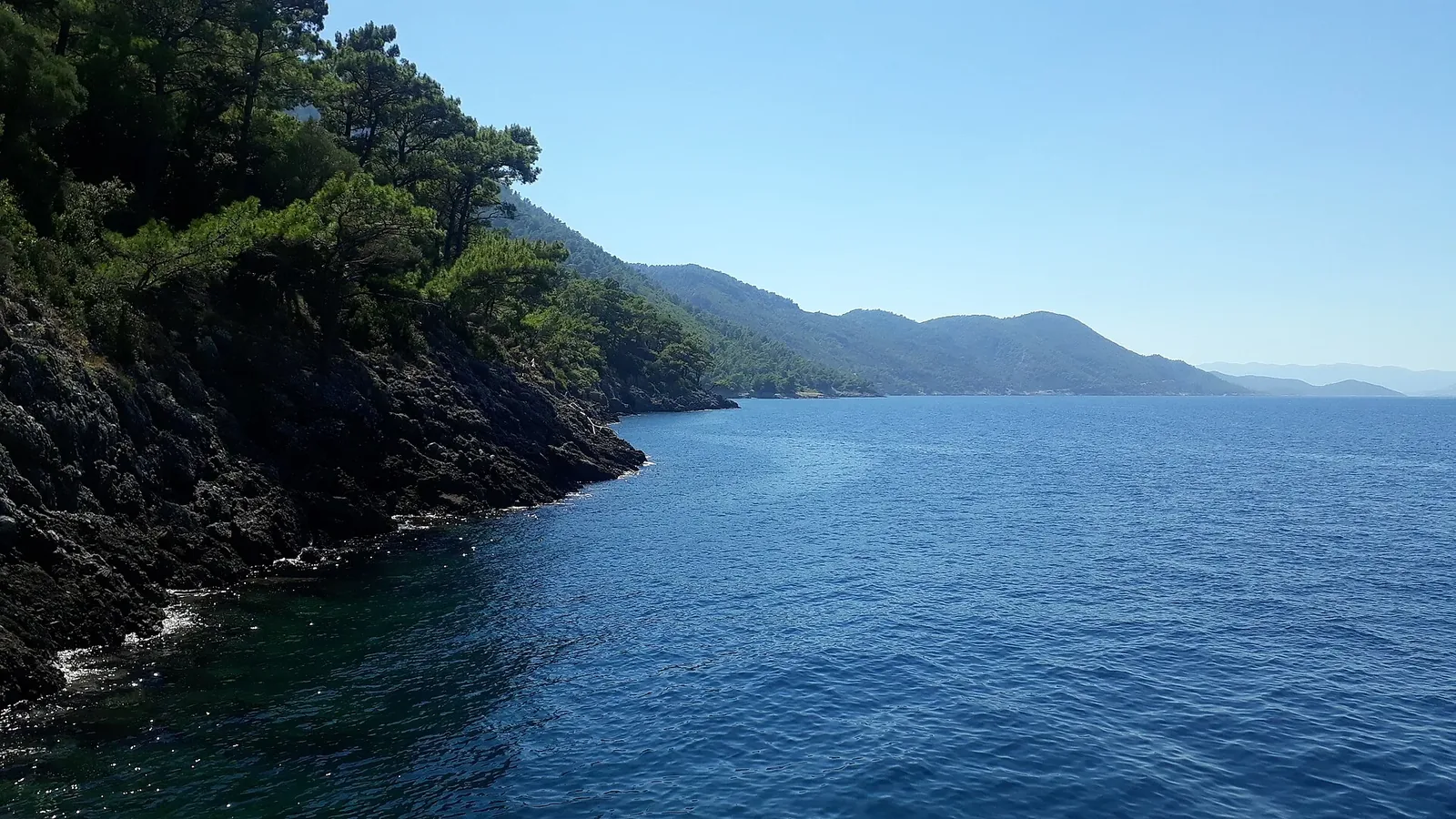
Salamis broke the Persian fleet, but it did not end the war. A Persian army stayed behind in Greece under Mardonius, and in the summer of 479 BC it burned Athens a second time. That August the largest Greek army ever assembled met it on the plain of Plataea in Boeotia, and on the same day, according to Herodotus, a Greek fleet stormed the Persian camp at Mycale on the coast of Asia Minor. After these two battles no Persian army ever invaded Greece again.
Where this chapter fits
This is the last chapter of the second Persian invasion. In the previous chapter the Greek fleet beat the Persian fleet in the strait of Salamis in September 480 BC, and Xerxes went home. He did not take his whole army with him. On the advice of his cousin and brother-in-law Mardonius, the man who had pressed hardest for the war, he left a picked army in Greece to finish the conquest, and Mardonius took it north to spend the winter in Thessaly, among the Greeks who had sided with Persia.1Herodotus, Histories 9.1Written c. 430 BC. Translation by A. D. GodleyRead on Perseus ↗
For the Greeks the danger was far from over. The Persian army was still the largest in Greece, its cavalry was unmatched, and much of central Greece, including Thebes and the whole of Thessaly, was on its side. The Greek alliance, meanwhile, was strained. The Peloponnesians were building a wall across the Isthmus of Corinth and had little reason to march north of it; the Athenians, whose city lay north of the wall, had no army that could face Mardonius alone. Whether the alliance held together through the coming summer would decide the war.
An offer Athens refused
Mardonius understood that the war would be decided at sea as much as on land, and that the strongest fleet in Greece was Athenian. If Athens changed sides, the wall at the Isthmus would be worthless: Persian ships could land an army anywhere on the Peloponnesian coast. So during the winter he sent an ambassador to Athens. He chose Alexander, king of Macedon, a vassal of Persia who was also an old friend of the Athenians: his sister was married to a Persian nobleman, and he had long been honoured at Athens as a protector and benefactor of the city.2Herodotus, Histories 8.136Written c. 430 BC. Translation by A. D. GodleyRead on Perseus ↗
The terms were generous. Athens would be forgiven, keep its land and receive more besides, live under its own laws, and have its burned temples rebuilt at the king’s expense, if only it would become the king’s ally. The Spartans heard of the embassy and hurried envoys to Athens to beg the Athenians not to accept. Herodotus gives the Athenian answer to both. To Alexander they said that they knew how much greater the Persian power was, but would defend their freedom as best they could:
As long as the sun holds the course by which he now goes, we will make no agreement with Xerxes.3Herodotus, Histories 8.143Written c. 430 BC. Translation by A. D. GodleyRead on Perseus ↗
Herodotus, Histories 8.143
To the Spartans they gave a famous definition of what it meant to be Greek: they could not betray the cause because of the burned temples of their gods, and because of “the kinship of all Greeks in blood and speech, and the shrines of gods and the sacrifices that we have in common, and the likeness of our way of life”.4Herodotus, Histories 8.144Written c. 430 BC. Translation by A. D. GodleyRead on Perseus ↗ In return they asked the Spartans for one thing: to march north quickly, so that the Persians could not overrun Attica again.
Athens taken a second time
The Spartans did not come. When Mardonius marched south in the early summer of 479 BC, the Athenians again carried their families and goods across to Salamis, and for the second time a Persian army walked into an empty Athens, ten months after Xerxes had taken it.5Herodotus, Histories 9.3Written c. 430 BC. Translation by A. D. GodleyRead on Perseus ↗ Mardonius tried once more, sending a Hellespontine Greek named Murychides to the Athenian council on Salamis with the same offer. One councillor, Lycidas, proposed that the offer be put to the people. The Athenians, Herodotus says, were so angry that they surrounded him and stoned him to death; their wives did the same to his wife and children. Murychides was allowed to leave unharmed.
In Sparta the Athenian envoys found the city celebrating the festival of the Hyacinthia, and the wall at the Isthmus nearly finished. The ephors put off their answer from day to day for ten days. Herodotus cannot explain the delay, except that with the wall finished the Spartans may have felt they no longer needed Athens. In the end, he says, a man from Tegea named Chileus pointed out to the ephors that the wall would be useless if the Athenian fleet joined the Persians. That night, without telling the envoys, the Spartans sent five thousand Spartiates north, each attended by seven helots, under the command of Pausanias, the regent for Leonidas’ young son and the dead king’s nephew. The next morning the Athenian envoys, about to leave in anger and threatening to make peace with Persia, learned that the army was already on its way.
Mardonius chooses his ground
Mardonius did not wait for the Greeks in Attica. Attica was poor cavalry country, and if he were beaten there he would have to retreat through narrow passes. He burned Athens, this time demolishing whatever wall, house or temple was still standing, and withdrew north into Boeotia, where the plains suited his horsemen and Thebes, his strongest Greek ally, could supply him.6Herodotus, Histories 9.13Written c. 430 BC. Translation by A. D. GodleyRead on Perseus ↗ On the river Asopus, south of Thebes, his men built a fortified camp, a square stockade of wood about ten stades, or nearly two kilometres, on each side, as a refuge if the battle went badly.
Herodotus records a remarkable scene from these weeks, told to him by a man who was there. A leading Theban, Attaginus, gave a banquet for Mardonius and fifty Persian officers, seating a Persian and a Theban on each couch. Thersander of Orchomenus, one of the guests, later told Herodotus that the Persian beside him wept as they drank, and said that in a little while few of the men at the feast would still be alive. When Thersander asked why he did not tell Mardonius, the Persian answered that no one would believe him, and that many Persians knew it but followed out of necessity. It is one of the rare places where Herodotus names his informant, and one of the few windows we have on the mood in the Persian camp.
Masistius and the cavalry
The Greek army gathered at the Isthmus, joined by the Athenians at Eleusis, and crossed Mount Cithaeron into Boeotia. At first it stayed on the lower slopes near Erythrae, where the ground was broken and cavalry could do little. Mardonius sent his entire cavalry against it under its commander Masistius, a famous officer who rode a Nesaean horse with a golden bit. The horsemen attacked squadron by squadron, shooting arrows and calling the Greeks women.
The Megarians, posted on the most open ground, were hard pressed and asked for help. Three hundred picked Athenians, with archers, volunteered to take their place. In the fighting Masistius’ horse was hit in the side by an arrow and threw him. The Athenians fell on him, but at first could not kill him: under his purple tunic he wore a cuirass of golden scales. In the end a soldier stabbed him through the eye.7Diodorus Siculus, Library of History 11.30Written c. 30 BC. Translation by C. H. Oldfather (1946)Read on LacusCurtius ↗ The Persian camp mourned him loudly, cutting their own hair and the manes of their horses; the Greeks put his body on a cart and paraded it along their lines, and men left their ranks to look at it.
The success gave the Greeks confidence to come down from the hills. They moved west to the territory of Plataea, where there was more water, and drew up along a low ridge near the spring of Gargaphia, facing the Persians across the Asopus.
Two armies on the Asopus
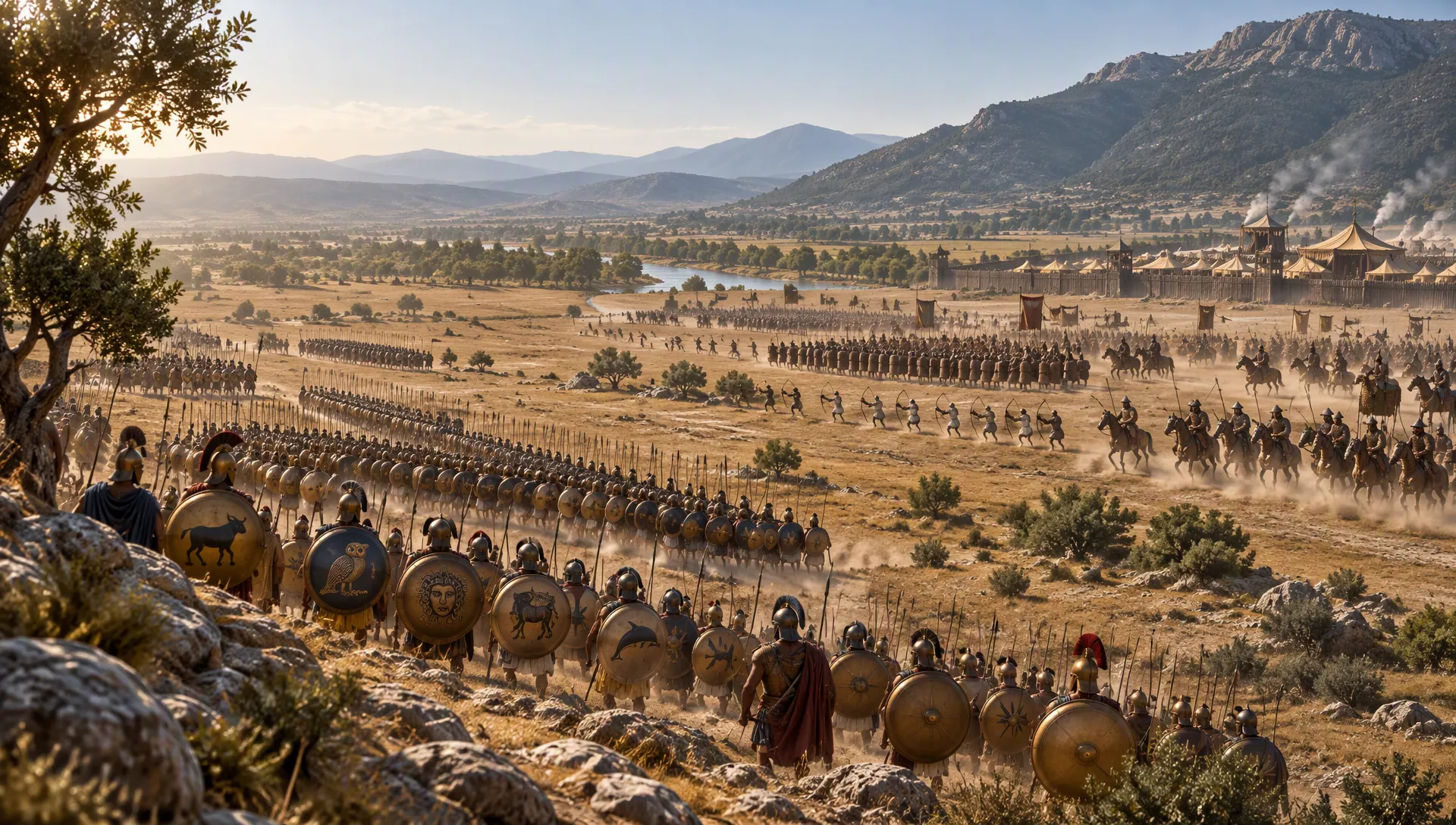
Herodotus gives the Greek army contingent by contingent, the longest such list in his work. On the right wing stood ten thousand Lacedaemonians, five thousand of them Spartiates, each with seven helots; next to them 1,500 Tegeans, then 5,000 Corinthians, and so on down the line to 8,000 Athenians under Aristides on the left. In all he counts 38,700 heavy infantry and 69,500 light-armed men, together with 1,800 survivors from Thespiae: 110,000 men. Grundy, who walked the battlefield in the 1890s, accepted these figures and pointed out that almost all of them came from the Peloponnese, Megara and Attica, while many other men of fighting age were serving with the fleet at the same time.8Grundy, The Great Persian War, ch. 11G. B. Grundy, The Great Persian War (1901). Grundy surveyed the battlefields himselfRead on Project Gutenberg ↗
For the Persian side Herodotus gives three hundred thousand men, besides Greek allies whose number, he says, nobody knew. Diodorus, four centuries later, makes it five hundred thousand. Modern historians think both figures far too high: Lazenby, for example, reckons the Persian army at Plataea at about 70,000 men, including some 10,000 cavalry, still larger than the Greek force but nothing like the ancient totals.9J. F. Lazenby, The Defence of Greece 490–479 BC (1993), pp. 227–228Modern military history of the Persian WarsView on Google Books ↗ The heart of the army, Herodotus says, was the Persians themselves, whom Mardonius posted opposite the Spartans, with Medes, Bactrians, Indians and Sacae beside them and the Greek allies of Persia, above all the Thebans, facing the Athenians.
Eleven days of waiting
Then nothing happened for more than a week. Both sides consulted their seers, and both seers gave the same answer: victory to the side that defended, defeat to the side that crossed the Asopus and attacked first.10Herodotus, Histories 9.36Written c. 430 BC. Translation by A. D. GodleyRead on Perseus ↗ The Greeks had good reason to wait, since reinforcements kept arriving. Mardonius used the time to strike at their supplies. On the advice of a Theban, his horsemen rode round to the pass over Cithaeron behind the Greek army and caught a supply column of five hundred pack animals coming from the Peloponnese, killing men and beasts alike.
On the eleventh day Mardonius held a council. Artabazus, the most respected of his generals, advised withdrawing into Thebes, where there was food and fodder, and using Persian gold to buy the leading men of the Greek cities. Mardonius, Herodotus says, thought his army much the stronger and wanted to fight before the Greeks grew any stronger still. That night, the story goes, Alexander of Macedon rode secretly to the Athenian outposts, told them that Mardonius would attack at dawn, and reminded them that he was Greek by descent and did not want to see Greece enslaved. Herodotus adds an odd episode: Pausanias proposed that the Athenians, who had fought Persians at Marathon, should change places with the Spartans; the Persians noticed and changed their own line to match, and in the end everyone went back to where they had been.
The night withdrawal
The attack at dawn was by cavalry. The Persian horse archers rode along the Greek line shooting arrows and javelins, and they reached the spring of Gargaphia, from which the whole Greek army drew its water, and fouled and blocked it. The Asopus was out of reach because of the arrows, the food had run out, and the supply trains could not get through the passes. The Greek commanders decided to fall back that night to a place Herodotus calls the Island, a strip of ground between two arms of a stream in front of the town of Plataea, where there was water and the cavalry could not reach them.
The withdrawal went badly wrong. The centre of the Greek army, glad to be rid of the cavalry, did not go to the Island but straight on to the temple of Hera outside Plataea, twenty stades, about three and a half kilometres, from the spring. On the right wing one Spartan officer, Amompharetus, commander of the battalion of Pitana, refused to move: he had not been at the council, and he would not, he said, run away from the foreigners and bring shame on Sparta. Pausanias and his colleague argued with him through the night. At one point Amompharetus picked up a large stone with both hands and threw it at Pausanias’ feet, saying that this was his pebble, his vote, against fleeing from the strangers.11Plutarch, AristidesWritten c. AD 100. Translation by J. Dryden, revised by A. H. CloughRead on Project Gutenberg ↗ The Athenians on the left, distrusting the Spartans, waited where they were and sent a horseman to ask what to do.
At dawn Pausanias finally marched off without Amompharetus, who then followed; the Spartans and Tegeans halted about a mile back, near a sanctuary of Demeter, to let him catch up. Grundy, who walked the ground, thought the confusion in Herodotus’ story came from his informants: soldiers who had seen what happened around them but never knew the generals’ plans.
The battle by the temple of Demeter
When Mardonius saw the Greek ridge empty at daybreak, he concluded that the Greeks were running away. He led the Persians across the Asopus at speed after the Spartans and Tegeans, and the rest of his army followed in no order, shouting, as if to finish off a beaten enemy.12Herodotus, Histories 9.59Written c. 430 BC. Translation by A. D. GodleyRead on Perseus ↗ Pausanias sent a horseman to ask the Athenians for help, but they were already engaged with the Thebans and the other Greeks on the Persian side and could not come. So the Spartans and Tegeans stood alone.
The Persians planted their wicker shields in a wall and shot arrows from behind it, while the Spartan sacrifices, Herodotus says, would not come out favourably. Pausanias looked towards the temple of Hera and prayed; the Tegeans charged first, and as soon as he finished his prayer the omens turned good and the Spartans advanced. They fought first at the fence of shields and, when that fell, around the temple of Demeter itself. Herodotus is generous to the enemy:
Now the Persians were neither less valorous nor weaker, but they had no armor; moreover, since they were unskilled and no match for their adversaries in craft, they would rush out singly and in tens or in groups great or small, hurling themselves on the Spartans and so perishing.13Herodotus, Histories 9.62Written c. 430 BC. Translation by A. D. GodleyRead on Perseus ↗
Herodotus, Histories 9.62
Mardonius fought on a white horse among a thousand picked Persians, and as long as he lived, they held their ground. Then he was killed, by a Spartan whom Herodotus calls Aeimnestus, and when his guard fell around him the rest of the Persians broke and ran for the stockade. Herodotus calls it the most glorious victory of all those he knew, and the vengeance for Leonidas that an oracle had promised Sparta. On the other wing the Thebans fought hard against the Athenians and lost three hundred of their best men before they too fled to Thebes. The other Greeks on the Persian side, Herodotus says, fought badly on purpose.
Not all of Mardonius’ army fought. Artabazus, who had argued against the battle, had some forty thousand men under his own command. As soon as the fighting began he turned them round and marched north at full speed, through Phocis and Thessaly to the Hellespont, and got most of them home to Asia.
Storming the camp
The fugitives reached the stockade and manned its towers before the Spartans arrived, and the Spartans, who had little skill in attacking walls, could make no headway. Only when the Athenians came up did the Greeks break in; the Tegeans were the first through the breach. What followed was a massacre. Herodotus claims that of the 260,000 men left after Artabazus’ departure, scarcely three thousand survived. The Greek dead he puts at 91 Spartans, 17 Tegeans and 52 Athenians.
Even ancient readers found these numbers hard to believe. Plutarch gives 1,360 Greek dead, and Diodorus more than ten thousand.14Diodorus Siculus, Library of History 11.33Written c. 30 BC. Translation by C. H. Oldfather (1946)Read on LacusCurtius ↗ Grundy thought Herodotus’ figures referred only to the last day and still seemed too low, since it was hardly credible that the Spartans lost only ninety-one men against an enemy fighting with full confidence. The Persian losses were certainly very heavy, but no ancient figure can be trusted, and a modern estimate is no more than a guess.
Two dinners and a tithe
The camp was full of treasure: tents decorated with gold and silver, gilded couches, golden bowls, armlets and daggers. Pausanias forbade looting and had the helots gather everything; Herodotus adds that the helots stole a good deal of it and sold the gold to the Aeginetans as if it were bronze. One of the Aeginetans, Lampon, came to Pausanias with a suggestion: Xerxes and Mardonius had cut off the head of Leonidas and put it on a stake, so Pausanias should do the same to Mardonius. Pausanias refused. Such deeds, he said, were fitter for barbarians than Greeks, and Leonidas was avenged already by the multitude of the dead.
Herodotus tells another story about Pausanias. In Mardonius’ tent, which had been Xerxes’ own, he had the Persian cooks prepare a dinner as they did for Mardonius, with couches of gold and silver and golden tables, and next to it his own servants prepared an ordinary Spartan meal. Then he called the Greek generals and pointed from one to the other: “Men of Hellas, I have brought you here because I desired to show you the foolishness of the leader of the Medes who, with such provisions for life as you see, came here to take away from us our possessions which are so pitiful.”15Herodotus, Histories 9.82Written c. 430 BC. Translation by A. D. GodleyRead on Perseus ↗
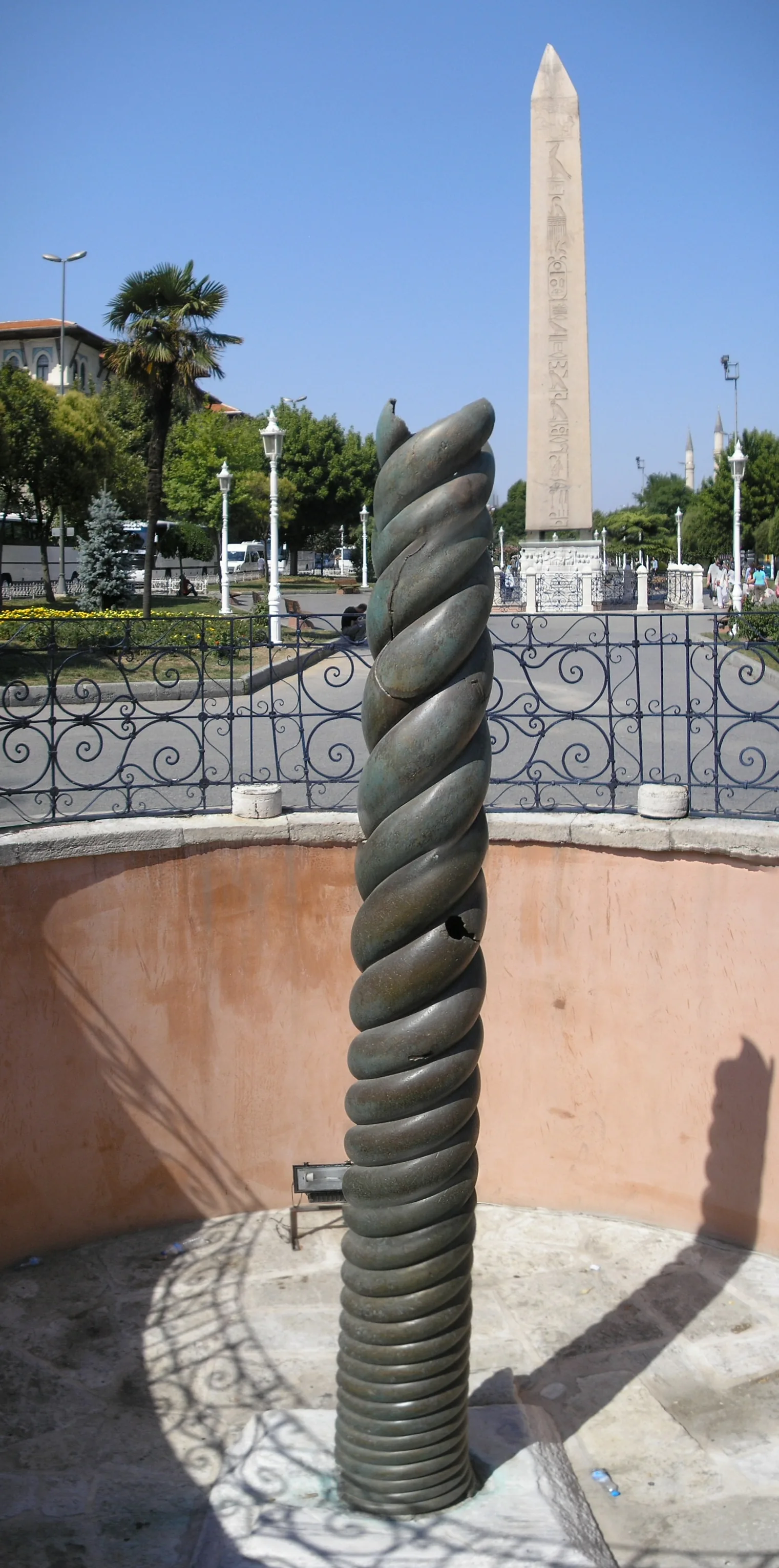
A tenth of the spoils was set aside for the gods. For Apollo at Delphi the Greeks made a golden tripod on a bronze column of three intertwined snakes, the Serpent Column, which named the cities that had fought; for Zeus at Olympia a bronze statue ten cubits high, and for Poseidon at the Isthmus a bronze statue seven cubits high. Six centuries later the travel writer Pausanias saw the statue of Zeus at Olympia and the list of cities on its base, and at Plataea the graves of the Greeks who had fallen: one common tomb, and separate burial grounds for the Spartans and the Athenians with epitaphs by Simonides.16Pausanias, Description of Greece 9.2Written c. AD 160; Pausanias visited the sites. Translation by A. R. Shilleto (1886)Read on Project Gutenberg ↗
Thebes pays the price
On the eleventh day after the battle, the Greeks marched on Thebes and demanded the surrender of the men who had led the city to the Persian side, above all Timagenidas and Attaginus, the host of the banquet. When the Thebans refused, the Greeks laid waste their land and attacked the walls. When nineteen days had passed, Timagenidas himself proposed that the leaders give themselves up rather than see the city ruined. They expected a trial they could win with bribes; instead Pausanias sent the allied army home, took them to Corinth and had them put to death. Attaginus escaped. His sons were brought to Pausanias, who let them go, saying that sons could not be guilty of their father’s treason.17Herodotus, Histories 9.88Written c. 430 BC. Translation by A. D. GodleyRead on Perseus ↗
Mycale: the war crosses the Aegean
While the armies faced each other in Boeotia, a Greek fleet under the Spartan king Leotychidas lay at Delos in the middle of the Aegean. Three envoys came secretly from Samos, which was ruled by a tyrant installed by the Persians, and begged the Greeks to come to Ionia: the Ionians would rise as soon as they saw a Greek fleet, and the Persian ships were in poor shape. Leotychidas asked the leader of the envoys his name. “Hegesistratus,” he answered, which means “leader of the army”, and Leotychidas accepted the name as a good omen.18Herodotus, Histories 9.91Written c. 430 BC. Translation by A. D. GodleyRead on Perseus ↗
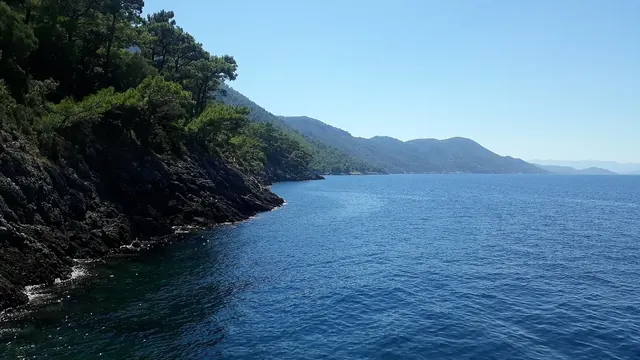
The Persian commanders did not want to fight at sea. They sent the Phoenician squadron away and brought the rest of their ships to the shore at Mycale, a mountainous promontory on the mainland opposite Samos, where a Persian army was stationed. There they hauled the ships onto the beach and built a wall of stones and tree trunks around them, with stakes in front. The Greeks followed and landed. Before the attack Leotychidas sailed along the shore and had a herald call out to the Ionians in the Persian camp to remember their freedom; the Persians, suspicious, disarmed the Samians among them and sent the Milesians off to guard the mountain paths.
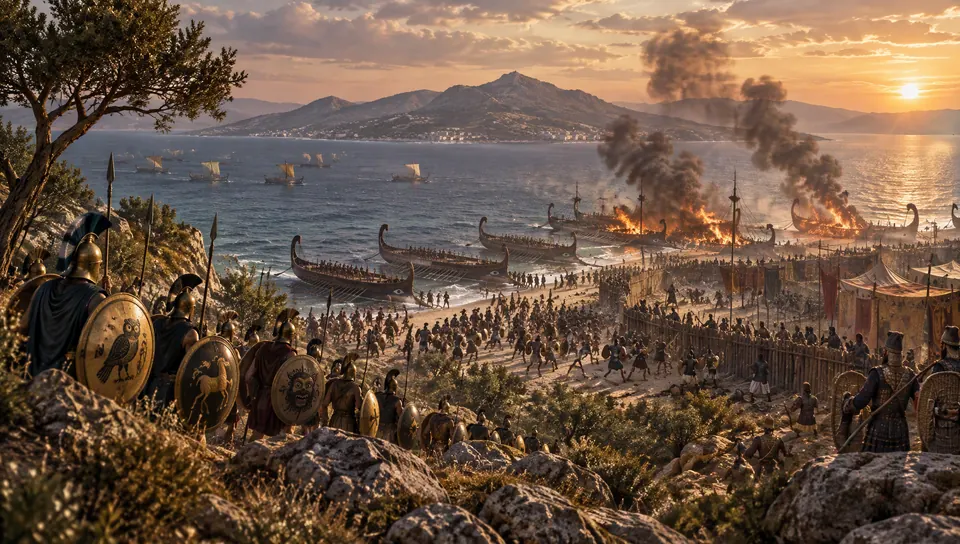
As the Greeks advanced, a rumour ran through their ranks that their countrymen had won a victory over Mardonius in Boeotia, and a herald’s staff was found lying on the beach. Herodotus treats it as a sign of the gods: the battle of Plataea, he says, was fought early in the day and Mycale in the afternoon of the same day, and the Greeks later confirmed that both fell on the same day of the same month. The Athenians and their neighbours, advancing along the beach, broke through first, eager to win before the Spartans, who were coming round through a ravine, could arrive. The disarmed Samians joined in against the Persians, the other Ionians followed, and the Milesians led the fleeing Persians into the hands of their enemies. Herodotus calls it the second revolt of Ionia. The Greeks burned the ships and the wall and sailed to Samos.
Modern historians are divided about the day. Flower and Marincola, in their commentary on Herodotus’ ninth book, find the parallels between the two battles, both on the same day and both near a sanctuary of Eleusinian Demeter, suspiciously neat, while Hignett saw nothing implausible in them.19M. A. Flower and J. Marincola, Herodotus: Histories Book IX (2002), pp. 27–28Modern commentary on Herodotus book 9 (Cambridge University Press)View on Google Books ↗20C. Hignett, Xerxes’ Invasion of Greece (1963), p. 258Modern study (Oxford, Clarendon Press)Find in a library (WorldCat) ↗ Grundy suggested that the rumour at Mycale may really have referred to the earlier Greek success at Plataea, weeks before the final battle.21Grundy, The Great Persian War, ch. 12G. B. Grundy, The Great Persian War (1901). Grundy surveyed the battlefields himselfRead on Project Gutenberg ↗ Diodorus, for his part, puts the landing a day before the battle and thinks Leotychidas simply invented the news to encourage his men. As for the numbers, Herodotus gives the Persian army at Mycale sixty thousand men; modern historians put it far lower, Green for example at about ten thousand, with perhaps four thousand killed.22P. Green, The Greco-Persian Wars (1996), pp. 278, 283Modern history of the Persian WarsView on Google Books ↗
The end of the invasion
At Samos the allies debated what to do with the Greeks of Ionia, who could not be protected forever on the Persian side of the sea. The Peloponnesians proposed to move them to Greece and give them the land of the Greeks who had sided with Persia. The Athenians objected: the Ionians were their colonists, and the Peloponnesians had no right to decide their fate. The islanders, Samos, Chios and Lesbos among them, were taken into the alliance instead. The fleet sailed on to the Hellespont to break Xerxes’ bridges and found them already broken. Leotychidas and the Peloponnesians went home; the Athenians under Xanthippus, father of Pericles, stayed and besieged Sestos through the winter.23Thucydides, History of the Peloponnesian War 1.89Written c. 400 BC. Translation by R. CrawleyRead on Project Gutenberg ↗
That division at the Hellespont, with Sparta going home and Athens staying on with the Ionians, was the start of the next phase of the war. Herodotus ends his history there, with the fall of Sestos in the spring of 478 BC and the cables of Xerxes’ bridges carried home to be dedicated in Greek temples. The story continues in Chapter 9: The Delian League.
A general who had to win
For Mardonius, 479 BC was a test he could not avoid. He had urged Xerxes to invade, and after Salamis he had offered to stay and finish the conquest with a picked army. Herodotus has Mardonius reason that he would be blamed for the failure if he went home; a victory would win back the king’s favour. His strategy was sensible: win over Athens by diplomacy, split the Greek alliance, and fight only on ground that suited his cavalry. It almost worked. Athens refused his offer twice, but Sparta hesitated for weeks, Argos promised to hold the Spartans back, and Thebes and Thessaly fought for him.
Herodotus, who never tells the story from a Persian source, nonetheless gives the Persians their due. He describes how the whole Persian army mourned Masistius, so loudly that the sound was heard across Boeotia, and he says that at Plataea the Persians were not inferior in courage or strength, only in armour and training.24Herodotus, Histories 9.24Written c. 430 BC. Translation by A. D. GodleyRead on Perseus ↗ Of all the men in Mardonius’ army, he judges, the bravest was Mardonius himself.
The earliest surviving description of Plataea is Persian in setting, though Greek in authorship. In Aeschylus’ play The Persians of 472 BC, the ghost of King Darius rises from his tomb at Susa and foretells the disaster still to come for the army left behind in Greece: “so great will be the mass of clotted gore spilled by the Dorian lance upon Plataean soil that heaps of dead will reveal, even to the third generation, a voiceless record”.25Aeschylus, The Persians, lines 816–820Performed in 472 BC; Aeschylus fought in the war. Translation by H. W. SmythRead on Perseus ↗ For the empire itself, Plataea and Mycale meant the loss of a distant frontier, not the end of Persian power. Xerxes ruled for another fourteen years, and Persia remained a great power that would play a large part in Greek affairs until Alexander the Great, a century and a half later. No Persian account of these battles survives.
How close is our evidence?
Almost everything we know about Plataea and Mycale comes from Herodotus, who wrote about fifty years later and talked to men who had been there, such as Thersander of Orchomenus. Grote, writing in 1847, already noticed how few of the soldiers on either side really fought: on the Persian side, he concluded from Herodotus, only the Persians and Sacae against the Spartans and the Boeotians against the Athenians.26Grote, History of Greece, vol. 5, ch. 42G. Grote, History of Greece, vol. 5 (1847). A modern history, written 2,300 years laterRead on Project Gutenberg ↗ Even the date has to be reconstructed: Plutarch gives the fourth day of the Athenian month Boedromion, and modern historians usually place the battle in late August 479 BC; Rahe, for example, puts it on the 27th or 28th of August.27P. A. Rahe, The Grand Strategy of Classical Sparta: The Persian Challenge (2015), p. 316Modern study (Yale University Press)View on Google Books ↗
Why Plataea and Mycale mattered
After 479 BC no Persian army ever set foot in mainland Greece again. Plataea showed that Greek hoplites, properly led and fighting together, could beat the best infantry of the Persian Empire in open country, and it destroyed the army that might have conquered Greece piece by piece. Mycale carried the war across the Aegean and freed, for the moment, the Greeks of Ionia whose revolt twenty years earlier had started the whole conflict.
The victory also changed the Greek world. The alliance of 481 BC had held together long enough to win, but the quarrel at Samos over Ionia, and the parting at the Hellespont, showed where it would split. Sparta, the leader on land, went home; Athens, which had borne the burden at sea, stayed in the east with the islanders and the Ionians. Within a year those cities would form a new alliance under Athenian leadership, the Delian League, which would grow into an Athenian empire. And Pausanias, the victor of Plataea, would soon be accused of behaving like a Persian himself, the first of many ironies in the story of the war’s winners.
- Herodotus, Histories 9.1
- Herodotus, Histories 8.136
- Herodotus, Histories 8.143
- Herodotus, Histories 8.144
- Herodotus, Histories 9.3
- Herodotus, Histories 9.13
- Diodorus Siculus, Library of History 11.30
- Grundy, The Great Persian War, ch. 11
- J. F. Lazenby, The Defence of Greece 490–479 BC (1993), pp. 227–228
- Herodotus, Histories 9.36
- Plutarch, Aristides
- Herodotus, Histories 9.59
- Herodotus, Histories 9.62
- Diodorus Siculus, Library of History 11.33
- Herodotus, Histories 9.82
- Pausanias, Description of Greece 9.2
- Herodotus, Histories 9.88
- Herodotus, Histories 9.91
- M. A. Flower and J. Marincola, Herodotus: Histories Book IX (2002), pp. 27–28
- C. Hignett, Xerxes’ Invasion of Greece (1963), p. 258
- Grundy, The Great Persian War, ch. 12
- P. Green, The Greco-Persian Wars (1996), pp. 278, 283
- Thucydides, History of the Peloponnesian War 1.89
- Herodotus, Histories 9.24
- Aeschylus, The Persians, lines 816–820
- Grote, History of Greece, vol. 5, ch. 42
- P. A. Rahe, The Grand Strategy of Classical Sparta: The Persian Challenge (2015), p. 316
- Herodotus, Histories: 9.8, 9.16, 9.20, 9.25, 9.29, 9.32, 9.39, 9.41, 9.45, 9.49, 9.64, 9.66, 9.70, 9.79, 9.81, 9.97, 9.101, 9.106
- Grundy, The Great Persian War: ch. 11
- Diodorus Siculus, Library of History: 11.35
- Plutarch, Aristides