In September 480 BC Athens stood empty and its Acropolis was burning. The Greek fleet lay in the narrow strait between the island of Salamis and the coast of Attica, its commanders arguing about whether to stay or to run for the Isthmus. One night, one message and one morning of fighting decided the outcome. By evening the Persian fleet was broken, and within days Xerxes was on his way back to Asia.
Where this chapter fits
This is the third chapter of the second Persian invasion. In the previous chapter the Greeks held the pass of Thermopylae and the strait of Artemisium for three days, until the Persians found the path over the mountain. A small boat had been waiting near the pass to carry the news to the fleet. When the Athenian Abronichus arrived with word that Leonidas and his men were dead, the Greek ships left Artemisium at once and sailed south.1Herodotus, Histories 8.21Written c. 430 BC. Translation by A. D. GodleyRead on Perseus ↗
Nothing now stood between Xerxes’ army and Athens. The Peloponnesian cities had decided to defend only their own peninsula, behind a wall across the Isthmus of Corinth. The Athenians had expected to find a Greek army waiting in Boeotia and found none; instead, they asked the fleet to put in at Salamis, so that they could get their families out of Attica.
Athens abandoned
Once the Athenian ships had landed in Attica, a proclamation went out that every Athenian should save his children and household as best he could. Most sent their families across the Saronic Gulf to Troezen in the Peloponnese, some to the island of Aegina and some to Salamis itself. The men of fighting age went aboard the fleet. In a few days the city emptied.
Herodotus says the Athenians were in a hurry partly to obey the oracle of the “wooden wall”, and partly because of a sign from the goddess. A great sacred snake was believed to live on the Acropolis and was given a honey-cake every month. Now the honey-cake was found untouched, and the priestess announced that the snake had left the citadel. The Athenians took it as a sign that Athena herself had abandoned the city, and left all the more readily. Plutarch, writing six centuries later, adds the scene that later Greeks remembered: old people left behind, animals running along the shore, and the dog of Xanthippus, father of Pericles, swimming after his master’s ship all the way to Salamis.2Plutarch, ThemistoclesWritten c. AD 100. Translation by J. Dryden, revised by A. H. CloughRead on Project Gutenberg ↗
The Acropolis falls
Xerxes’ army reached Athens about four months after crossing the Hellespont, when Calliades was archon. The town was deserted, but a few Athenians had stayed on the Acropolis: temple stewards and poor people who could not leave, and some who believed they had understood the oracle better than anyone. The “wooden wall”, they thought, meant a wall of wood around the citadel, and they barricaded the entrance with doors and timbers.3Herodotus, Histories 8.51Written c. 430 BC. Translation by A. D. GodleyRead on Perseus ↗
The Persians took up position on the Areopagus, the hill facing the Acropolis, and shot burning arrows wrapped in tow into the barricade. The defenders held on, rolling boulders down on anyone who came near the gate, and refused terms offered by the sons of Peisistratus, the exiled tyrant family who had come with Xerxes. In the end Persian soldiers climbed the sheer cliff at the front of the Acropolis, near the shrine of Aglaurus, where nobody kept watch. Some defenders threw themselves from the wall; those who had fled into the temple were murdered, and the whole Acropolis was plundered and set on fire.
Xerxes sent a horseman to Susa with the news. The next day he ordered the Athenian exiles in his army to go up and sacrifice on the Acropolis in their own way. They found that the sacred olive tree of Athena, burned with the rest of the sanctuary, had already put out a new shoot about a cubit long. For the Greeks at Salamis, watching the smoke rise from the city, the news of the fall of the Acropolis was a shock: some Peloponnesian commanders did not even wait for the council to finish, but ran to their ships and hoisted sail.
The Greek fleet
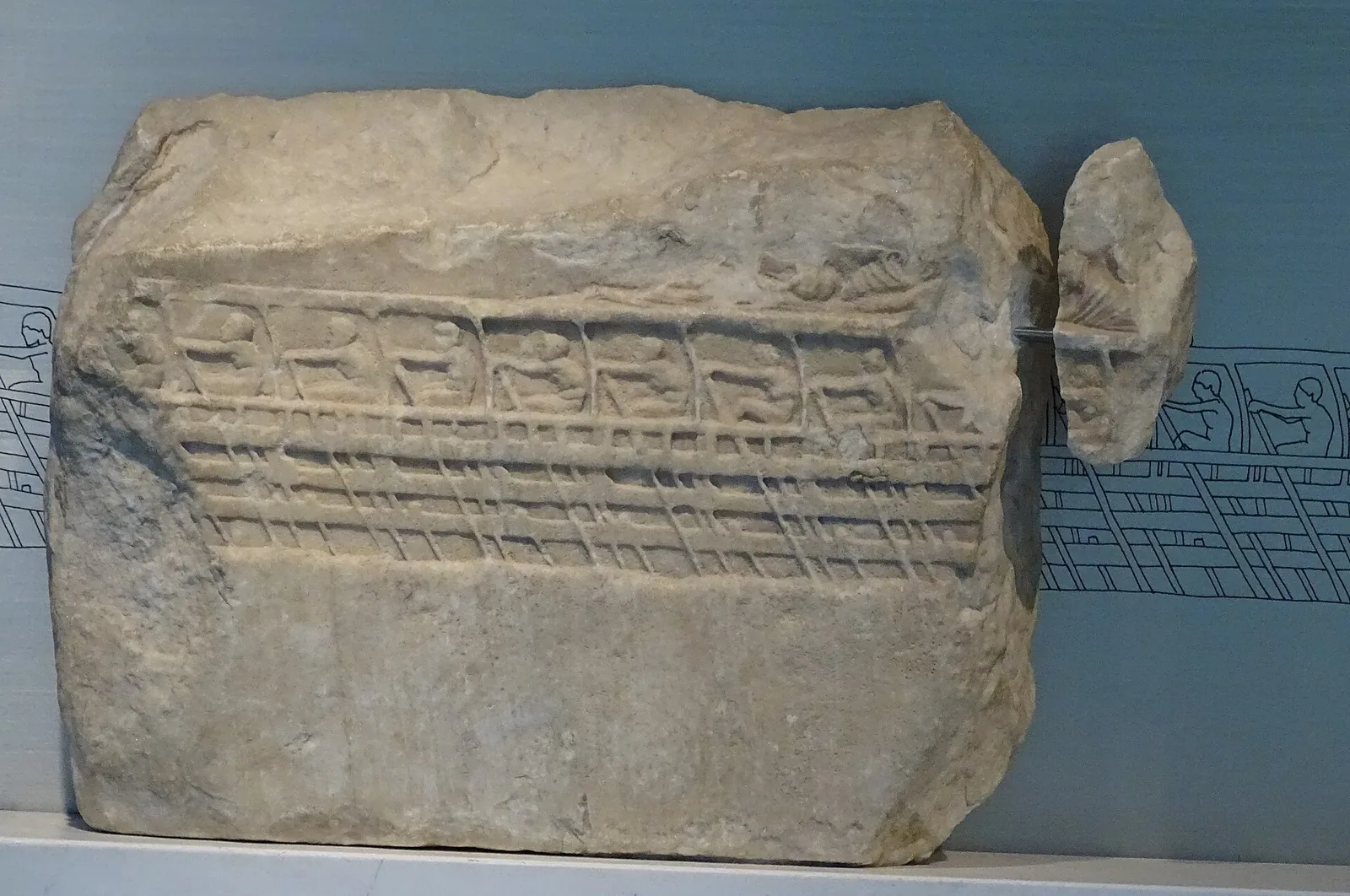
At Salamis the Greek fleet was larger than it had been at Artemisium, because ships that had waited at Pogon, the harbour of Troezen, now joined it. The commander was still the Spartan Eurybiades, but the Athenian ships were, in Herodotus’ words, by far the most numerous and the most seaworthy.4Herodotus, Histories 8.42Written c. 430 BC. Translation by A. D. GodleyRead on Perseus ↗ Herodotus lists the contingents city by city. Athens alone provided 180 triremes; the Plataeans, who had rowed with the Athenians at Artemisium, had gone home to rescue their own families. Corinth sent 40, Aegina 30, Megara and Chalcis 20 each, and more than a dozen other states smaller squadrons, down to single ships from Cythnos and from Croton in southern Italy.
Isthmus or Salamis?
When the commanders met, Eurybiades asked where they should fight. Most of the speakers wanted to sail to the Isthmus and fight in front of the Peloponnese: if they lost at Salamis they would be trapped on an island, while at the Isthmus they could escape to their own lands. The news from Athens settled the vote, and that night the council resolved to fight for the Isthmus.
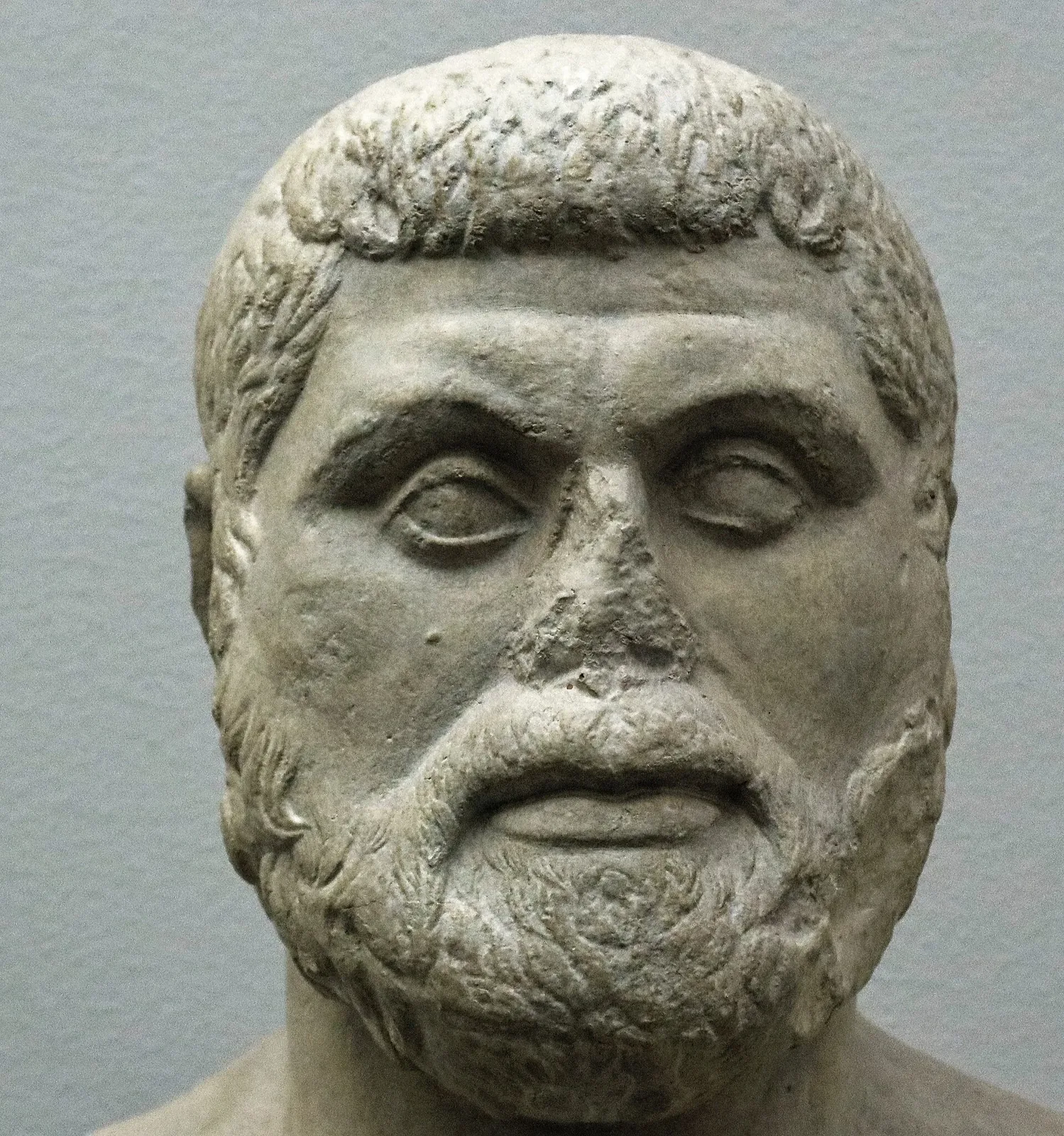
Herodotus says it was an Athenian called Mnesiphilus who warned Themistocles what this meant. Once the ships left Salamis, he said, they would no longer fight for one country: every contingent would sail home to its own city, and Greece would be lost through bad planning. Themistocles went straight to Eurybiades’ ship and persuaded him to call the commanders together again. Before Eurybiades could even explain why, Themistocles began to speak, and the Corinthian Adeimantus cut him off: “At the games, those who start before the signal are beaten with rods.” “Those left behind win no crown,” Themistocles answered.5Herodotus, Histories 8.59Written c. 430 BC. Translation by A. D. GodleyRead on Perseus ↗
His argument, as Herodotus reports it, was about the sea itself. In the open water off the Isthmus the heavier and fewer Greek ships would be overwhelmed; in a narrow strait, numbers would count for little. Salamis, where the Athenian families were sheltering, would be saved, and if the Greeks won at sea the Persians would get no further than Attica. Diodorus, writing four centuries later, gives Themistocles the same argument.6Diodorus Siculus, Library of History 11.15.4Written c. 30 BC. Translation by C. H. Oldfather (1946)Read on LacusCurtius ↗ Adeimantus attacked again: a man without a city, he said, had no right to vote. Themistocles answered that as long as the Athenians had two hundred manned ships they had a city and a country greater than Corinth’s. Then he played his last card. If the fleet left, he told Eurybiades, the Athenians would take their families and sail to Siris in southern Italy to found a new city. Eurybiades gave way. Herodotus thinks he did so chiefly for fear that without the Athenian ships the rest would be no match for the enemy.
At sunrise the next day there was an earthquake on land and sea. The Greeks prayed to the gods and called on the heroes of Salamis and Aegina, Ajax and Telamon and the sons of Aeacus, to fight on their side, and sent a ship to Aegina to bring their images.
The Persian fleet and Artemisia’s warning
Meanwhile the Persian fleet had come south from Artemisium through the channel of the Euripus and anchored at Phalerum, the old harbour of Athens. Herodotus admits that it had lost many ships in the storms and at Artemisium, but he believes that new allies made up the losses: the Malians, Dorians, Locrians and Boeotians on land, and the islanders of Carystus, Andros, Tenos and others at sea. The further Xerxes advanced into Greece, he says, the more peoples followed him.
How big was that fleet? At the start of the campaign Herodotus counts 1,207 triremes, 300 of them Phoenician and 200 Egyptian. Aeschylus, who according to an ancient tradition fought at Salamis himself, gives the same figure in another form: Xerxes had “a thousand” ships, plus 207 of outstanding speed, against some 300 Greek ships and a picked squadron of ten.7Aeschylus, The Persians, lines 337–343Performed in 472 BC; Aeschylus fought in the war. Translation by H. W. SmythRead on Perseus ↗ Grundy, writing in 1901, saw no solid grounds for doubting the 1,207. Most modern historians disagree: they think the fleet that actually fought at Salamis was far smaller, roughly 400 to 700 ships, after the storms and the fighting at Artemisium.8J. Roisman (ed.), Ancient Greece from Homer to Alexander: The Evidence (2011), p. 235Modern sourcebook on the ancient evidence, with commentary on the size of the Persian fleet. Translations by J. C. YardleyView on Google Books ↗ What all agree on is that the Greeks were heavily outnumbered.
Xerxes came down to Phalerum to hear his commanders. He sat on his throne with the kings and captains of the fleet arranged by rank, the king of Sidon first, then the king of Tyre, and sent Mardonius round to ask each one whether to fight at sea. All said yes except one: Artemisia, queen of Halicarnassus, Herodotus’ own home town, who commanded the ships of her city and its neighbours. Her advice, as Herodotus records it, was blunt: spare the ships and do not fight at sea. Athens was already taken; if the fleet simply stayed near the coast or advanced along the Peloponnese, the Greeks, short of food on their island, would scatter to their own cities. Xerxes was pleased with her advice but followed the majority. At Artemisium, he believed, his men had fought badly because he was not there to see them; this time he would watch the battle himself.
Themistocles’ message
That evening the Persian fleet moved out toward Salamis, too late to fight, and the Persian army began its march toward the Peloponnese. On the island the fear returned. The Peloponnesians held another assembly and argued once more for the Isthmus; only the Athenians, Aeginetans and Megarians, whose homes lay behind the Persian lines, insisted on staying.
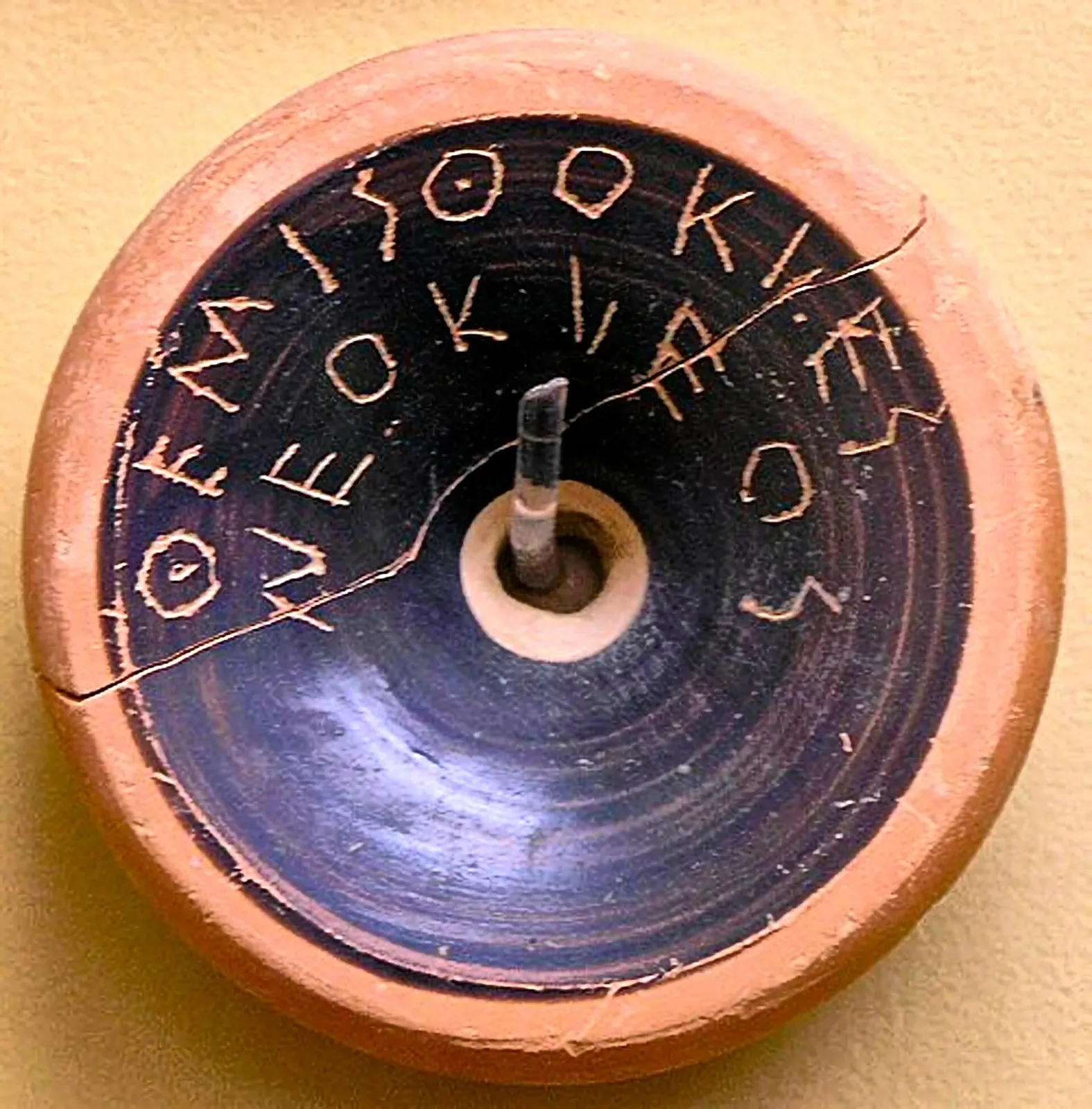
When the vote was going against him, Themistocles slipped out of the meeting and sent a man in a boat to the Persian fleet. His name was Sicinnus, a slave of Themistocles and tutor to his sons. He told the Persian commanders that Themistocles was secretly on the king’s side: the Greeks were terrified and planning to flee, and if the Persians blocked their escape now, they would find the Greeks fighting among themselves. Aeschylus tells the same story from the Persian side, without names: “a Hellene from the Athenian host” came to Xerxes with the news that the Greeks would run in the night.9Aeschylus, The Persians, lines 355–360Performed in 472 BC; Aeschylus fought in the war. Translation by H. W. SmythRead on Perseus ↗ Plutarch, much later, calls Sicinnus a Persian prisoner of war.10Plutarch, ThemistoclesWritten c. AD 100. Translation by J. Dryden, revised by A. H. CloughRead on Project Gutenberg ↗
The Persians believed him. During the night they landed troops on the small island of Psyttaleia, between Salamis and the mainland, where wrecks and men would drift in the battle. According to Herodotus, at midnight one wing of the fleet swung round toward Salamis, and ships from the stations at Ceos and Cynosura closed the whole passage as far as Munychia. It was done in silence, and the crews went without sleep. Modern historians argue about whether the Persians really entered the narrows in the dark, or only blocked the exits overnight and rowed in at dawn. In Aeschylus’ version the fleet was drawn up in three lines to close the exits, and every captain was told he would lose his head if a single Greek ship escaped.11Aeschylus, The Persians, lines 361–371Performed in 472 BC; Aeschylus fought in the war. Translation by H. W. SmythRead on Perseus ↗ Diodorus adds that the Egyptian squadron was sent to block the western channel toward Megara; Herodotus does not mention this, and historians disagree about whether it happened.
Aristides and the Tenian ship
The Greek commanders, still arguing, did not know that they were surrounded. Then Aristides arrived from Aegina. He was an Athenian politician and Themistocles’ bitter rival, ostracised a few years earlier and now recalled; Herodotus, having made inquiries about his character, calls him the best and most just man in Athens.12Herodotus, Histories 8.79Written c. 430 BC. Translation by A. D. GodleyRead on Perseus ↗ He called Themistocles out of the meeting and told him that whatever the Peloponnesians decided, they could no longer sail away: he had barely slipped through the Persian blockade himself.
Themistocles told him the truth: the encirclement was his own doing, because the Greeks would not fight willingly. He asked Aristides to give the news to the commanders himself, since they would not believe it from Themistocles. Most of them still did not believe it. They were convinced only when a trireme from Tenos, deserting from the Persian fleet under its captain Panaetius, came in with the whole truth. For this the Tenians were later engraved on the victory tripod at Delphi, the Serpent Column, among those who had defeated the barbarian.
The battle in the narrows
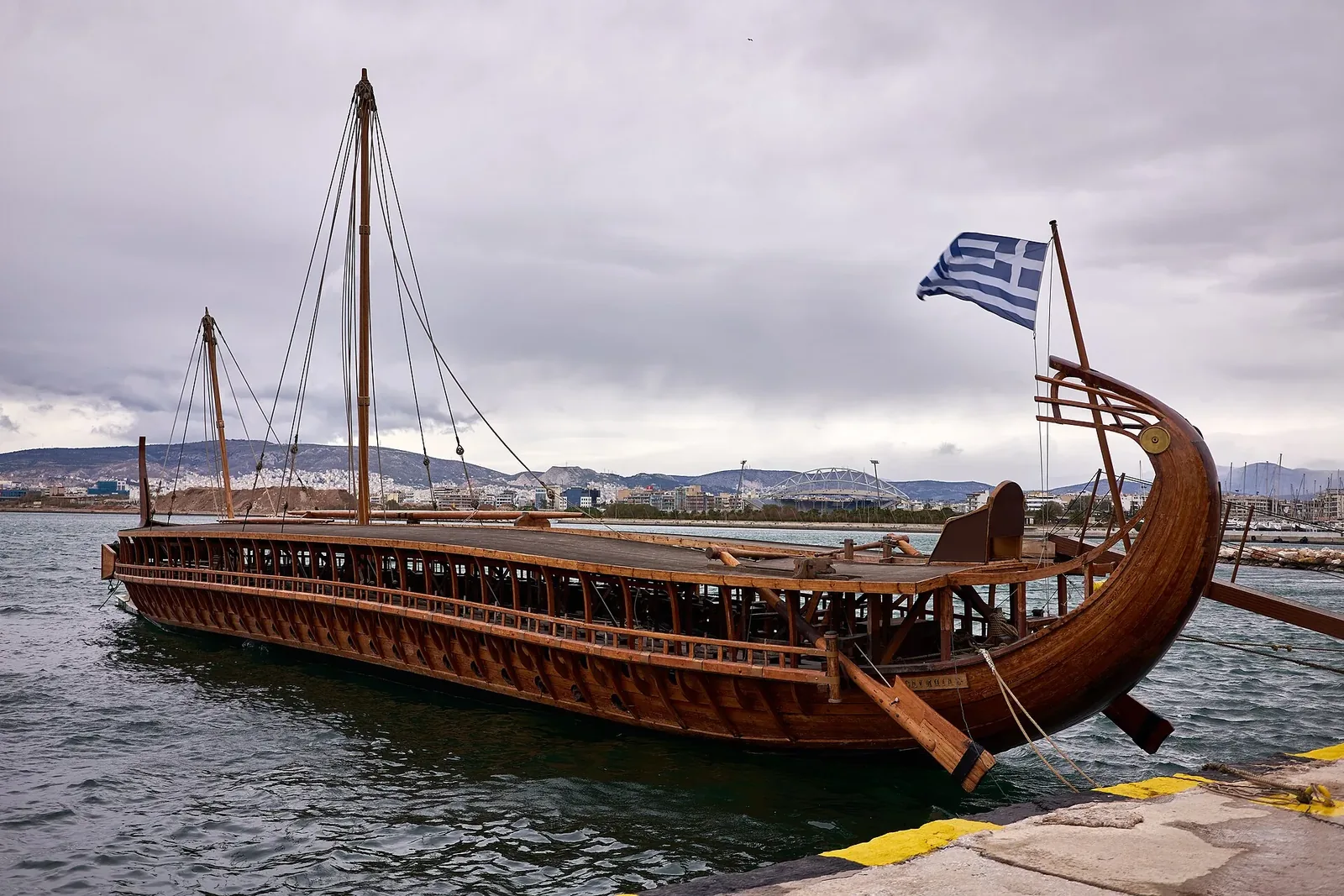
At dawn the Greek commanders assembled the fighting men, and Themistocles spoke for them all, contrasting the better and the worse in human nature and urging them to choose the better. Then the order came to board the ships, just as the trireme sent to Aegina for the sons of Aeacus returned.
Aeschylus describes what the Persians heard at that moment. First a great cheer, echoed back from the rocks of the island; then the paean, the Greek battle hymn, sung not as men in flight but as men going to attack; then a trumpet, the stroke of oars, and a shout across the water:
On, you men of Hellas! Free your native land. Free your children, your wives, the temples of your fathers’ gods, and the tombs of your ancestors. Now you are fighting for all you have.13Aeschylus, The Persians, lines 402–405Performed in 472 BC; Aeschylus fought in the war. Translation by H. W. SmythRead on Perseus ↗
Aeschylus, The Persians (472 BC), translation by H. W. Smyth
Herodotus’ version is less heroic at the start. As the Greeks put out, the Persians came straight at them, and most of the Greek ships began to back water toward the shore. Then Ameinias of Pallene, an Athenian captain, charged and rammed an enemy ship; his ship stuck fast, the others came to help him, and the battle was joined. The Aeginetans told it differently: for them the first blow was struck by the ship that had fetched the images of the Aeacidae from Aegina. Diodorus, following a later tradition, calls Ameinias the brother of the poet Aeschylus.14Diodorus Siculus, Library of History 11.27.2Written c. 30 BC. Translation by C. H. Oldfather (1946)Read on LacusCurtius ↗
The Phoenician ships faced the Athenians on the western wing, toward Eleusis; the Ionian Greeks of Asia Minor, fighting for Xerxes, faced the Spartans on the eastern wing, toward Piraeus. Herodotus says a few Ionians held back as Themistocles had hoped, but most fought hard. In the narrows the Persian advantage in numbers turned into a disadvantage. The Greeks fought in order and kept their line; the Persians, crowded together, lost their formation. Ships in the rear pushed forward to show their courage before the king, and fouled their own ships turning back from the front. Aeschylus describes the same crush from the Persian side: ships packed in the strait, crashing their bronze rams into their own line, oars sheared away, the sea so thick with wrecks and bodies that the water could not be seen.
Among the dead was Xerxes’ brother Ariabignes, one of the admirals. Few Greeks drowned, Herodotus notes, because they could swim, and men whose ships sank swam across to Salamis; many of the Persians and their allies could not. Plutarch, writing much later, names Ariabignes as Ariamenes and says he was killed in a fight with the Athenian ship of Ameinias of Decelea and Sosicles of Paeania, then thrown into the sea. As the Persian ships turned to flee toward Phalerum, the Aeginetans waited for them at the mouth of the strait: those who escaped the Athenians ran straight into the Aeginetans.
Artemisia’s escape
Herodotus tells one story from inside the Persian fleet in detail, perhaps because Artemisia came from his own city. In the confusion her ship was chased by an Athenian trireme and found its way out blocked by friendly ships. So she rammed one of them, a ship from Calynda with its king Damasithymus aboard, and sank it. The Athenian captain, thinking she must be on the Greek side or a deserter, turned away to chase someone else.15Herodotus, Histories 8.87Written c. 430 BC. Translation by A. D. GodleyRead on Perseus ↗
Xerxes, watching from the shore, saw the ram strike. A courtier pointed it out: “Master, do you see how well Artemisia fights, and how she has sunk an enemy ship?” Nobody from the Calyndian ship survived to tell the truth, and Xerxes is said to have answered:
My men have become women, and my women men.16Herodotus, Histories 8.88Written c. 430 BC. Translation by A. D. GodleyRead on Perseus ↗
Herodotus, Histories 8.88
The Athenians had offered ten thousand drachmas to whoever took her alive, angry that a woman was making war on Athens. Herodotus adds that if Ameinias had known whose ship he was chasing, he would not have given up until he had either taken it or been taken himself.
Xerxes on Mount Aegaleos
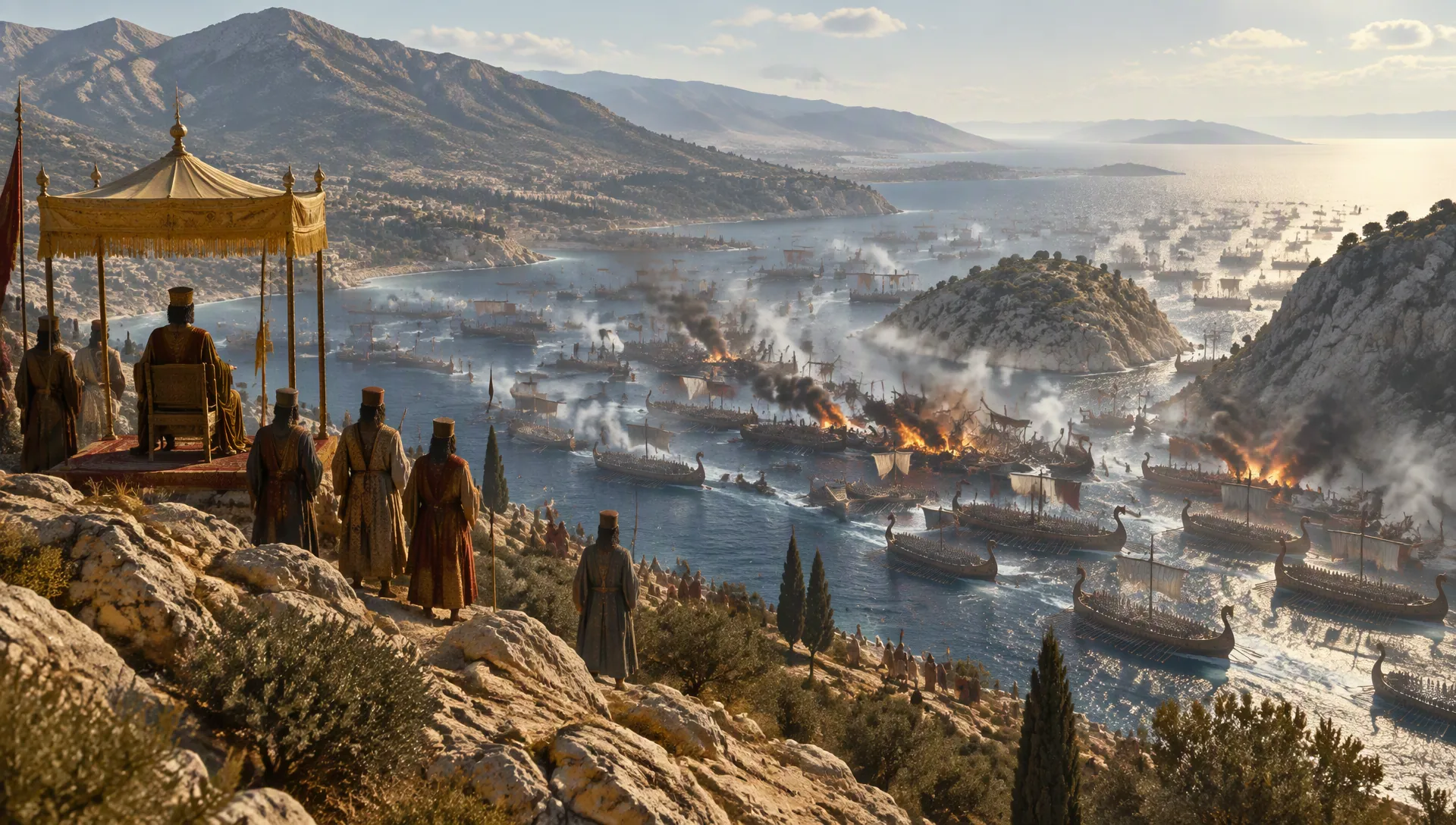
Xerxes had come to see his men fight, and he did. He sat at the foot of Mount Aegaleos, opposite Salamis, and whenever one of his captains did something notable, he asked who it was, and his scribes wrote down the man’s name, his father’s name and his city. Aeschylus gives him “a seat commanding a clear view of the entire army, a lofty headland by the open sea”.17Aeschylus, The Persians, lines 465–467Performed in 472 BC; Aeschylus fought in the war. Translation by H. W. SmythRead on Perseus ↗ Later writers decorated the scene. Plutarch reports one version in which Xerxes sat on a golden chair with secretaries around him to record everything that happened.18Plutarch, ThemistoclesWritten c. AD 100. Translation by J. Dryden, revised by A. H. CloughRead on Project Gutenberg ↗
What he saw was not only defeat but recrimination. Phoenician captains whose ships had been lost came to him and blamed the Ionians for treachery. At that very moment, Herodotus says, a ship from Samothrace rammed an Athenian ship and was itself sunk by an Aeginetan, whose crew the Samothracians then swept off its deck with javelins and captured the ship. Xerxes, having seen this, turned on the Phoenicians and had their heads cut off, so that cowards would not slander braver men.
Psyttaleia
The troops the Persians had landed on Psyttaleia were meant to kill Greeks washed ashore from their wrecks and to rescue their own men. Instead, in the confusion of the battle, Aristides took many of the Athenian hoplites drawn up along the shore of Salamis, crossed to the islet and killed every Persian on it. For Aeschylus this was the worst blow of all. His messenger describes the men sent to the islet as the best of the Persians, young, noble and loyal, surrounded by Greeks in bronze armour, struck by stones and arrows, then cut down to the last man. It was after this, he says, that Xerxes tore his robes and ordered his army to retreat.19Aeschylus, The Persians, lines 447–471Performed in 472 BC; Aeschylus fought in the war. Translation by H. W. SmythRead on Perseus ↗
Losses and other versions
Herodotus gives no total for the ships lost. He says only that most of the ships sunk at Salamis were destroyed by the Athenians and the Aeginetans, and that the Greek losses in men were small. Aeschylus’ messenger says simply that so great a multitude of men had never died in a single day. Diodorus gives figures: the Greeks lost forty ships, the Persians more than two hundred, not counting those captured with their crews. Ctesias, the Greek doctor at the Persian court, says the Persians lost five hundred ships.20Ctesias, Persica, summarised by Photius (Bibliotheca, codex 72)Ctesias wrote c. 400 BC; the summary is from the 9th century AD. Translation by J. H. Freese (1920)Read on Project Gutenberg ↗ The next spring, Herodotus says, the whole Persian fleet gathered at Samos numbered three hundred ships, and did not dare to sail further west.
Plutarch adds a darker story, taken from the fourth-century writer Phanias of Lesbos: before the battle three Persian prisoners, said to be nephews of Xerxes, were sacrificed at the demand of a seer and the crowd, against Themistocles’ will. Herodotus, Aeschylus and Diodorus say nothing of it, and many historians treat it as a later invention. Like the golden chair on the hill, it shows how the story kept growing in the centuries after the battle.
Xerxes goes home
The Greeks towed in what wrecks they could and prepared for a second battle, expecting the king to use his surviving ships. Xerxes, Herodotus says, was afraid that the Greeks, or Ionians advising them, would sail to the Hellespont and break his bridges, trapping him in Europe. To hide his plans he began building a causeway of linked merchant ships toward Salamis, as if to continue the fight, and sent a messenger to Persia with the news. At Susa, where the first message about the capture of Athens had been celebrated with myrtle branches and incense, the second message made the Persians tear their clothes, more from fear for the king than grief for the ships.
Mardonius, who had urged the war and feared he would be blamed, offered a solution: the defeat was the fault of Phoenicians, Egyptians and Cypriots, not of Persians; let the king go home, and he would conquer Greece with three hundred thousand picked men. Xerxes asked Artemisia’s advice again, and this time took it. She told him to go home: if Mardonius succeeded, the victory would be the king’s; if he failed, it would be no great loss, as long as the king and his house were safe. Herodotus thinks Xerxes would have left anyway, so frightened was he.
That night the Persian fleet sailed for the Hellespont to guard the bridges. The Greeks followed as far as Andros, where Themistocles proposed sailing on to break the bridges. Eurybiades argued against trapping the Persian army in Europe, and Themistocles, Herodotus says, then changed his tune and sent Sicinnus to Xerxes a second time, claiming credit for stopping the pursuit. Decades later, as an exile at the Persian court, Themistocles would remind Xerxes’ son of that warning, according to Thucydides.21Thucydides, History of the Peloponnesian War 1.137Written c. 400 BC. Translation by R. CrawleyRead on Project Gutenberg ↗
A few days after the battle the army marched back through Boeotia to Thessaly, where Mardonius chose the troops he would keep for the winter. Xerxes went on to the Hellespont in forty-five days, bringing back, in Herodotus’ phrase, almost nothing of his army: on the way the soldiers ate grass and tree bark, and disease and dysentery killed many. The bridges had been broken by a storm, and the army crossed to Abydos by ship. The Sicilian Greeks later claimed that on the very day of Salamis, Gelon and Theron had defeated a great Carthaginian army at Himera; Herodotus reports this only as their story.
A defeat at sea, not the end of the war
The fullest picture of how Salamis looked from the Persian side comes, paradoxically, from a Greek. In 472 BC, eight years after the battle, Aeschylus staged The Persians in Athens, set not in Greece but at the Persian court in Susa. The queen mother Atossa waits for news; a messenger arrives and lists the Persian commanders who died, by name; the ghost of Darius rises to blame his son’s pride; finally Xerxes himself returns, his robes torn.22Aeschylus, The Persians, lines 714–715 and throughoutPerformed in 472 BC; Aeschylus fought in the war. Translation by H. W. SmythRead on Perseus ↗ It is a play written for a Greek audience, and it turns defeat into tragedy, but it treats the Persians as human beings who grieve, not as monsters.
For the Persian king the campaign of 480 BC was far from a failure. Athens had been taken and burned, the punishment for Sardis delivered, and most of northern and central Greece now belonged to the king. The fleet that lost at Salamis was largely made up of subject peoples, Phoenicians, Egyptians, Cypriots, Cilicians and Ionian Greeks, and Herodotus shows how quickly blame fell on them. Mardonius told Xerxes that the defeat was theirs, not the Persians’, and Xerxes himself executed Phoenician captains who blamed the Ionians. The king went home; his best general and a large army stayed. The decisive land battle was still to come.
No Persian account of Salamis survives. Herodotus gives the Persians speeches and reasons, and Artemisia, a subject queen from a Greek city, the wisest advice of anyone in the king’s council, but his Persians speak through a Greek writer. Even Aeschylus’ Persian court is imagined. What both show is that in Greek memory, Salamis was a victory over an empire made of many peoples, won in a few hours in a narrow strait.
How close is our evidence?
Salamis is unusual among ancient battles: we have an account by someone who probably was there. Aeschylus’ play is poetry, not history, and it was written to move an Athenian audience, but its details of the night manoeuvres, the dawn paean and the slaughter on Psyttaleia come from a man who, according to tradition, fought in the battle. Herodotus wrote about fifty years later, with access to people who had fought; everything else is later still.
Each city also kept its own memory. The Corinthians, whom the Athenians accused of fleeing at the start of the battle, buried their dead on Salamis under an epitaph that Herodotus could have read: “Once, O stranger, we lived in the well-watered citadel of Corinth, but now we dwell in Ajax’ isle of Salamis.”23Epitaph of the Corinthians buried on Salamis (Simonides?)Inscribed soon after 480 BC; the stone was found on Salamis. Text in J. M. Edmonds, Lyra Graeca II (1924)Read on archive.org ↗ Herodotus himself reports the Athenian story of Adeimantus’ flight, and then adds that the Corinthians deny it and that the rest of Greece bears them witness.24Herodotus, Histories 8.94Written c. 430 BC. Translation by A. D. GodleyRead on Perseus ↗ A century later the Athenians still claimed in speeches that they had provided nearly two-thirds of the fleet, which Herodotus’ own figures do not support.25Thucydides, History of the Peloponnesian War 1.74Written c. 400 BC. Translation by R. CrawleyRead on Project Gutenberg ↗
Why Salamis mattered
Salamis did not end the war. A Persian army wintered in Thessaly, Mardonius burned Athens a second time the following year, and the decisive battle was fought on land at Plataea in 479 BC. But without its fleet the Persian army could no longer outflank the Greek defences by sea or keep itself supplied along the coast, and the wall across the Isthmus, which a fleet could have bypassed at will, became a real barrier. Herodotus, in a passage he knew would annoy his readers, says that if the Athenians had not stood firm at sea, the Peloponnesians behind their wall would have been picked off one by one.26Herodotus, Histories 7.139Written c. 430 BC. Translation by A. D. GodleyRead on Perseus ↗
It also changed Athens. The city that had evacuated its people and fought from its ships came out of the war as the leading naval power in Greece, and within two years at the head of a new alliance, the Delian League. Themistocles was the hero of the hour: when the commanders voted at the Isthmus for the prize of valour, each voted for himself first, and most put Themistocles second; the Spartans then honoured him with an olive crown and the finest chariot in Sparta. Within a decade he would be ostracised, and he ended his life in the service of the Persian king. The story continues in Chapter 8: Plataea and Mycale.
- Herodotus, Histories 8.21
- Plutarch, Themistocles
- Herodotus, Histories 8.51
- Herodotus, Histories 8.42
- Herodotus, Histories 8.59
- Diodorus Siculus, Library of History 11.15.4
- Aeschylus, The Persians, lines 337–343
- J. Roisman (ed.), Ancient Greece from Homer to Alexander: The Evidence (2011), p. 235
- Aeschylus, The Persians, lines 355–360
- Plutarch, Themistocles
- Aeschylus, The Persians, lines 361–371
- Herodotus, Histories 8.79
- Aeschylus, The Persians, lines 402–405
- Diodorus Siculus, Library of History 11.27.2
- Herodotus, Histories 8.87
- Herodotus, Histories 8.88
- Aeschylus, The Persians, lines 465–467
- Plutarch, Themistocles
- Aeschylus, The Persians, lines 447–471
- Ctesias, Persica, summarised by Photius (Bibliotheca, codex 72)
- Thucydides, History of the Peloponnesian War 1.137
- Aeschylus, The Persians, lines 714–715 and throughout
- Epitaph of the Corinthians buried on Salamis (Simonides?)
- Herodotus, Histories 8.94
- Thucydides, History of the Peloponnesian War 1.74
- Herodotus, Histories 7.139
- Herodotus, Histories: 7.89, 7.166, 8.40, 8.41, 8.44, 8.49, 8.52–53, 8.54–55, 8.56, 8.57, 8.60, 8.61–62, 8.63, 8.64, 8.66, 8.67, 8.68, 8.69, 8.70–71, 8.74, 8.75, 8.76, 8.79, 8.80, 8.82, 8.83, 8.84, 8.85, 8.86, 8.89, 8.90, 8.91, 8.93, 8.95, 8.96, 8.97, 8.99, 8.100, 8.103, 8.110, 8.115, 8.123–124, 8.130
- Grundy, The Great Persian War: ch. 6
- Diodorus Siculus, Library of History: 11.17.2, 11.19.3
- Aeschylus, The Persians, lines: 412–421, 431–432
- Plutarch, Themistocles