At the end of 870 the Great Army rode into Wessex, the last English kingdom still standing. In the next twelve months the West Saxons fought it at least nine times. They won at Englefield and, gloriously, on the downs at Ashdown, where the king’s younger brother Alfred charged uphill before the king had finished hearing Mass. They lost most of the rest. In April the king died, and Alfred, twenty-three years old, became king in the middle of a war.
Where this chapter fits
The Great Army had landed in East Anglia in 865. In the chapters before this one it took York and broke the kingdom of Northumbria in 866–867, forced the Mercians to make peace at Nottingham in 868, and in the winter of 869–870 killed King Edmund of East Anglia. Three of the four English kingdoms had now been beaten. The fourth was Wessex, the kingdom of the West Saxons, south of the Thames, from Kent to Devon. Its king since 865 was Æthelred I, the fourth of the sons of King Æthelwulf to rule, and his only surviving brother, Alfred, was his second in command.
The brothers had seen the army before. In 868 they had marched into Mercia to help the Mercian king against it at Nottingham, but there was no real battle, and the Mercians made peace.1Anglo-Saxon Chronicle, s.a. 868Compiled c. 890 at the court of King Alfred, about twenty years after the events. Translation by J. Ingram (1823)Read on Project Gutenberg ↗ Now the army was coming for them. Its leaders in 871 were two kings, Halfdan and Bagsecg, with a number of jarls. Ivar, the most famous of the earlier leaders, is not named in the West Saxon sources after 870; Æthelweard, writing a century later, says he died in the year of King Edmund’s death.
For this year the sources are unusually full. The Anglo-Saxon Chronicle, compiled at Alfred’s court about twenty years later, gives a battle-by-battle account. Asser, a Welsh churchman who joined Alfred’s household in the 880s and wrote his Life of King Alfred in 893, follows the Chronicle but adds details from “truthful eye-witnesses”, and he had seen the battlefield of Ashdown himself. Æthelweard, an ealdorman descended from King Æthelred, wrote a Latin chronicle about 980 from a lost copy of the Chronicle. Their story is the West Saxon story: the army’s side of it survives in no written source at all.
Two brothers and a kingdom
Æthelred and Alfred were the last of five sons of King Æthelwulf of Wessex. Their elder brothers Æthelstan, Æthelbald and Æthelberht had died one after the other, and the kingdom had passed from brother to brother rather than to their sons, a choice that kept a grown man on the throne in years of war. Æthelred became king in 865 or 866. Asser dates it to the year of Alfred’s eighteenth birthday, and puts the arrival of the Great Army in East Anglia in the same year, where “they became in the main an army of cavalry”.2Asser, Life of King Alfred, ch. 21Written in 893 by Alfred’s Welsh adviser, who knew the king and visited the battlefield. Translation by A. S. Cook (1906)Read on Project Gutenberg ↗ An army on horseback could move fast across country and choose where to fight, and that is how it reached Reading.
Alfred was the king’s right hand. Asser calls him secundarius, “the second”, a word for a designated deputy and heir. As a small boy he had been sent to Rome in 853, where Pope Leo IV, Asser says, “anointed as king” the child and adopted him as his godson; Asser’s claim is probably a later reading of a confirmation and a Roman honour as a royal anointing.3Asser, Life of King Alfred, ch. 8Written in 893 by Alfred’s Welsh adviser, who knew the king and visited the battlefield. Translation by A. S. Cook (1906)Read on Project Gutenberg ↗4S. Keynes and M. Lapidge, Alfred the Great: Asser’s Life of King Alfred and Other Contemporary Sources (1983)Modern translation with notes (Penguin Classics). The 853 “anointing” at Rome was probably a confirmation, read later as a sign of kingshipView on Google Books ↗ In 868, at the age of nineteen or twenty, Alfred married Ealhswith, a Mercian noblewoman of the royal line, and that same year he marched with his brother into Mercia against the army at Nottingham.5Asser, Life of King Alfred, ch. 29Written in 893 by Alfred’s Welsh adviser, who knew the king and visited the battlefield. Translation by A. S. Cook (1906)Read on Project Gutenberg ↗ At the wedding feast, Asser adds, Alfred was struck by a sudden pain that no doctor could explain, an illness that troubled him for twenty years and more.
The army that came to Reading was the same that had broken Northumbria and East Anglia. It was led by kings and jarls who each commanded their own followers, and it moved with its own baggage, plunder and probably women and children. Archaeologists working on its later winter camps think it numbered in the thousands, though no figure is recorded for 871.6Hadley and Richards, “The winter camp of the Viking Great Army, AD 872–3, Torksey”, Antiquaries Journal 96 (2016)Modern archaeological study (open access, CC BY 4.0)Read the article ↗ Wessex had more people and land than the army could hope to hold down by force; what it needed was to break the West Saxon army in the field, as it had broken the Northumbrians at York.
Reading: the army digs in
The army came from Thetford in East Anglia. Late in 870, as winter set in, it entered Wessex and occupied the royal estate at Reading, on the south bank of the Thames where the river Kennet joins it. The Chronicle simply says “this year came the army to Reading in Wessex”.7Anglo-Saxon Chronicle, s.a. 871Compiled c. 890 at the court of King Alfred, about twenty years after the events. Translation by J. Ingram (1823)Read on Project Gutenberg ↗ Asser adds that while some of the army went out to plunder, the rest built a rampart between the two rivers, on the south side of the royal estate.8Asser, Life of King Alfred, ch. 35Written in 893 by Alfred’s Welsh adviser, who knew the king and visited the battlefield. Translation by A. S. Cook (1906)Read on Project Gutenberg ↗ The camp could be supplied by water and was protected on two sides by rivers; it was the same kind of fortified base the army had used at York, Nottingham and Thetford.
Archaeologists have not found the camp. Collingwood in 1908 put it on the tongue of land between the rivers, close to where the Saxon minster stood and the medieval abbey was later built; more recent writers have also suggested that it lay under the site of the abbey. Why Reading? It was on the Thames, the border between Wessex and Mercia, it was a royal centre with food stores, and it opened the way up the Kennet valley and along the chalk ridges into the heart of Wessex.
The timing was deliberate. Armies of the time usually fought in summer, when the roads were dry and there was food in the fields; the Great Army moved in the dead of winter. Collingwood thought the army probably rode from Thetford along the Icknield Way, the old track along the chalk, and that the speed of the West Saxon response showed they had been expecting it.9Collingwood, Scandinavian Britain, ch. 4W. G. Collingwood, Scandinavian Britain (1908). Dated in placesRead on archive.org ↗ Whatever its route, by the last days of December the army had a fortified base inside Wessex, on a navigable river, with the stores of a royal estate to live on. From there it could raid in any direction. The West Saxons had to come to it, in the worst season of the year, and they had to come quickly before the countryside was stripped bare.
The army’s habit of building a camp at once and raiding from it explains the shape of the whole year. Almost every battle of 871 began either with a West Saxon attack on a Danish raiding party, as at Englefield, or with an attempt to catch the army in the open, as at Ashdown and Basing. The West Saxons never managed to take the camp itself, and after each defeat in the field the army could fall back behind its rampart and wait.
Englefield and the fight at the gates
The first fight came three days after the army’s arrival. Two jarls rode out with a large party to forage and plunder, and were met at Englefield, about nine kilometres west of Reading, by Ealdorman Æthelwulf with the men of Berkshire. Both sides fought hard. One of the jarls was killed, the Chronicle names him as Sidroc, and the rest fled; the West Saxons held the field.10Anglo-Saxon Chronicle, s.a. 871Compiled c. 890 at the court of King Alfred, about twenty years after the events. Translation by J. Ingram (1823)Read on Project Gutenberg ↗ Æthelweard, who liked a flourish, describes the jarls riding proudly through the fields on horseback, “which nature had denied to them”, as if the sea-raiders had no right to be riders at all.11Æthelweard, Chronicle, book 4Written c. 975–983 by an ealdorman descended from King Æthelred I, from a lost copy of the Chronicle. Translation by J. A. Giles (1848)Read on Project Gutenberg ↗
Four days later the king and Alfred arrived with the main West Saxon army and attacked the camp itself. At first they cut down the men they found outside the defences. Then the defenders came out, “rushing like wolves out of every gate”, Asser writes, and after a long, hard fight the West Saxons gave way.12Asser, Life of King Alfred, ch. 36Written in 893 by Alfred’s Welsh adviser, who knew the king and visited the battlefield. Translation by A. S. Cook (1906)Read on Project Gutenberg ↗ Ealdorman Æthelwulf, the victor of Englefield, was among the dead. Æthelweard adds that his body was carried away secretly to Mercia and buried at Northworthy, “but Derby in the language of the Danes”.13Æthelweard, Chronicle, book 4Written c. 975–983 by an ealdorman descended from King Æthelred I, from a lost copy of the Chronicle. Translation by J. A. Giles (1848)Read on Project Gutenberg ↗
A 12th-century Anglo-Norman poet, Geoffrey Gaimar, adds that the beaten West Saxons escaped by a ford over the Loddon at Twyford that the Danes did not know. Plummer, the great editor of the Chronicle, thought this “sounds perfectly genuine”, but Gaimar wrote about 1136, more than 250 years later, and nobody knows where he found it.14Plummer, Two of the Saxon Chronicles Parallel, vol. 2, notes on 871C. Plummer (1899), notes to the ChronicleRead on archive.org ↗ The defeat at Reading showed what every English army had learned since 865: the Great Army behind its rampart was very hard to beat.
Ashdown: the battle
Four days after the defeat at Reading, the West Saxons came back. The army had marched out of its camp onto the chalk downs, and the two forces met at a place the Chronicle calls Æscesdun, Ashdown. Plummer, reckoning back from a later date in the year, put the battle on about 8 January 871.15Plummer, The Life and Times of Alfred the Great, lecture IIIC. Plummer, The Life and Times of Alfred the Great (1902). Careful source criticism; dated in placesRead on Project Gutenberg ↗ The army was formed in two divisions: one under the two kings, Bagsecg and Halfdan, and the other under the jarls. The West Saxons divided their army in the same way. King Æthelred was to fight the kings, and Alfred the jarls.
Then came the scene that made the battle famous. Asser had heard it from “truthful eye-witnesses”. The king, he says, stayed a long time in his tent hearing Mass, and declared that he would not leave alive until the priest had finished, nor abandon the service of God for that of men. Meanwhile the Danes had reached the field and were ready to fight. Alfred, “though only second in command”, could not hold his position any longer unless he either retreated or attacked without waiting for his brother.16Asser, Life of King Alfred, ch. 38Written in 893 by Alfred’s Welsh adviser, who knew the king and visited the battlefield. Translation by A. S. Cook (1906)Read on Project Gutenberg ↗
He attacked. In Asser’s words, Alfred “with the rush of a wild boar” led the Christian troops against the enemy, closed up his shield-wall and advanced his standards.17Asser, Life of King Alfred, ch. 38Written in 893 by Alfred’s Welsh adviser, who knew the king and visited the battlefield. Translation by A. S. Cook (1906)Read on Project Gutenberg ↗ The ground was against him. The Danes had seized the higher ground, and the West Saxons had to advance uphill. In the middle of the field, Asser writes, there was “a solitary low thorn-tree, which I have seen with my own eyes”, and around it the two armies met “with deafening uproar”.18Asser, Life of King Alfred, ch. 39Written in 893 by Alfred’s Welsh adviser, who knew the king and visited the battlefield. Translation by A. S. Cook (1906)Read on Project Gutenberg ↗ Then, according to a sentence supplied in the modern edition from John of Worcester, King Æthelred finished his prayers, came up and joined the battle.
After a long and hard fight the Danes broke. “One of the two heathen kings and five ealdormen” fell, Asser says, and many thousands of their men were killed on the spot or lay scattered “far and wide over the whole field of Ashdown”.19Asser, Life of King Alfred, ch. 39Written in 893 by Alfred’s Welsh adviser, who knew the king and visited the battlefield. Translation by A. S. Cook (1906)Read on Project Gutenberg ↗ He gives the names: King Bagsecg, Sidroc the Elder and Sidroc the Younger, Osbern, Fræna and Harold. The survivors fled through the night and the next day back to their camp at Reading, with the West Saxons pursuing them until dark. The Chronicle agrees, and adds that “they continued fighting till night”.20Anglo-Saxon Chronicle, s.a. 871Compiled c. 890 at the court of King Alfred, about twenty years after the events. Translation by J. Ingram (1823)Read on Project Gutenberg ↗
Æthelweard, writing a century later as the great-great-grandson of King Æthelred, went further: “all the flower of the barbarian youth” was killed, and never before or since had there been such destruction since the Saxons first won Britain.21Æthelweard, Chronicle, book 4Written c. 975–983 by an ealdorman descended from King Æthelred I, from a lost copy of the Chronicle. Translation by J. A. Giles (1848)Read on Project Gutenberg ↗ That is family pride, but the Chronicle also counts the dead jarls with unusual care. Ashdown was the first clear victory in open battle over the whole Great Army recorded since it landed in 865, and it killed one of its two kings.
What should we make of the Mass? Plummer found it hard to fit Asser’s story into the Chronicle’s account, but noted that if it was true, the king’s delay did no harm: fresh troops arriving after Alfred’s charge had disordered the enemy may well have decided the battle. Some modern historians agree that Æthelred’s late attack may have been decisive, even planned.22R. Abels, Alfred the Great: War, Kingship and Culture in Anglo-Saxon England (1998)Modern biography of Alfred (Longman). Æthelred’s late attack may have decided the battleView on Google Books ↗ Asser, writing for Alfred’s court, wanted to show Alfred as the hero of the day and Æthelred as a pious king whose faith God rewarded; he gives both, and the Chronicle, also written under Alfred, gives the two brothers equal credit. Asser’s eye-witnesses are unnamed, and he was writing twenty-two years later, but the story is not impossible: Plummer points out that the church allowed Mass to be said in a tent on campaign.
Where was Ashdown?
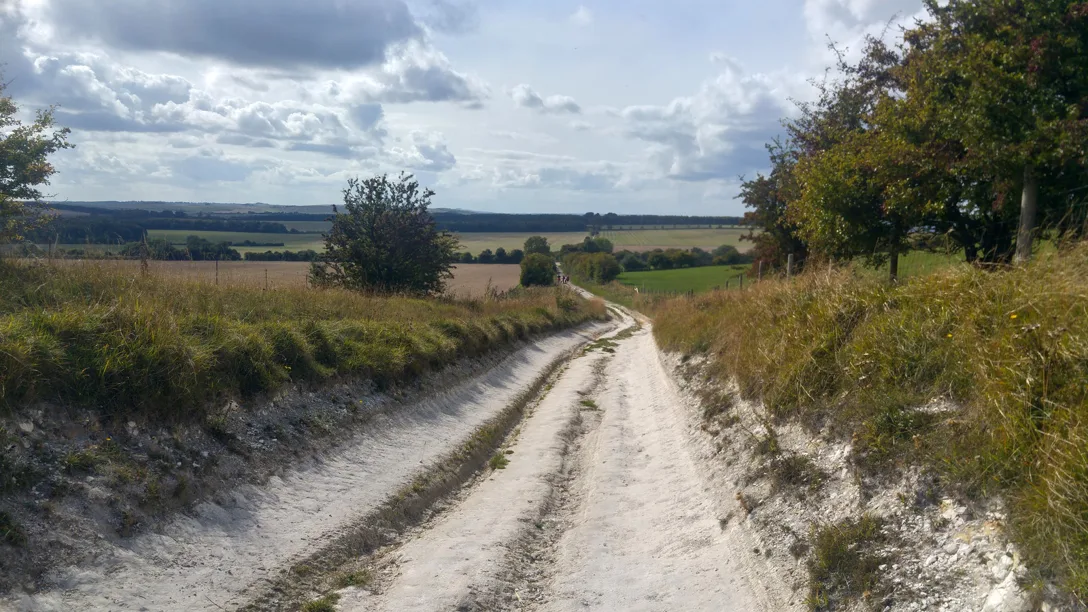
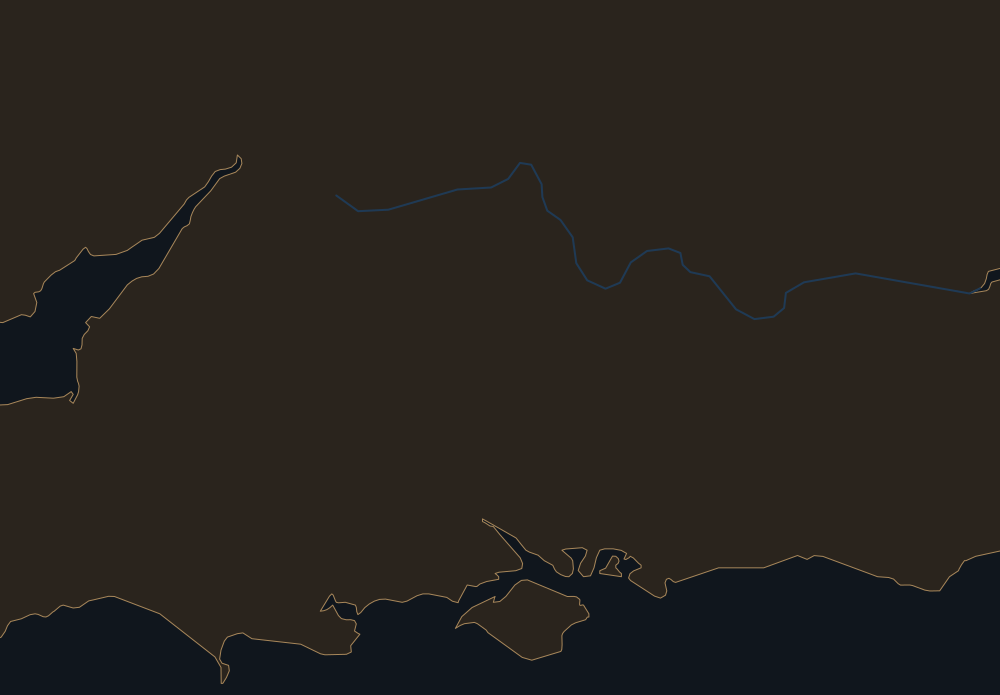
No one knows exactly where the battle was fought. The name Æscesdun was used for the whole chalk upland of the Berkshire Downs, the ridge that runs west from the Thames gap at Goring and Streatley towards Marlborough, along which the ancient Ridgeway track still runs. Plummer, quoting his fellow editor Earle, showed from other mentions in the Chronicle that Æscesdun meant “that mass of chalk-hills between Wallingford and Marlborough”.23Plummer, Two of the Saxon Chronicles Parallel, vol. 2, notes on 871C. Plummer (1899), notes to the ChronicleRead on archive.org ↗ A 10th-century charter for Compton, near East Ilsley, describes it as lying “by the hill called Æscesdune”, and the name survives in Ashdown Park, near Ashbury and Uffington at the western end of the downs. A battle four days’ march from Reading could have been fought almost anywhere along that ridge.
Several sites have been proposed. Asser’s 19th-century editor took the battlefield to be the Berkshire Downs in general. Modern writers have argued for Kingstanding Hill near Moulsford, close to the Thames, or for the area near Starveall and Lowbury Hill, north of Aldworth; both are on the eastern downs, within a day’s march of Reading.24J. Peddie, Alfred, Warrior King (2005) and P. Marren, Battles of the Dark Ages (2009)Modern military studies; they suggest sites near Moulsford (Kingstanding Hill) and near Aldworth (Starveall, below Lowbury Hill)Find in a library (WorldCat) ↗ Plummer added a clue from Domesday Book: a Berkshire hundred called Nachededorn, “naked thorn”, which contained the manor of Ashdown, and which may remember Asser’s solitary thorn tree.25Plummer, The Life and Times of Alfred the Great, lecture IIIC. Plummer, The Life and Times of Alfred the Great (1902). Careful source criticism; dated in placesRead on Project Gutenberg ↗ None of these suggestions has been confirmed by finds on the ground.
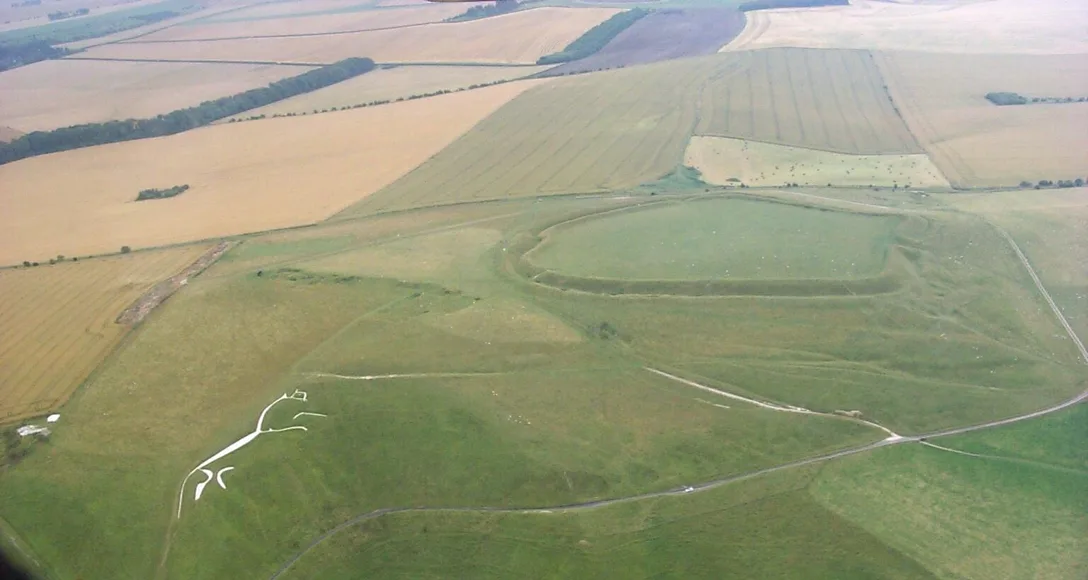
The best-known claim is the least likely. For centuries the White Horse of Uffington, a huge figure of a horse cut into the chalk on the western downs, was said to have been made to celebrate Alfred’s victory. Plummer still reported in 1899 that the White Horse was “believed to commemorate” the battle.26Plummer, Two of the Saxon Chronicles Parallel, vol. 2, notes on 871C. Plummer (1899), notes to the ChronicleRead on archive.org ↗ Excavations in the 1990s dated soil from the figure by optically stimulated luminescence to the late Bronze Age or early Iron Age, roughly 1,500 to 2,000 years before Alfred.27D. Miles, S. Palmer, G. Lock, C. Gosden and A. M. Cromarty, Uffington White Horse and its Landscape (2003)Modern excavation report (Oxford Archaeology, Thames Valley Landscapes Monograph 18): soil from the figure dated by optically stimulated luminescence to the late Bronze Age or early Iron AgeRead at Oxford Archaeology ↗ The horse is a prehistoric monument; the link with Ashdown is legend.

Basing and Meretun
Ashdown did not end the war. The army was beaten but not destroyed, and its camp at Reading was untouched. Fourteen days later, Asser says, the brothers again joined their forces and marched to Basing, in Hampshire, south of Reading, to fight the heathen; the battle was long, but this time the Danes won and held the field. Plummer read the move to Basing as a thrust towards Winchester, the chief royal city of Wessex, which the army was not strong enough to press home.28Plummer, The Life and Times of Alfred the Great, lecture IIIC. Plummer, The Life and Times of Alfred the Great (1902). Careful source criticism; dated in placesRead on Project Gutenberg ↗ Æthelweard says the barbarians had the victory “but gained no spoils”.
About two months later the brothers fought the whole army again at a place the Chronicle calls Meretun. The West Saxons formed two divisions and at first put both Danish divisions to flight, “enjoying the victory for some time during the day”, but there was heavy slaughter on both sides and in the end the Danes held the field.29Anglo-Saxon Chronicle, s.a. 871Compiled c. 890 at the court of King Alfred, about twenty years after the events. Translation by J. Ingram (1823)Read on Project Gutenberg ↗ Among the dead was Heahmund, bishop of Sherborne, who had fought with the king. Æthelweard says he was buried at Keynsham.
Heahmund’s death gives the year its dates. He was remembered as a martyr, and his feast day was 22 March, which is almost certainly the day he died. Counting back by the Chronicle’s intervals, Plummer and his contemporaries dated Basing to about 22 January, Ashdown to about 8 January, the attack on Reading to 4 January and Englefield to 31 December 870.30M. L. R. Beaven, “The beginning of the year in the Alfredian Calendar (866–87)”, English Historical Review 33 (1918), p. 334Modern article on the calendar of the Chronicle: the dates of 871 reckoned back from Bishop Heahmund’s feast daySearch on JSTOR ↗ Because the Chronicle began its year at Christmas, it rightly places the late December fighting in 871. The two-month interval is only approximate, so all these dates are a modern reckoning, close but not certain.
Where Meretun was is unknown. Plummer, following the military writer Simcox, preferred Marten near Great Bedwyn in Wiltshire; others have suggested Merdon, near Hursley in Hampshire, or places in Dorset, and older writers proposed Merton in Surrey or Marden in Wiltshire, which Plummer rejected. After this battle, the Chronicle adds, “came a vast army in the summer to Reading”: a fresh fleet from overseas, which Asser says joined the army there.
Æthelred dies, Alfred becomes king
Easter fell on 15 April in 871. Shortly after it King Æthelred died, after a reign of five years, and was buried at Wimborne Minster in Dorset. Plummer quotes John of Worcester for the date 23 April. Whether he died of a wound from Meretun or was simply worn out by four months of fighting, no source says; Plummer thought either was possible.31Plummer, The Life and Times of Alfred the Great, lecture IIIC. Plummer, The Life and Times of Alfred the Great (1902). Careful source criticism; dated in placesRead on Project Gutenberg ↗
Æthelred left two small sons, Æthelhelm and Æthelwold, too young to lead an army. The kingdom went to his brother. Asser, writing for Alfred, insists that he took it “amid the acclamations of all the people”, and that he could easily have been king even in his brother’s lifetime, because he surpassed all his brothers in wisdom and was victorious in almost every battle.32Asser, Life of King Alfred, ch. 42Written in 893 by Alfred’s Welsh adviser, who knew the king and visited the battlefield. Translation by A. S. Cook (1906)Read on Project Gutenberg ↗ The real arrangement had been made earlier: Alfred’s will refers to an agreement made by the brothers at an assembly at Swinbeorg, that whichever of them lived longer would succeed to the family lands. Æthelwold never accepted the result; after Alfred’s death in 899 he rose in revolt against Alfred’s son.33S. Keynes and M. Lapidge, Alfred the Great: Asser’s Life of King Alfred and Other Contemporary Sources (1983)Modern translation with notes (Penguin Classics). Alfred’s accession and the agreement at Swinbeorg in Alfred’s willView on Google Books ↗
Æthelweard records a fight that the Chronicle does not describe. While the new king was away burying his brother, the “summer army” that had come to Reading attacked the West Saxons. Their army was small because the king was absent, he says, but they fought bravely and drove the enemy back, until at last, worn out, they gave up the fight and the Danes held “a sterile field of battle”.34Æthelweard, Chronicle, book 4Written c. 975–983 by an ealdorman descended from King Æthelred I, from a lost copy of the Chronicle. Translation by J. A. Giles (1848)Read on Project Gutenberg ↗ Æthelweard’s Latin is hard to follow, and his account may refer to one of the unnamed battles of the year.
Asser also gives Alfred’s age. The year 871, he says, was the twenty-third of Alfred’s life, so the new king was 22 or 23. He had grown up as the youngest of five brothers and had never expected to rule. Now he inherited a kingdom at war, with its best ealdormen and its bishop dead, and an enemy that had just been reinforced from overseas.
Wilton and the peace
Within a month of becoming king, Alfred fought the whole army with a small force at Wilton, on the river Wylye in Wiltshire. Asser says the fight lasted a large part of the day and the Danes turned and fled, but then took advantage of their pursuers’ rashness, rallied, and won the field. It was the same pattern as at Meretun: an English success turned into defeat by a counter-attack. Asser explains why Alfred had so few men: the Saxons had been “all but worn out by eight battles in this selfsame year”.
Then the fighting stopped. The Chronicle says only that “the same year the West-Saxons made peace with the army”, and Asser that the Saxons made peace “on condition that they should take their departure; and this they did”.35Asser, Life of King Alfred, ch. 43Written in 893 by Alfred’s Welsh adviser, who knew the king and visited the battlefield. Translation by A. S. Cook (1906)Read on Project Gutenberg ↗ Neither says what the peace cost. The Mercians, the next year, made a treaty with the army and, Æthelweard says, paid it. Many historians assume that Wessex paid too, but the West Saxon sources are silent. In the autumn the army left Reading and went to London, where it spent the winter of 871–872.
The army’s movements after 871 show what the peace meant. It turned away from Wessex for five years: to London, to Northumbria and Torksey in Lincolnshire, and to Repton in Mercia, where in 874 it drove out the Mercian king. A hoard of silver found at Croydon, with coins from Mercia, Wessex and the Continent and three Arab dirhams, has been linked with the army’s move to London in the winter of 871–872.36Hadley and Richards, “The winter camp of the Viking Great Army, AD 872–3, Torksey”, Antiquaries Journal 96 (2016)Modern archaeological study (open access, CC BY 4.0)Read the article ↗ When the army came back to Wessex in 875–876, Alfred had had four years to prepare.
Nine battles: counting the year
The Chronicle sums up the year: “This year were nine general battles fought with the army in the kingdom south of the Thames”, besides countless raids by small parties, which “were accounted nothing”, and in them nine jarls and one king were killed.37Anglo-Saxon Chronicle, s.a. 871Compiled c. 890 at the court of King Alfred, about twenty years after the events. Translation by J. Ingram (1823)Read on Project Gutenberg ↗ Asser speaks of eight battles before Wilton, which with Wilton makes nine, and of “one king, nine chieftains” killed.38Asser, Life of King Alfred, ch. 42Written in 893 by Alfred’s Welsh adviser, who knew the king and visited the battlefield. Translation by A. S. Cook (1906)Read on Project Gutenberg ↗ Only six battles are named: Englefield, Reading, Ashdown, Basing, Meretun and Wilton. The other three are lost, unless the Chronicler counted differently.
Of the six named battles, the West Saxons won two and lost four. Yet the year did what no English kingdom had managed since 865: it kept the army out of the heart of the kingdom, cost it a king and many leaders, and made it leave. Æthelweard, a century later, still counted the losses on the army’s side with pride, saying that besides the battles named, three more were fought and eleven of their “earls” and one king were killed.39Æthelweard, Chronicle, book 4Written c. 975–983 by an ealdorman descended from King Æthelred I, from a lost copy of the Chronicle. Translation by J. A. Giles (1848)Read on Project Gutenberg ↗ Wessex survived 871, and Alfred learned his trade in it.
An army of many bands, and a year of mostly victories
No Norse text mentions Ashdown, Reading or any battle of 871. The names the West Saxon writers recorded are the army’s only trace in writing: Bagsecg, a name otherwise unknown; Halfdan; and the jarls Sigtrygg the Elder and Sigtrygg the Younger (Sidroc), Ásbjǫrn (Osbern), Fræni (Fræna) and Haraldr (Harold), all good Old Norse names. The later sagas make Halfdan a son of Ragnar Lothbrok, but that belongs to the legend, not to the record of 871.
Seen from the camp at Reading, 871 looked very different. Of the named battles the army won four of six. It beat the West Saxons at its own gates, at Basing, at Meretun and at Wilton, and it received a large new force in the summer. Archaeologists Dawn Hadley and Julian Richards stress that the Great Army was not one united force but several warbands from different parts of Scandinavia, and the account of 871, with two kings, many jarls and an army that kept dividing in two, is their best evidence.40Hadley and Richards, “The winter camp of the Viking Great Army, AD 872–3, Torksey”, Antiquaries Journal 96 (2016)Modern archaeological study (open access, CC BY 4.0)Read the article ↗ The jarls killed at Ashdown were leaders of such bands, and their deaths will have weakened the army more than the number of dead men alone.
The army also had aims that were not about battles. Its winter camps were places of trade, metalworking and the sharing out of plunder, and it lived by foraging and by tribute. A peace that sent it to London with whatever the West Saxons gave it was not a defeat in its own terms. The army stayed together for several more years, took Mercia, and in 876 divided its land in Northumbria among its men. What the West Saxons remembered as the year of Ashdown was, for the men from the north, one hard winter in a long and mostly successful campaign.
How close is our evidence?
For a battle of the 9th century, Ashdown is well recorded. The Chronicle was compiled at Alfred’s court within about twenty years, and Asser wrote in Alfred’s lifetime from the stories of men who had fought there, and walked the field himself. Both, however, were written for the king who had won the battle, and both tell it as his story. A few historians have even doubted that Asser’s Life is genuine, though most accept it. Everything after Asser, Æthelweard’s pride, John of Worcester’s date, Gaimar’s ford and the legend of the White Horse, adds colour but must be weighed as later tradition. The site of the battle, the size of the armies and what the peace cost are simply not known.41S. Keynes and M. Lapidge, Alfred the Great: Asser’s Life of King Alfred and Other Contemporary Sources (1983)Modern translation with notes (Penguin Classics). Asser’s Life is accepted as genuine by most historians; A. P. Smyth (1995) argued that it was a later forgeryView on Google Books ↗
- Anglo-Saxon Chronicle, s.a. 868
- Asser, Life of King Alfred, ch. 21
- Asser, Life of King Alfred, ch. 8
- S. Keynes and M. Lapidge, Alfred the Great: Asser’s Life of King Alfred and Other Contemporary Sources (1983)
- Asser, Life of King Alfred, ch. 29
- Hadley and Richards, “The winter camp of the Viking Great Army, AD 872–3, Torksey”, Antiquaries Journal 96 (2016)
- Anglo-Saxon Chronicle, s.a. 871
- Asser, Life of King Alfred, ch. 35
- Collingwood, Scandinavian Britain, ch. 4
- Anglo-Saxon Chronicle, s.a. 871
- Æthelweard, Chronicle, book 4
- Asser, Life of King Alfred, ch. 36
- Æthelweard, Chronicle, book 4
- Plummer, Two of the Saxon Chronicles Parallel, vol. 2, notes on 871
- Plummer, The Life and Times of Alfred the Great, lecture III
- Asser, Life of King Alfred, ch. 38
- Asser, Life of King Alfred, ch. 38
- Asser, Life of King Alfred, ch. 39
- Asser, Life of King Alfred, ch. 39
- Anglo-Saxon Chronicle, s.a. 871
- Æthelweard, Chronicle, book 4
- R. Abels, Alfred the Great: War, Kingship and Culture in Anglo-Saxon England (1998)
- Plummer, Two of the Saxon Chronicles Parallel, vol. 2, notes on 871
- J. Peddie, Alfred, Warrior King (2005) and P. Marren, Battles of the Dark Ages (2009)
- Plummer, The Life and Times of Alfred the Great, lecture III
- Plummer, Two of the Saxon Chronicles Parallel, vol. 2, notes on 871
- D. Miles, S. Palmer, G. Lock, C. Gosden and A. M. Cromarty, Uffington White Horse and its Landscape (2003)
- Plummer, The Life and Times of Alfred the Great, lecture III
- Anglo-Saxon Chronicle, s.a. 871
- M. L. R. Beaven, “The beginning of the year in the Alfredian Calendar (866–87)”, English Historical Review 33 (1918), p. 334
- Plummer, The Life and Times of Alfred the Great, lecture III
- Asser, Life of King Alfred, ch. 42
- S. Keynes and M. Lapidge, Alfred the Great: Asser’s Life of King Alfred and Other Contemporary Sources (1983)
- Æthelweard, Chronicle, book 4
- Asser, Life of King Alfred, ch. 43
- Hadley and Richards, “The winter camp of the Viking Great Army, AD 872–3, Torksey”, Antiquaries Journal 96 (2016)
- Anglo-Saxon Chronicle, s.a. 871
- Asser, Life of King Alfred, ch. 42
- Æthelweard, Chronicle, book 4
- Hadley and Richards, “The winter camp of the Viking Great Army, AD 872–3, Torksey”, Antiquaries Journal 96 (2016)
- S. Keynes and M. Lapidge, Alfred the Great: Asser’s Life of King Alfred and Other Contemporary Sources (1983)
- Æthelweard, Chronicle, book: 4
- Hadley and Richards, “The winter camp of the Viking Great Army, AD 872–3, Torksey”, Antiquaries Journal: 96 (2016)
- Anglo-Saxon Chronicle, s.a.: 871, 872
- Plummer, The Life and Times of Alfred the Great, lecture III
- Asser, Life of King Alfred: ch. 35, ch. 40, ch. 41, ch. 42