Did Vikings wear horned helmets?
No. Not a single horned helmet has been found from the Viking Age (about 793–1066). The one nearly complete Viking-Age helmet, found at Gjermundbu in Norway, is a plain rounded iron cap with a guard around the eyes and nose. Most Viking fighters probably had no metal helmet at all. The horns were added in the nineteenth century, by artists and by the costume designer of Wagner’s operas.

The one Viking helmet
In March 1943 a farmer digging foundations for a house at Gjermundbu, in Ringerike north-west of Oslo, broke into a rich cremation grave of the tenth century. Among the weapons were the pieces of an iron helmet and of a mail shirt. Restored from nine fragments, the helmet is a rounded cap of four iron plates held together by iron bands, with a small knob on top and a “spectacle” guard that protected the eyes and nose. It has no horns.
Gjermundbu is still unique. No other Viking-Age grave in Scandinavia has produced both a helmet and a mail shirt, and only a handful of helmet fragments are known: pieces from Tjele in Denmark, from Gotland, and from Kyiv. The only other fairly complete helmet, found at Yarm in North Yorkshire in the 1950s, was dated to the tenth century in a study of 2020, although its date is still debated; it too is an iron cap with a guard around the eyes and nose. Archaeologists find hundreds of Viking spears, axes and shield bosses, but almost no helmets.
What Viking warriors really wore
The evidence from graves, pictures and texts points to a simple kit. The most common weapons were the spear, the axe and a round wooden shield with an iron boss in the middle. Swords were expensive and belonged to richer men. A mail shirt and an iron helmet were rarer still: the man buried at Gjermundbu was clearly a leader. Most fighters probably went into battle with no metal helmet, perhaps a cap of leather or thick cloth, though none has survived.
Pictures made at the time agree. Picture stones, carvings and, at the very end of the Viking Age, the Bayeux Tapestry of the 1070s show warriors in rounded or pointed caps, often with a nose guard. Written sources from the Viking Age, written mostly by the people the Vikings attacked, mention helmets but never describe horns. The Icelandic sagas, written down later, also speak of helmets without horns.
There is also a practical argument. Horns would give an opponent something to strike or grab and would catch blows instead of letting them glance off. Real war helmets, Viking or otherwise, are smooth.
Horned helmets that did exist
Horned helmets are real, just much older than the Vikings and not made for fighting. In 1942 a peat cutter at Veksø in Denmark dug up two bronze helmets with long curved horns, eyes and a beak-like crest. A study published in 2021 dated them to about 900 BC, some 1,700 years before the Viking Age. They had been placed in a bog as an offering. The archaeologist who led the study compares them with horned figures from Sardinia and Iberia and says that they were never used in battle.

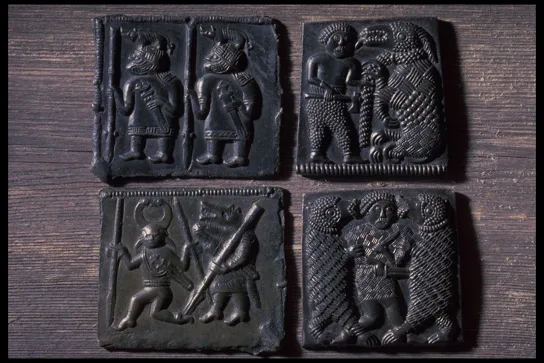
Horned head-dresses also appear in pictures from closer to the Viking Age. On the Torslunda plates from Öland in Sweden, bronze dies of the sixth or seventh century used to stamp helmet decorations, a man dances, weapons in hand, in a head-dress whose two curved “horns” end in birds’ heads. Almost the same dancer appears on the helmet from the Sutton Hoo ship burial in England, of about 600. On the Oseberg tapestry, from a Norwegian ship burial of 834 and so from the Viking Age itself, one figure in a procession, probably a religious one, wears a horned head-dress. These scenes show gods, priests or ritual dancers. They tell us horned head-dresses had a place in religion; they do not show warriors going to war in them.
Where the horns came from
The horned Viking is a modern invention, and historians can trace it quite closely. The Toronto scholar Roberta Frank showed in 2000 that in the eighteenth and early nineteenth centuries artists usually gave Vikings winged helmets, the romantic headgear of heroes. Horns were reserved for ancient Gauls and Germans. That idea went back to the Renaissance, when scholars read the Greek historian Diodorus, who said that Gauls wore bronze helmets with horns, and assumed that what was true of Gauls was true of all northern “barbarians”. The Roman historian Tacitus had in fact written that hardly any Germans had helmets at all.
The first horned Norsemen appeared in the middle of the nineteenth century. The Danish painter Lorenz Frølich drew a horned Frithiof, the hero of a popular Swedish poem, in the 1840s, but the drawing was never published. A German frieze of 1850 gave horns to the war god Tyr. In France a book of myths of 1851 showed Ragnar Lodbrok, the most famous Viking of all, in a horned helmet, and a French history of 1862 repeated it. Popular websites often say that the Swedish painter Gustav (or August) Malmström started the fashion with illustrations to the Frithiof poem in the 1820s; the studies by Frank and by Johnni Langer do not support this, and Langer notes that Malmström’s own Viking pictures of 1862 and 1880 have no horns.
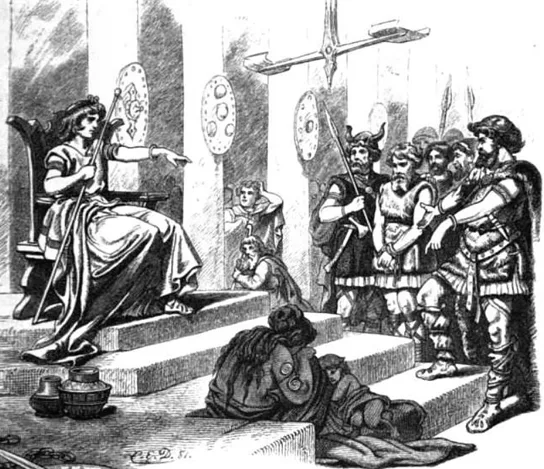
The decisive moment came in 1876. For the first complete performance of Richard Wagner’s opera cycle The Ring of the Nibelung at Bayreuth, the costume designer Carl Emil Doepler, working in 1875 from old commentaries on Tacitus, gave cow-horned helmets to some of the Germanic warriors. Wagner’s operas mixed Norse myths with German legend, and audiences took the costumes as a picture of the ancient North. Cosima Wagner, the composer’s wife, did not like them: she thought they looked like costumes for Native American chiefs.
Why the horns stuck
After 1876 the horned helmet spread fast, above all in Germany and Britain. Doepler and his son illustrated books of Norse myths and sagas with horned heroes; children’s books, school histories, paintings, adverts and even a cruise-ship menu of 1895 followed. Frank found that within twenty years “the horned helmet spelled ‘viking’” in popular culture. In Germany it suited a new nationalism that claimed the Norse past as Germanic; Kaiser Wilhelm II, a great admirer of Wagner and of Norway, even wrote a Viking song whose title pages show horned helmets. Scandinavian artists, who knew the archaeology better, mostly left the horns out.
The timing matters. The term “Viking Age” itself was first used in the 1870s, the same decade as Doepler’s costumes. The Gjermundbu helmet was found only in 1943, long after the image was fixed. Hollywood took over the horns in the twentieth century, and the image is so useful, instantly recognisable and a little wild, that sports teams, cartoons and souvenir shops still use it. It tells us a lot about the nineteenth century and nothing about the Vikings.