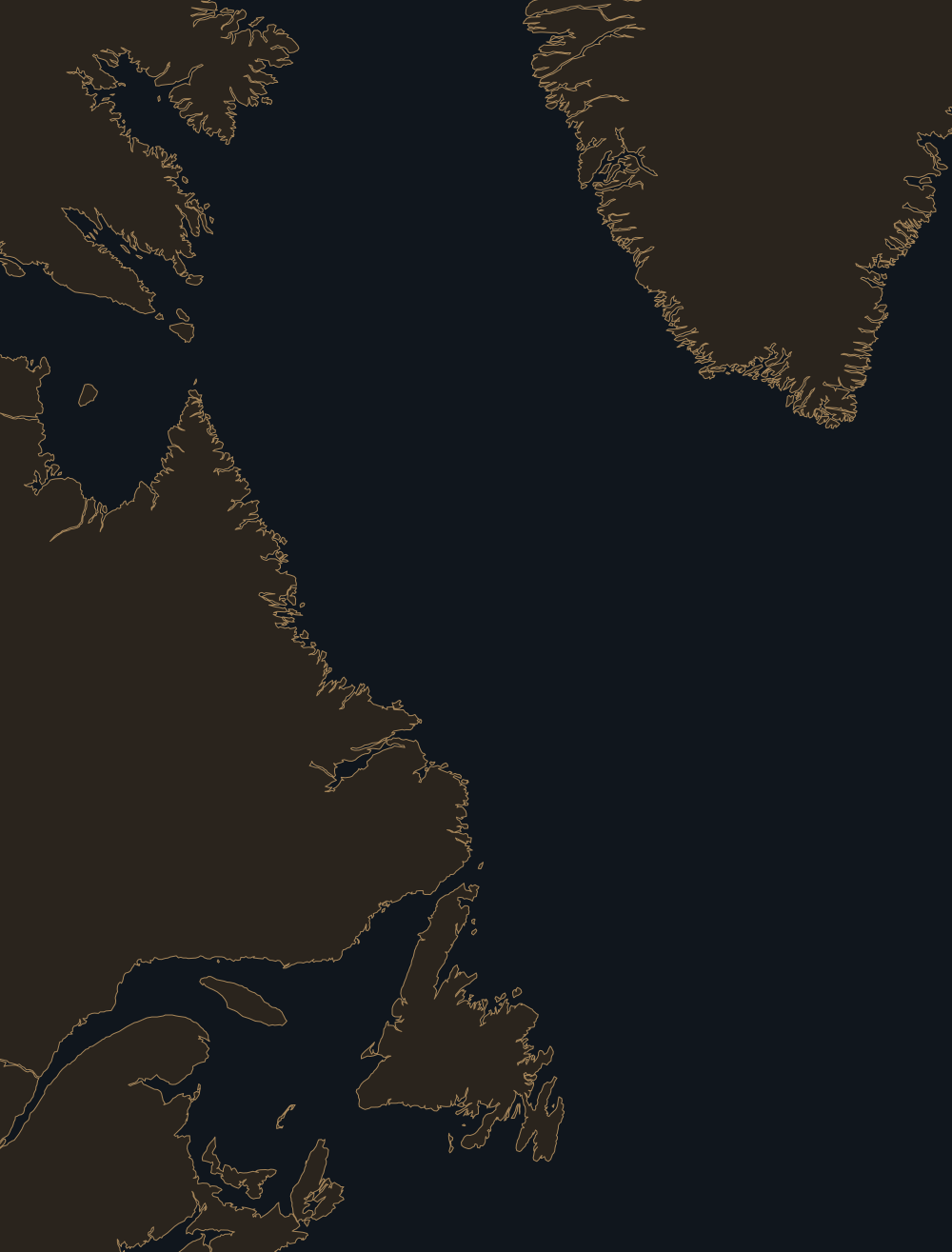
Around the year 1000, Norse farmers from Greenland sailed west and south and reached the coast of North America, nearly 500 years before Columbus. They called the lands they found Helluland, Markland and Vinland. Two Icelandic sagas, written down more than two centuries later, tell the story of these voyages in different ways. For a long time nobody could say how much of it was true. Then, in 1960, a Norwegian couple found the remains of Norse houses at L’Anse aux Meadows in Newfoundland, and in 2021 scientists showed that wood there had been cut by Norse tools in exactly the year 1021.
Greenland: the base for the voyages
The road to America ran through Iceland and Greenland. Iceland was settled from the 870s; about a hundred years later Erik the Red, an Icelander outlawed for killings, explored the land to the west and gave it an attractive name. Ari Þorgilsson, the first historian of Iceland, wrote in the 1120s that Erik “called it Greenland, and said that men would be ready to go thither if the land had a good name”.1Ari Þorgilsson, Íslendingabók (The Book of the Icelanders), ch. 6Written c. 1122–1133, about 140 years after Greenland was settled. Translation by G. Vigfusson and F. York Powell, Origines Islandicae (1905)Read on archive.org ↗ Ari dates the start of the settlement to “fourteen or fifteen winters” before Iceland became Christian in 999 or 1000, so to 985 or 986, and names his source: a man who had sailed out with Erik himself.
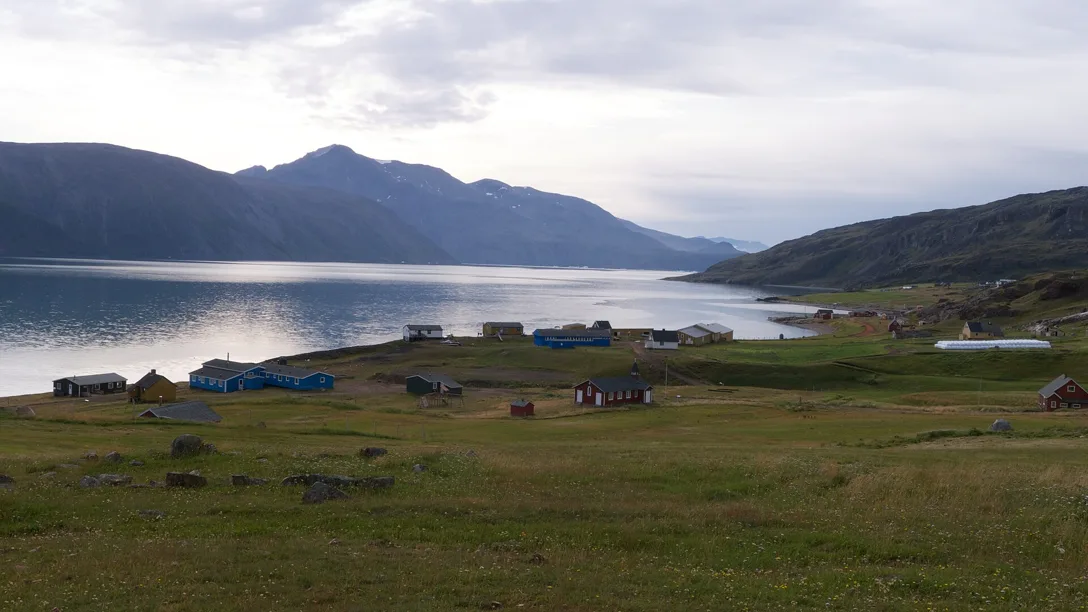
Greenland was a small and lonely place. The Norse settled two areas on the south-west coast, the Eastern Settlement around Erik’s farm at Brattahlíð and the Western Settlement near today’s Nuuk. The archaeologist Birgitta Wallace estimates that in the early eleventh century the colony had no more than 400 to 500 people, and even at its peak in the thirteenth century no more than 2,000 to 3,000.2B. L. Wallace, “The Norse in Newfoundland: L’Anse aux Meadows and Vinland”, Newfoundland Studies 19.1 (2003), p. 31Modern study by the Parks Canada archaeologist who excavated at L’Anse aux Meadows in 1976 (open access)Read the article ↗ Greenland had pasture, seals, walrus and caribou, but almost no trees. Timber for houses and ships had to come from elsewhere. That need, as much as curiosity, explains why the Greenlanders kept sailing west.
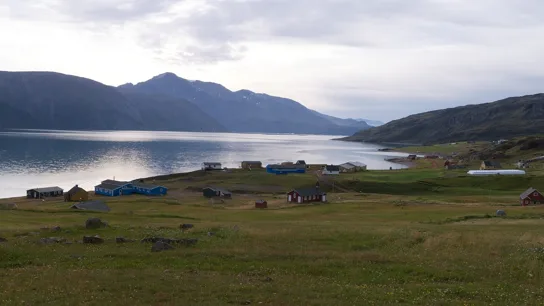
Everything we read about the voyages to Vinland comes from people who lived in this small world, or from their descendants in Iceland. The two sagas that tell the story were written in Iceland in the thirteenth century, more than 200 years after the events, from family traditions handed down by word of mouth. They agree on the main lines and disagree on almost every detail. This chapter follows both, and then turns to the archaeology that has tested them.
Bjarni Herjólfsson sees a new land
According to the Saga of the Greenlanders, the first European to see America never set foot on it. Bjarni Herjólfsson was a young Icelandic merchant who spent his winters alternately abroad and with his father. In the summer of 985 or 986 he came home to Iceland and found that his father had sailed to Greenland with Erik. Bjarni decided to follow, although, as he told his crew, “no one of us has ever been in the Greenland Sea”.3Saga of the Greenlanders (Grænlendinga saga), the story of BjarniWritten in the 13th century (some scholars say c. 1200, others later); known only from the Flatey Book, copied 1387–1394. Translation by A. M. Reeves (1890)Read on archive.org ↗
Fog and north winds drove the ship off course for many days. When the sun came out again they saw land, but it was “level, and covered with woods”, with small hills, and Bjarni said it could not be Greenland.4Saga of the Greenlanders (Grænlendinga saga), the story of BjarniWritten in the 13th century (some scholars say c. 1200, others later); known only from the Flatey Book, copied 1387–1394. Translation by A. M. Reeves (1890)Read on archive.org ↗ They sailed on and saw a second flat, wooded land, and then a high, mountainous island with glaciers. Each time Bjarni refused to go ashore, even when his men asked to collect wood and water. On the fourth landfall he recognised Greenland and reached his father’s farm at Herjólfsnes. Later, in Norway, people thought he had shown little curiosity: he had seen new lands and could tell nothing about them.
Bjarni’s voyage appears only in the Saga of the Greenlanders. The Saga of Erik the Red does not mention him at all and gives the discovery to Leif Erikson. Historians cannot check either version. The story of a ship blown off course is believable, because the sea between Iceland and Greenland is notorious for fog and storms, but the details of the three landfalls look as if they were shaped to match the three lands that Leif later named, in reverse order.
Leif Erikson: Helluland, Markland and Vinland
Leif was Erik the Red’s son. The two sagas send him west for different reasons. In the Saga of the Greenlanders, Leif hears Bjarni’s story, buys his ship and sails with thirty-five men on purpose to find the lands Bjarni saw. His father Erik was meant to lead the expedition, but on the way to the ship his horse stumbled and threw him, and Erik took it as a sign: “It is not designed for me to discover more lands than the one in which we are now living”.5Saga of the Greenlanders (Grænlendinga saga), Leif’s voyageWritten in the 13th century (some scholars say c. 1200, others later); known only from the Flatey Book, copied 1387–1394. Translation by A. M. Reeves (1890)Read on archive.org ↗
Leif found Bjarni’s lands in reverse order. The first was a barren plain of flat rock between the sea and the glaciers. “To this country I will now give a name, and call it Helluland”, he said: the land of flat stones.6Saga of the Greenlanders (Grænlendinga saga), Leif’s voyageWritten in the 13th century (some scholars say c. 1200, others later); known only from the Flatey Book, copied 1387–1394. Translation by A. M. Reeves (1890)Read on archive.org ↗ The second was low and wooded, with broad white beaches, and he called it Markland, forest land.7Saga of the Greenlanders (Grænlendinga saga), Leif’s voyageWritten in the 13th century (some scholars say c. 1200, others later); known only from the Flatey Book, copied 1387–1394. Translation by A. M. Reeves (1890)Read on archive.org ↗ Two days’ sailing further, they reached an island where the dew on the grass tasted sweeter than anything they had known, then a sound, a river flowing out of a lake, and a place to spend the winter.
The Saga of Erik the Red tells it differently. Here Leif has spent a winter at the court of King Olaf Tryggvason of Norway, who sends him home to preach Christianity in Greenland. On the way he is “tossed about a long time out at sea” and comes by chance upon lands “of which before he had no expectation”, with wild wheat, vines and great trees.8Saga of Erik the Red (Eiríks saga rauða), ch. 4Written in the 13th century, over 200 years after the voyages; copies in Hauksbók (c. 1300–1310) and Skálholtsbók (15th century). Translation by J. Sephton (1880)Read on Project Gutenberg ↗ On the way home he rescues a shipwrecked crew, which earns him his nickname, Leif the Lucky. The thirteenth-century Kristni saga, a history of the conversion of Iceland, puts this in the summer when King Olaf sent Leif to Greenland: “It was then that Leif discovered Wine-land the Good.”9Kristni saga (The Story of the Conversion), ch. 8Written in the 13th century. Translation by G. Vigfusson and F. York Powell, Origines Islandicae (1905)Read on archive.org ↗ That would be the year 999 or 1000.
A winter at Leifsbúðir
In the Saga of the Greenlanders, Leif’s men first built simple booths and then, deciding to stay the winter, “a large house”. There were bigger salmon in the river and the lake than they had ever seen, and the land seemed so good that cattle would need no fodder in winter. The days and nights were more nearly equal than in Greenland or Iceland: on the shortest day the sun was up between the times the Icelanders called eyktarstaðr and dagmálastaðr.10Saga of the Greenlanders (Grænlendinga saga), Leif in VinlandWritten in the 13th century (some scholars say c. 1200, others later); known only from the Flatey Book, copied 1387–1394. Translation by A. M. Reeves (1890)Read on archive.org ↗ Scholars since the nineteenth century have tried to turn that phrase into a latitude, with very different results, because nobody is sure which hours of the day the two words meant.
Then comes the famous scene that gave the land its name. One evening Tyrker, a German who had been Leif’s foster-father, was missing. When he was found he was excited and spoke German at first, and then explained: “I have found vines and grapes.”11Saga of the Greenlanders (Grænlendinga saga), Leif in VinlandWritten in the 13th century (some scholars say c. 1200, others later); known only from the Flatey Book, copied 1387–1394. Translation by A. M. Reeves (1890)Read on archive.org ↗ He was sure, he said, because “I was born where there is no lack of either grapes or vines”.12Saga of the Greenlanders (Grænlendinga saga), Leif in VinlandWritten in the 13th century (some scholars say c. 1200, others later); known only from the Flatey Book, copied 1387–1394. Translation by A. M. Reeves (1890)Read on archive.org ↗ Leif’s men spent the rest of their stay gathering grapes and cutting vines and timber, and in spring they sailed home with a full cargo. “From its products Leif gave the land a name, and called it Wineland.”13Saga of the Greenlanders (Grænlendinga saga), Leif in VinlandWritten in the 13th century (some scholars say c. 1200, others later); known only from the Flatey Book, copied 1387–1394. Translation by A. M. Reeves (1890)Read on archive.org ↗
Whether there really were grapes has been argued about for a century and a half. Some scholars, among them Helge Ingstad, thought the first part of the name was not vín, wine, but vin, meadow or pasture, and that Vinland simply meant “meadow land”. A modern translator of Ari’s Book of the Icelanders notes that the name is first recorded there, and that other explanations “relating it to grassland” have been proposed beside the usual one.14S. Grønlie, Íslendingabók and Kristni saga (2006), note 56Modern translation with notes (Viking Society for Northern Research, free PDF)Read the PDF ↗ But the oldest writer of all, Adam of Bremen, already explained the name by the vines, about fifty years after the voyages, and the archaeology described below suggests that the Norse did reach the region where wild grapes grow.
Thorvald and the first fight
In the Saga of the Greenlanders, Leif’s brother Thorvald thought the country “had not been sufficiently explored” and borrowed Leif’s ship. With thirty men he wintered at Leif’s houses, explored the coasts for two summers and, at a wooded headland, said: “here I should like to make my home.”15Saga of the Greenlanders (Grænlendinga saga), Thorvald’s voyageWritten in the 13th century (some scholars say c. 1200, others later); known only from the Flatey Book, copied 1387–1394. Translation by A. M. Reeves (1890)Read on archive.org ↗ Then the Norse saw three skin boats on the beach with three men under each. They seized and killed eight of the nine; one escaped.16Saga of the Greenlanders (Grænlendinga saga), Thorvald’s voyageWritten in the 13th century (some scholars say c. 1200, others later); known only from the Flatey Book, copied 1387–1394. Translation by A. M. Reeves (1890)Read on archive.org ↗
It was the first recorded meeting between Europeans and the people of America, and it began with a killing. That night, the saga says, a great number of skin boats came out of the fjord. The Norse put up their shields along the ship’s side and defended themselves. When the attackers withdrew, only Thorvald was wounded: an arrow had flown “in between the gunwale and the shield, below my arm”, and he knew it would kill him.17Saga of the Greenlanders (Grænlendinga saga), Thorvald’s voyageWritten in the 13th century (some scholars say c. 1200, others later); known only from the Flatey Book, copied 1387–1394. Translation by A. M. Reeves (1890)Read on archive.org ↗ He asked to be buried on the headland he had liked, with a cross at his head and another at his feet, and to call the place Krossanes, Cross Point.
The Saga of Erik the Red gives Thorvald a stranger death. Here he sails with Karlsefni’s expedition, and a “One-footer”, a creature from the old European tales of monstrous peoples at the edges of the world, shoots him in the belly with an arrow. Thorvald pulls it out and makes a grim joke: “Good land have we reached, and fat is it about the paunch.”18Saga of Erik the Red (Eiríks saga rauða), ch. 13Written in the 13th century, over 200 years after the voyages; copies in Hauksbók (c. 1300–1310) and Skálholtsbók (15th century). Translation by J. Sephton (1880)Read on Project Gutenberg ↗ The one-footer shows how the saga writers mixed family tradition with learned lore from the books they had read.

Thorfinn Karlsefni and Gudrid
The largest expedition was led by Thorfinn Karlsefni, a rich Icelandic merchant whose nickname means something like “the makings of a man”. In Greenland he married Gudrid Thorbjarnardóttir, the widow of Leif’s brother Thorstein, who had died of a sickness in the Western Settlement. Both sagas make Gudrid one of the central figures of the story: beautiful, wise and Christian, a woman to whom the dead and the spirits speak.
The two sagas give very different sizes for Karlsefni’s venture. In the Saga of the Greenlanders he takes one ship, “sixty men and five women”, and livestock, “as it was their intention to settle the country, if they could”.19Saga of the Greenlanders (Grænlendinga saga), Karlsefni’s voyageWritten in the 13th century (some scholars say c. 1200, others later); known only from the Flatey Book, copied 1387–1394. Translation by A. M. Reeves (1890)Read on archive.org ↗ In the Saga of Erik the Red there are three ships, with Karlsefni, his partner Snorri Thorbrandsson, Bjarni Grimolfsson, Thorhall the Hunter, Erik’s son Thorvald and his daughter Freydís: “There were one hundred and sixty men in their ships.”20Saga of Erik the Red (Eiríks saga rauða), ch. 7Written in the 13th century, over 200 years after the voyages; copies in Hauksbók (c. 1300–1310) and Skálholtsbók (15th century). Translation by J. Sephton (1880)Read on Project Gutenberg ↗ They sailed past Helluland and Markland to a long, harbourless coast they called Furðustrandir, the Wonder Beaches, and set up their main camp at a fjord with strong currents, Straumsfjörðr.
Their first winter was hard. Food ran short and the fishing failed. Thorhall the Hunter, the one heathen among them, disappeared and was found on a crag, reciting verses to Thor; when a strange whale washed ashore he claimed it as Thor’s gift, and the Christians threw the meat away. In spring Thorhall sailed north with nine men to look for Vinland and was blown to Ireland, where, the saga says, he was enslaved and died. Karlsefni went south to a place called Hóp, a lagoon behind sandbars, where wild wheat and vines grew and every stream was full of fish.
Snorri, the first European child born in America
Both sagas agree on one small, important detail: Gudrid gave birth to a son in Vinland, and he was called Snorri. In the Saga of Erik the Red, “Snorri, Karlsefni’s son, was born the first autumn, and he was three winters old when they began their journey home.”21Saga of Erik the Red (Eiríks saga rauða), ch. 13Written in the 13th century, over 200 years after the voyages; copies in Hauksbók (c. 1300–1310) and Skálholtsbók (15th century). Translation by J. Sephton (1880)Read on Project Gutenberg ↗ In the Saga of the Greenlanders he is born in the first summer, soon after the Norse built a palisade around their house. If the sagas are right, he was the first child of European parents born in the Americas, about 1005 or a little later; no source gives the year.
Snorri’s descendants are the reason this story was remembered. Karlsefni and Gudrid went home to Iceland and farmed in Skagafjörður in the north. After Karlsefni died, the Saga of the Greenlanders says, Gudrid went on a pilgrimage “to the South”, which in the sagas usually means Rome, came back to live with Snorri at Glaumbær, where he had built a church, and ended her life as a nun. Three Icelandic bishops of the twelfth century, Thorlak, Björn and Brand, were Snorri’s descendants, and the sagas end with their family trees.22Saga of the Greenlanders (Grænlendinga saga), the endWritten in the 13th century (some scholars say c. 1200, others later); known only from the Flatey Book, copied 1387–1394. Translation by A. M. Reeves (1890)Read on archive.org ↗ A family proud of a famous ancestor kept the story alive; that also means it had reasons to polish it.
The Skrælings
The Norse called the people they met in Vinland Skrælingar. The word appears first in Ari’s Book of the Icelanders, written in the 1120s, which says that the Greenland settlers found remains of skin boats and stone tools, “whereby it may be seen that the same kind of folk had been there as they which inhabit Wine-land”, the people the Greenlanders called Skrælings.23Ari Þorgilsson, Íslendingabók (The Book of the Icelanders), ch. 6Written c. 1122–1133, about 140 years after Greenland was settled. Translation by G. Vigfusson and F. York Powell, Origines Islandicae (1905)Read on archive.org ↗ Its origin is uncertain; it may be related to words for shouting or for shrivelling, and it was certainly an insult. A modern translator puts it plainly: “It is clearly a derogatory term”.24S. Grønlie, Íslendingabók and Kristni saga (2006), note 57Modern translation with notes (Viking Society for Northern Research, free PDF)Read the PDF ↗
The Saga of Erik the Red describes the first meeting at Hóp in detail. Nine skin boats came; their crews waved sticks that made a noise like flails. Karlsefni’s men held up a white shield as a sign of peace. The visitors were “short men, ill-looking, with their hair in disorderly fashion on their heads”, large-eyed and broad-cheeked.25Saga of Erik the Red (Eiríks saga rauða), ch. 9Written in the 13th century, over 200 years after the voyages; copies in Hauksbók (c. 1300–1310) and Skálholtsbók (15th century). Translation by J. Sephton (1880)Read on Project Gutenberg ↗ The description is unfriendly, written by people who never met them, two centuries later.
Next spring many boats came, and a market began. The Skrælings wanted red cloth and paid with furs; when the cloth ran low the Norse cut it into strips “not more than a finger’s breadth”, and the buyers still paid as much.26Saga of Erik the Red (Eiríks saga rauða), ch. 10Written in the 13th century, over 200 years after the voyages; copies in Hauksbók (c. 1300–1310) and Skálholtsbók (15th century). Translation by J. Sephton (1880)Read on Project Gutenberg ↗ They wanted swords and spears too, but Karlsefni forbade selling weapons. In the Saga of the Greenlanders the Norse women sell milk instead, and the visitors leave “their wares away in their stomachs” while the Norse keep the furs.27Saga of the Greenlanders (Grænlendinga saga), Karlsefni’s voyageWritten in the 13th century (some scholars say c. 1200, others later); known only from the Flatey Book, copied 1387–1394. Translation by A. M. Reeves (1890)Read on archive.org ↗ Then Karlsefni’s bull burst out of the woods bellowing, the visitors fled, and when they returned it was to fight. In the Saga of Erik the Red they used slings and a great dark ball on a pole that came down “with a hideous noise”, and the Norse ran.28Saga of Erik the Red (Eiríks saga rauða), ch. 11Written in the 13th century, over 200 years after the voyages; copies in Hauksbók (c. 1300–1310) and Skálholtsbók (15th century). Translation by J. Sephton (1880)Read on Project Gutenberg ↗ Two Norse and four Skrælings were killed.
Who were these people? The sagas give no names and no languages, and no Indigenous account of the meetings has survived. Archaeologists have pieced together who lived on these coasts around AD 1000. In Newfoundland and southern Labrador they were hunters and fishers of what archaeologists call the Recent Indian cultures, the ancestors of the Beothuk of Newfoundland and the Innu of Labrador; further north in Labrador there were still Late Dorset people, an older Arctic culture; the Thule, ancestors of the Inuit, had not yet arrived.29D. Odess, S. Loring and W. W. Fitzhugh, “Skraeling: First Peoples of Helluland, Markland, and Vinland”, in W. W. Fitzhugh and E. I. Ward (eds), Vikings: The North Atlantic Saga (2000), pp. 193–205Modern study (Smithsonian Institution Press) of the Indigenous peoples of north-eastern North America around AD 1000Find in a library (WorldCat) ↗ Wallace argues that the people the Norse met at Hóp, if Hóp was on the Gulf of St Lawrence, were probably ancestors of the Mi’kmaq, who used canoes, some of them of skin.30B. L. Wallace, “The Norse in Newfoundland: L’Anse aux Meadows and Vinland”, Newfoundland Studies 19.1 (2003), p. 30Modern study by the Parks Canada archaeologist who excavated at L’Anse aux Meadows in 1976 (open access)Read the article ↗ At L’Anse aux Meadows itself no Indigenous group was living on the site while the Norse were there, although others had camped there before and after them.
Freydís: heroine or murderer?
Erik the Red’s daughter Freydís shows how far the two sagas can drift apart. In the Saga of Erik the Red she is a heroine. When the Skrælings attack and the men run, she is pregnant and cannot keep up. She picks up the sword of a dead man, Thorbrand, and as the attackers come at her she bares her breast and strikes it with the blade. The Skrælings flee. “Why run you away from such worthless creatures,” she had shouted at the men, “stout men that ye are?”31Saga of Erik the Red (Eiríks saga rauða), ch. 11Written in the 13th century, over 200 years after the voyages; copies in Hauksbók (c. 1300–1310) and Skálholtsbók (15th century). Translation by J. Sephton (1880)Read on Project Gutenberg ↗
In the Saga of the Greenlanders she leads her own expedition with two Icelandic brothers, Helgi and Finnbogi, and breaks the agreement by hiding five extra men on her ship. In Vinland she quarrels with the brothers, tells her husband they have beaten her, and has all their men killed in their sleep. When nobody will kill the five women of the brothers’ party, she does it herself: “Hand me an axe!”32Saga of the Greenlanders (Grænlendinga saga), FreydísWritten in the 13th century (some scholars say c. 1200, others later); known only from the Flatey Book, copied 1387–1394. Translation by A. M. Reeves (1890)Read on archive.org ↗ Back in Greenland Leif learns the truth from three of her men but has “no heart” to punish his sister.
Which Freydís is the real one? Probably neither. The two pictures say more about the saga writers than about her. One writer needed a brave woman to shame cowardly men; the other needed a villain to contrast with the saintly Gudrid, ancestor of bishops. All that can be said is that Icelandic tradition remembered a daughter of Erik who went to Vinland.
Why the Norse left
None of the expeditions stayed. The Saga of Erik the Red gives a clear reason: Karlsefni’s people saw that “though the land might be choice and good, there would be always war and terror overhanging them, from those who dwelt there before them.”33Saga of Erik the Red (Eiríks saga rauða), ch. 12Written in the 13th century, over 200 years after the voyages; copies in Hauksbók (c. 1300–1310) and Skálholtsbók (15th century). Translation by J. Sephton (1880)Read on Project Gutenberg ↗ In the Saga of the Greenlanders, too, Karlsefni gives up after the third visit of the Skrælings ends in a battle. On the way home, the Saga of Erik the Red adds, his men killed five sleeping Skrælings and kidnapped two boys in Markland, who were baptised and taught Norse.
Modern historians add reasons the sagas take for granted. Greenland itself had only a few hundred people. Vinland was as far from Greenland as Norway, and the voyage was more dangerous. What Greenlanders really needed from abroad, iron, grain, salt and church goods, came from Europe, and they paid for it with walrus ivory and furs from the Arctic north, the opposite direction. Timber was easier to fetch from Markland. Wallace sums it up: Greenland “simply could not supply sufficient labour to establish another settlement in Vinland or to even to maintain a permanent settlement there”.34B. L. Wallace, “The Norse in Newfoundland: L’Anse aux Meadows and Vinland”, Newfoundland Studies 19.1 (2003), p. 31Modern study by the Parks Canada archaeologist who excavated at L’Anse aux Meadows in 1976 (open access)Read the article ↗
Vinland was not forgotten. Icelandic annals record under the year 1121 that “Bishop Eric of Greenland went in search of Wineland”; nobody knows what he found.35Icelandic annals (Annales regii), s.a. 1121Annals written up in Iceland; this manuscript before 1307. Translation in A. M. Reeves (1890)Read on archive.org ↗ Under 1347 they note a small ship from Greenland, without an anchor, that had “sailed to Markland” and was blown to Iceland on the way back: probably a timber trip, more than three hundred years after Leif.36Icelandic annals (Annals of Skálholt), s.a. 1347Written about 1362. Translation in A. M. Reeves (1890)Read on archive.org ↗
Two sagas, two stories
The Saga of the Greenlanders and the Saga of Erik the Red are together called the Vinland sagas. Both were written in Iceland in the thirteenth century, more than 200 years after the voyages, by authors whose names are unknown. Neither survives in its first form. The Saga of Erik the Red exists in two versions: one in Hauksbók, a manuscript partly written by the Icelandic lawman Haukr Erlendsson in the early fourteenth century, and one in Skálholtsbók from the fifteenth. The Saga of the Greenlanders is known only from the Flatey Book, a huge manuscript of kings’ sagas copied in 1387–1394.
Which is older and more reliable has been argued for two hundred years. In the nineteenth century most scholars, including Arthur Reeves, preferred the Saga of Erik the Red. Since the 1950s many have argued that the Saga of the Greenlanders is older, from about 1200, and closer to oral tradition, while the Saga of Erik the Red reworked the story with more learned detail; others still date the Greenlanders’ saga later. The study that dated L’Anse aux Meadows to 1021 notes that the two sagas “offer differing scenarios for the frequency and duration of Norse activity in the Americas”.37M. Kuitems and others, “Evidence for European presence in the Americas in AD 1021”, Nature 601 (2022), p. 388Modern study (open access, published online 20 October 2021): tree rings and the radiocarbon spike of AD 993Read in Nature ↗ By its count, the Greenlanders’ saga implies about thirteen years between the first arrival and the last return, the Saga of Erik the Red about three.
The first written mention: Adam of Bremen
The oldest surviving text that names Vinland was written not in Iceland but in Germany. Around 1073–1076 Adam, a canon of Bremen, wrote a history of the archbishops of Hamburg-Bremen, whose mission field included Scandinavia. In its fourth book, a description of the northern islands, he reports what the Danish king Sven Estridsen told him: “he spoke of an island in that ocean discovered by many, which is called Wineland, for the reason that vines grow wild there, which yield the best of wine.” Unsown grain grows there too, Adam adds, “not a fabulous fancy, but, from the accounts of the Danes, we know to be a fact.”38Adam of Bremen, Deeds of the Bishops of Hamburg 4.39Written c. 1073–1076; Adam’s informant was King Sven Estridsen of Denmark. Latin text ed. B. Schmeidler (MGH, 1917)Read on archive.org ↗39Adam of Bremen 4.39, in the translation of A. M. Reeves (1890)Reeves translates the passage from Lindenbruch’s edition of 1595Read on archive.org ↗
Adam wrote about fifty years after the voyages, within living memory of the people who made them, and from a royal informant. That makes him the closest written witness. But he was not well informed: he thought Vinland was an island, and placed it beyond Iceland and Greenland in an ocean where, beyond it, “all those regions which are beyond are filled with insupportable ice and boundless gloom”.40Adam of Bremen 4.39, in the translation of A. M. Reeves (1890)Reeves translates the passage from Lindenbruch’s edition of 1595Read on archive.org ↗ For Adam, Vinland was a rumour from the edge of the world. The next mention, in Ari’s Book of the Icelanders around 1125, takes it for granted that readers know where Vinland is.
Finding the Norse: L’Anse aux Meadows, 1960
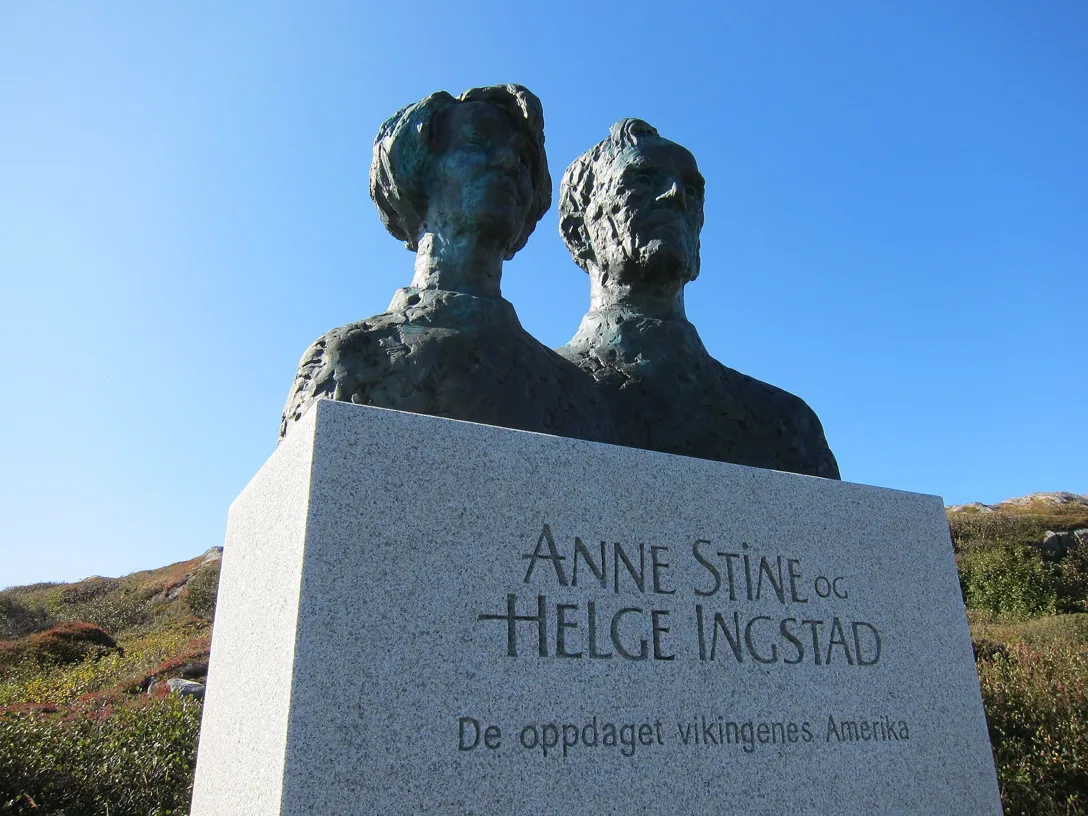
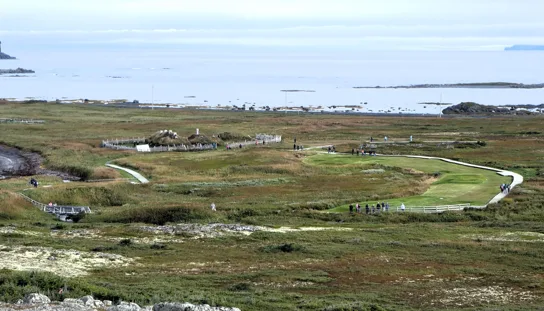
For centuries people searched for Vinland, from Labrador to Virginia, and found nothing that held up. In 1960 the Norwegian writer and explorer Helge Ingstad was searching the coast of northern Newfoundland. A local fisherman, George Decker, took him to a group of grassy mounds near the hamlet of L’Anse aux Meadows that the villagers called the old Indian camp. From 1961 to 1968 Helge and his wife, the archaeologist Anne Stine Ingstad, led an international team that excavated the mounds. Anne Stine directed the digging; she identified the buildings and artefacts as Norse by comparing them with sites in Iceland and Greenland.

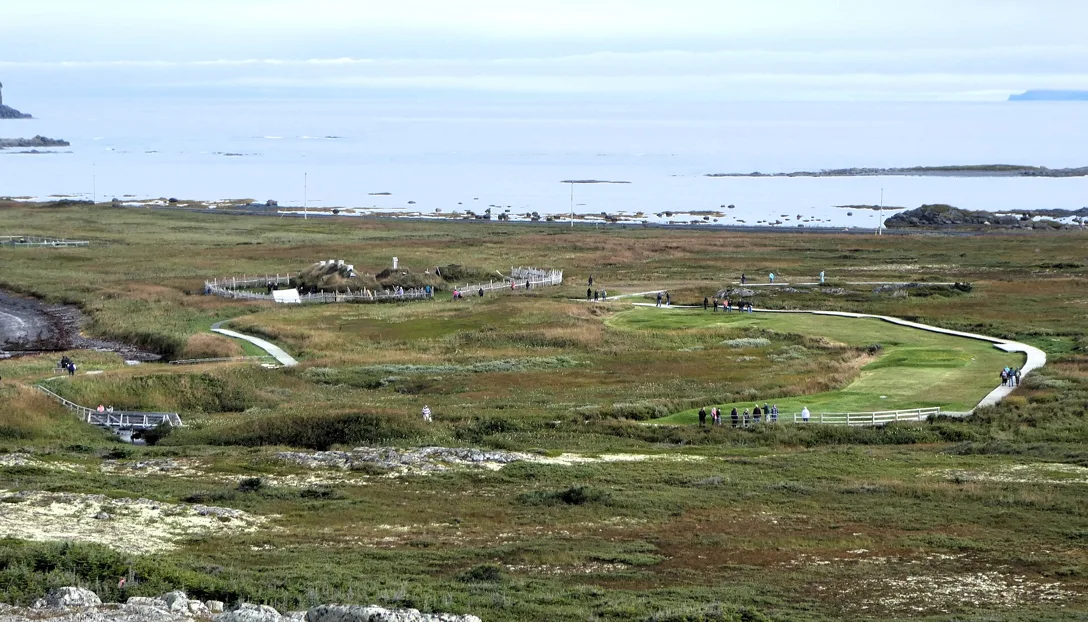
The site lies on a shallow bay facing the Strait of Belle Isle, at the northern tip of Newfoundland. It had eight buildings of turf over wooden frames: three large halls with several rooms each, smaller huts, a smithy where bog iron was smelted and worked, and a carpentry workshop where ship rivets were replaced. Parks Canada excavated more in 1973–1976, the last season under Birgitta Wallace. The finds are ordinary Norse things: a bronze cloak pin, a soapstone spindle whorl, a needle whetstone, and nine fire-strikers of jasper. Wallace concluded from the size of the buildings that “something like 70 to 90 people inhabited the settlement”.41B. L. Wallace, “The Norse in Newfoundland: L’Anse aux Meadows and Vinland”, Newfoundland Studies 19.1 (2003), p. 24Modern study by the Parks Canada archaeologist who excavated at L’Anse aux Meadows in 1976 (open access)Read the article ↗
The finds tell a story of their own. The spindle whorl and needle whetstone were women’s tools in Norse society, so women were probably there, as the sagas say. Of the jasper fire-strikers, four came from western Greenland and five from Iceland, which fits the sagas’ picture of expeditions led by Greenlanders with many Icelanders on board. The rubbish heaps are tiny, the buildings show no repairs, and nothing valuable was left behind: the Norse stayed only a few years and left in good order. Some archaeologists think activity in the area may have lasted longer, perhaps on and off for decades; the dating evidence is still debated.42P. M. Ledger, L. Girdland-Flink and V. Forbes, “New horizons at L’Anse aux Meadows”, PNAS 116 (2019), pp. 15341–15343Modern study suggesting the Norse may have used the area for longer than once thought; disputed (Dee and Kuitems 2019)Read in PNAS ↗
For Wallace those butternuts settle the old argument about the name. The nuts and the burl, she writes, “prove that some of the Norse who over-wintered at L’Anse aux Meadows had been farther south”, in the very areas where grapes grew wild.43B. L. Wallace, “The Norse in Newfoundland: L’Anse aux Meadows and Vinland”, Newfoundland Studies 19.1 (2003), p. 26Modern study by the Parks Canada archaeologist who excavated at L’Anse aux Meadows in 1976 (open access)Read the article ↗ Vinland, in her reading, was not only Newfoundland but the whole coast around the Gulf of St Lawrence, and L’Anse aux Meadows was its gateway: a base where ships were repaired and goods collected before the voyage back to Greenland.
1021: a date written by the sun
Until 2021 the site could only be dated to “about AD 1000”. More than 150 radiocarbon dates had been measured, but their ranges spread across the whole Viking Age. In 2021 a team led by Margot Kuitems and Michael Dee of the University of Groningen, with Birgitta Wallace, found a way to pin it down to a single year.
The key was a burst of cosmic radiation in AD 993, probably from a storm on the sun, that left a sudden jump in radiocarbon in the tree rings of that year all over the world. The team examined three pieces of wood from the Norse layers at L’Anse aux Meadows, from three different trees, all cut with metal tools, which the local Indigenous peoples did not make at that time. In each piece they found the ring of 993, then counted the rings out to the bark edge, the last ring the tree grew before it was cut. All three came out the same: “Here we provide evidence that the Vikings were present in Newfoundland in AD 1021.”44M. Kuitems and others, “Evidence for European presence in the Americas in AD 1021”, Nature 601 (2022), p. 388Modern study (open access, published online 20 October 2021): tree rings and the radiocarbon spike of AD 993Read in Nature ↗ One piece was cut in spring, another in summer or autumn.
The date needs to be read carefully. 1021 is the earliest year in which Europeans can be proved to have been in the Americas, not the year they first arrived. If the sagas are roughly right, Leif sailed about twenty years earlier, and the 1021 wood may come from one of the later voyages. The authors themselves say that how 1021 relates to the rest of the Norse activity in America “is a matter for future research”.45M. Kuitems and others, “Evidence for European presence in the Americas in AD 1021”, Nature 601 (2022), p. 389Modern study (open access, published online 20 October 2021): tree rings and the radiocarbon spike of AD 993Read in Nature ↗ They also note a wider meaning: with the Norse in America and other peoples already spread across Asia and the Pacific, 1021 is the first known moment at which human movement had circled the globe.
Is L’Anse aux Meadows Vinland?
L’Anse aux Meadows is the only proven Norse site in the Americas outside Greenland. Whether it is the place the sagas describe is another question. Helge Ingstad believed it was Leifsbúðir, Leif’s houses. Wallace argued that it matches the Straumsfjörðr of the Saga of Erik the Red, the main base where everyone gathered for the winter, and that Hóp, with its grapes and salmon, lay further south, probably in north-eastern New Brunswick. Others think the sagas’ Vinland lay further south still, in Nova Scotia or New England, and that L’Anse aux Meadows was just a stopping place on the way. Some Norse objects have turned up in Arctic Canada too, but no other Norse building site has been found.
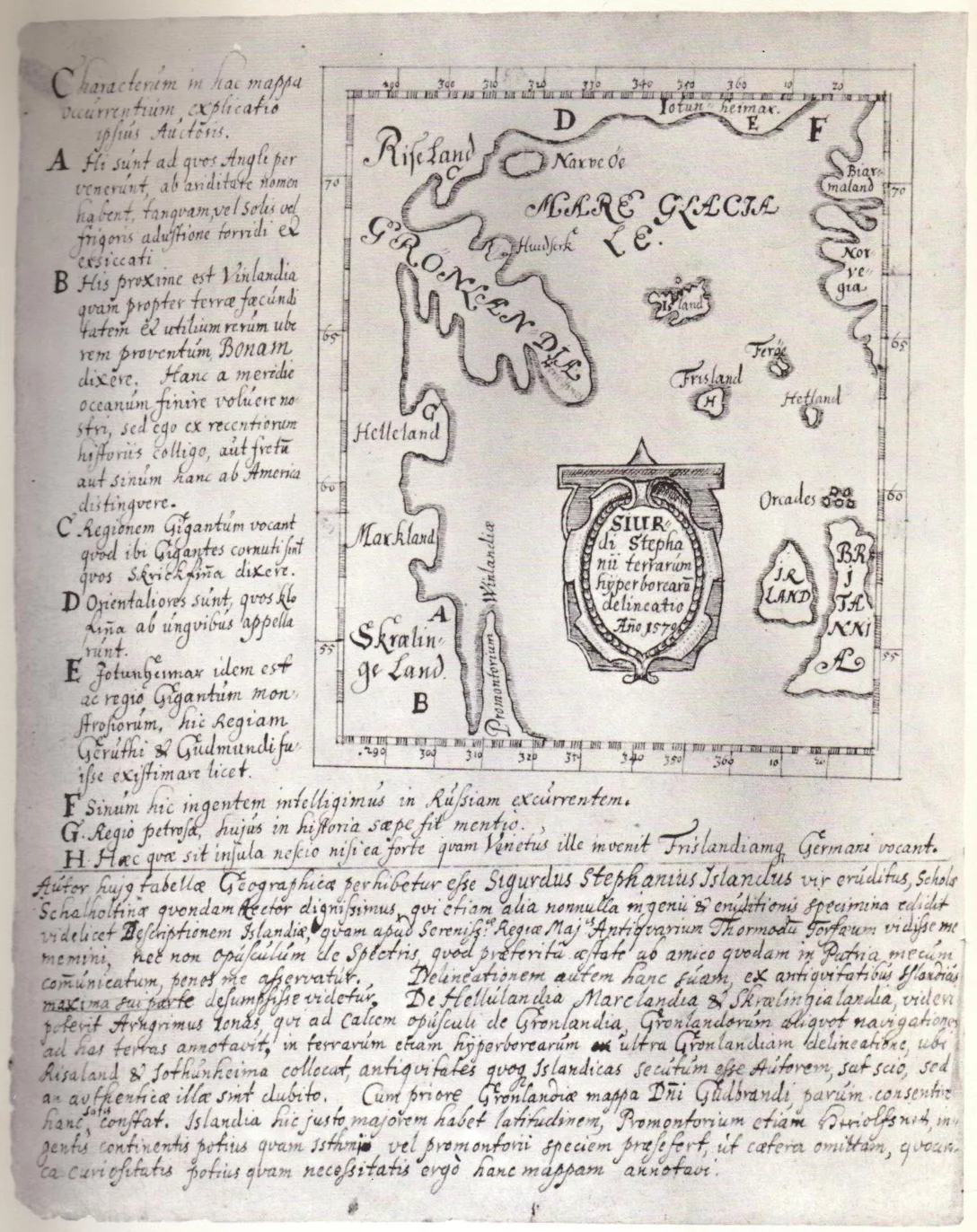
Part of the problem is the sagas themselves. Their sailing directions are vague, their distances are measured in dœgr, a word that may mean a half-day or a full day, and the writers had never been there. Wallace also points out a simple matter of numbers: building the site needed some 60 to 90 people, and the Greenland colony could hardly have built and staffed two or three such bases at once. In her view this is why “L’Anse aux Meadows must be the Straumfjord of the sagas”.46B. L. Wallace, “The Norse in Newfoundland: L’Anse aux Meadows and Vinland”, Newfoundland Studies 19.1 (2003), p. 31Modern study by the Parks Canada archaeologist who excavated at L’Anse aux Meadows in 1976 (open access)Read the article ↗ Not everyone accepts this, and the question is still open.
The Vinland Map: a modern forgery
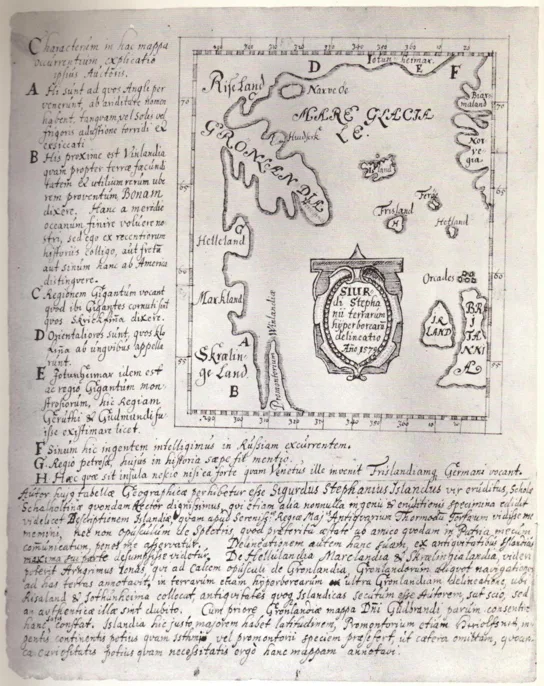
In 1957 a map appeared on the antiques market, bound with a genuine medieval text. It showed Europe, Africa and Asia, and in the far west an island labelled Vinlanda Insula, with a caption about Bjarni and Leif. Yale University acquired it, and in 1965 presented it to the world as a map from about 1440, the earliest map of America. It was a sensation. Scholars doubted it almost at once: its Latin, its handwriting and its shape of Greenland did not fit the fifteenth century.
The ink settled the matter. From the 1970s analyses found anatase, a form of titanium dioxide made as a pigment only since the 1920s, in the lines of the map. In 2021 Yale’s conservators announced the results of a full study: titanium compounds run through the ink everywhere on the map, and an inscription on its back, made to look like a medieval bookbinder’s note, had been written over in modern ink. Yale’s curator called the map a forgery and said: “There is no reasonable doubt here.”47M. Cummings, “Analysis unlocks the secret of the Vinland Map: it’s a fake”, YaleNews, 1 September 2021Report of the Yale University Library study of the map’s ink and of the altered inscription on its backRead on YaleNews ↗ The parchment itself is probably medieval, taken from the book the map was bound with; the drawing is twentieth-century. The map is still at Yale, now as a document of the history of forgery.
A good land, too far away
To us Vinland is the discovery of America. To the Norse it was not a new world but one more land in the west, after the Faroes, Iceland and Greenland, each found by being blown off course and then settled. The sagas never treat it as a turning point. They call it Vinland the Good, a land of self-sown wheat, vines, huge salmon and mild winters, and in the same breath a place where “there would be always war and terror”.48Saga of Erik the Red (Eiríks saga rauða), ch. 12Written in the 13th century, over 200 years after the voyages; copies in Hauksbók (c. 1300–1310) and Skálholtsbók (15th century). Translation by J. Sephton (1880)Read on Project Gutenberg ↗ Those two memories, plenty and danger, are what the Greenlanders and Icelanders kept.
The voyages were family business. Leif, Thorvald, Thorstein and Freydís were all children of Erik the Red, and Karlsefni married into the family. The Saga of the Greenlanders ends by saying that “of all men Karlsefni has given the most exact accounts of all these voyages”, a claim that points to the family tradition of his descendants, the Icelandic bishops, as the source.49Saga of the Greenlanders (Grænlendinga saga), the endWritten in the 13th century (some scholars say c. 1200, others later); known only from the Flatey Book, copied 1387–1394. Translation by A. M. Reeves (1890)Read on archive.org ↗ In that tradition the story is also a Christian one. Leif brings the faith to Greenland, the heathen Thorhall dies a slave, Gudrid ends as a nun, and the one-footed creature and the woman in black who appears to Gudrid and vanishes come from the learned wonder-tales of the same churchly world.
The voyages also show the practical Greenlanders. Timber, a cargo of grapes, burl wood that a merchant from Bremen would buy, furs from trade: the sagas count the profit of every voyage, and the Saga of the Greenlanders calls a Vinland voyage “both a profitable and an honourable enterprise”.50Saga of the Greenlanders (Grænlendinga saga), FreydísWritten in the 13th century (some scholars say c. 1200, others later); known only from the Flatey Book, copied 1387–1394. Translation by A. M. Reeves (1890)Read on archive.org ↗ When it stopped being profitable, they stopped going. The people who lived in Vinland left no written account of the meetings. Genetic studies have found no sign that the Norse and the peoples of America mixed in this period.51A. Margaryan and others, “Population genomics of the Viking world”, Nature 585 (2020), pp. 390–396Modern genetic study of over 400 Viking-Age skeletonsRead in Nature ↗ What survives from their side is the archaeology of their camps, and the fact that the Norse, outnumbered and far from home, went away.
How close is our evidence?
The only evidence from the time is archaeological: the houses, tools and wood of L’Anse aux Meadows, and the tree rings that date them to 1021. The earliest written witness, Adam of Bremen, wrote about fifty years later from what a Danish king told him, and got the geography wrong. Ari, a careful historian, mentions Vinland in passing about a century after the voyages. Everything else, the names of the explorers, their crews and quarrels, the meetings with the Skrælings, comes from two sagas written two hundred years or more after the events and copied later still. Where the archaeology and the sagas meet, at a short-lived Norse base in northern Newfoundland with women’s tools, Icelandic and Greenlandic jasper and nuts from the south, the sagas turn out to be remembering something real. Where they disagree with each other, neither can be trusted on its own.
- Ari Þorgilsson, Íslendingabók (The Book of the Icelanders), ch. 6
- B. L. Wallace, “The Norse in Newfoundland: L’Anse aux Meadows and Vinland”, Newfoundland Studies 19.1 (2003), p. 31
- Saga of the Greenlanders (Grænlendinga saga), the story of Bjarni
- Saga of the Greenlanders (Grænlendinga saga), the story of Bjarni
- Saga of the Greenlanders (Grænlendinga saga), Leif’s voyage
- Saga of the Greenlanders (Grænlendinga saga), Leif’s voyage
- Saga of the Greenlanders (Grænlendinga saga), Leif’s voyage
- Saga of Erik the Red (Eiríks saga rauða), ch. 4
- Kristni saga (The Story of the Conversion), ch. 8
- Saga of the Greenlanders (Grænlendinga saga), Leif in Vinland
- Saga of the Greenlanders (Grænlendinga saga), Leif in Vinland
- Saga of the Greenlanders (Grænlendinga saga), Leif in Vinland
- Saga of the Greenlanders (Grænlendinga saga), Leif in Vinland
- S. Grønlie, Íslendingabók and Kristni saga (2006), note 56
- Saga of the Greenlanders (Grænlendinga saga), Thorvald’s voyage
- Saga of the Greenlanders (Grænlendinga saga), Thorvald’s voyage
- Saga of the Greenlanders (Grænlendinga saga), Thorvald’s voyage
- Saga of Erik the Red (Eiríks saga rauða), ch. 13
- Saga of the Greenlanders (Grænlendinga saga), Karlsefni’s voyage
- Saga of Erik the Red (Eiríks saga rauða), ch. 7
- Saga of Erik the Red (Eiríks saga rauða), ch. 13
- Saga of the Greenlanders (Grænlendinga saga), the end
- Ari Þorgilsson, Íslendingabók (The Book of the Icelanders), ch. 6
- S. Grønlie, Íslendingabók and Kristni saga (2006), note 57
- Saga of Erik the Red (Eiríks saga rauða), ch. 9
- Saga of Erik the Red (Eiríks saga rauða), ch. 10
- Saga of the Greenlanders (Grænlendinga saga), Karlsefni’s voyage
- Saga of Erik the Red (Eiríks saga rauða), ch. 11
- D. Odess, S. Loring and W. W. Fitzhugh, “Skraeling: First Peoples of Helluland, Markland, and Vinland”, in W. W. Fitzhugh and E. I. Ward (eds), Vikings: The North Atlantic Saga (2000), pp. 193–205
- B. L. Wallace, “The Norse in Newfoundland: L’Anse aux Meadows and Vinland”, Newfoundland Studies 19.1 (2003), p. 30
- Saga of Erik the Red (Eiríks saga rauða), ch. 11
- Saga of the Greenlanders (Grænlendinga saga), Freydís
- Saga of Erik the Red (Eiríks saga rauða), ch. 12
- B. L. Wallace, “The Norse in Newfoundland: L’Anse aux Meadows and Vinland”, Newfoundland Studies 19.1 (2003), p. 31
- Icelandic annals (Annales regii), s.a. 1121
- Icelandic annals (Annals of Skálholt), s.a. 1347
- M. Kuitems and others, “Evidence for European presence in the Americas in AD 1021”, Nature 601 (2022), p. 388
- Adam of Bremen, Deeds of the Bishops of Hamburg 4.39
- Adam of Bremen 4.39, in the translation of A. M. Reeves (1890)
- Adam of Bremen 4.39, in the translation of A. M. Reeves (1890)
- B. L. Wallace, “The Norse in Newfoundland: L’Anse aux Meadows and Vinland”, Newfoundland Studies 19.1 (2003), p. 24
- P. M. Ledger, L. Girdland-Flink and V. Forbes, “New horizons at L’Anse aux Meadows”, PNAS 116 (2019), pp. 15341–15343
- B. L. Wallace, “The Norse in Newfoundland: L’Anse aux Meadows and Vinland”, Newfoundland Studies 19.1 (2003), p. 26
- M. Kuitems and others, “Evidence for European presence in the Americas in AD 1021”, Nature 601 (2022), p. 388
- M. Kuitems and others, “Evidence for European presence in the Americas in AD 1021”, Nature 601 (2022), p. 389
- B. L. Wallace, “The Norse in Newfoundland: L’Anse aux Meadows and Vinland”, Newfoundland Studies 19.1 (2003), p. 31
- M. Cummings, “Analysis unlocks the secret of the Vinland Map: it’s a fake”, YaleNews, 1 September 2021
- Saga of Erik the Red (Eiríks saga rauða), ch. 12
- Saga of the Greenlanders (Grænlendinga saga), the end
- Saga of the Greenlanders (Grænlendinga saga), Freydís
- A. Margaryan and others, “Population genomics of the Viking world”, Nature 585 (2020), pp. 390–396