Thermos means hot and pylai means gates. The pass had hot springs at the foot of its cliffs, and it was a narrow gateway into central Greece. Both come from the same geological fault.
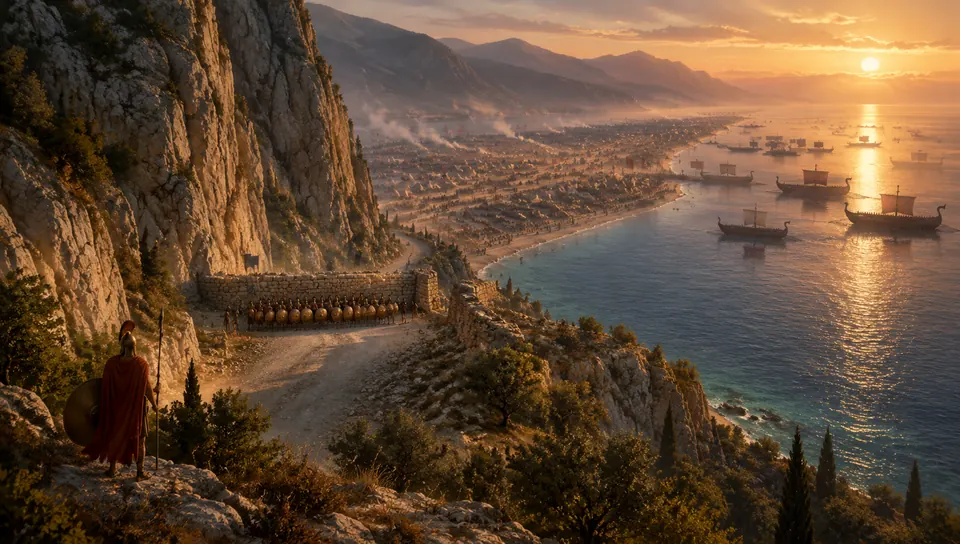
Reconstruction of the pass in 480 BC: the road squeezed between Mount Kallidromo and the sea. Today the coast lies kilometres further north.
The gates
A fault line runs along the foot of Mount Kallidromo. The land on one side dropped and was flooded by the sea; the other side stayed up as a steep cliff. Between the two ran a strip of shore just wide enough for a road. Herodotus says that at points it was only wide enough for a single cart.
The heat
The same fault is also a pipe for hot water. Herodotus mentions the springs and an altar of Heracles beside them; the locals called them “the Pots”.
Untangled History · how a hot spring works
01Rain soaks inRain on Mount Kallidromo seeps down through cracks in the rock.
02It heats upThe deeper it goes, the hotter the rock: roughly 25–30 °C more per kilometre.
03It risesHot water is lighter, so it climbs back up along the fault.
04Hot gatesIt comes out at the foot of the cliff, right beside the narrow road.
The gates are gone, the heat is not
Since 480 BC the Spercheios river has filled the gulf with mud, and the coast now lies kilometres away from the old road. The narrow gate has become a wide plain. The springs still flow, and they still smell of sulphur.
Coming soon♪ SongHot Gates (Thermo-Pylae)
The songHot Gates (Thermo-Pylae)Why the pass is called the Hot Gates: two Greek words, a fault line and hot springs.COMING SOON ON YOUTUBE
 Coming soon♪ SongHot Gates (Thermo-Pylae)